

Tech IPOs could see another mild year as bar for good listings is raised


SOUTH-EAST Asia’s initial public offering (IPO) scene for the tech sector may be in for another dull year as the region’s startups struggle under heavy losses.
With investors raising the bar for profitability, startups may need more time to whip their businesses into shape before going public, analysts told The Business Times.
Tech valuations in South-east Asia reached fever pitch in 2021, propelled by the pandemic craze and the influx of easy money.
Mature startups raised large amounts of funding based on a surge in revenue or gross merchandise value – the value of goods and services transacted on a platform, which may not translate into earnings.
As the economy soured, however, some startups have struggled to raise funds at higher valuations. The question of exits has weighed on the tech scene, prompting the industry to rethink the merits of pushing for valuation jumps.
“There is no purpose in optimising valuation if there is no exit at the end,” said Fandy Cendrajaya, partner at seed investor Kopital Ventures. “The region is at a stage where private capital grew really quickly to break multiple all-time records in the past few years, and public liquidity has not been able to keep up.”
He added: “What happens then, is that private companies get overvalued without any exit liquidity. Just because you can raise at a high valuation does not mean you should.”
South-east Asia has struggled with a dearth of exits. Regional funds started between 2016 and 2018 have returned a median 4 per cent of invested capital, versus 40 per cent in the United States, 20 per cent in Europe, 10 per cent in India and 50 per cent in China, the e-Conomy SEA 2023 report by Google, Temasek and Bain showed.
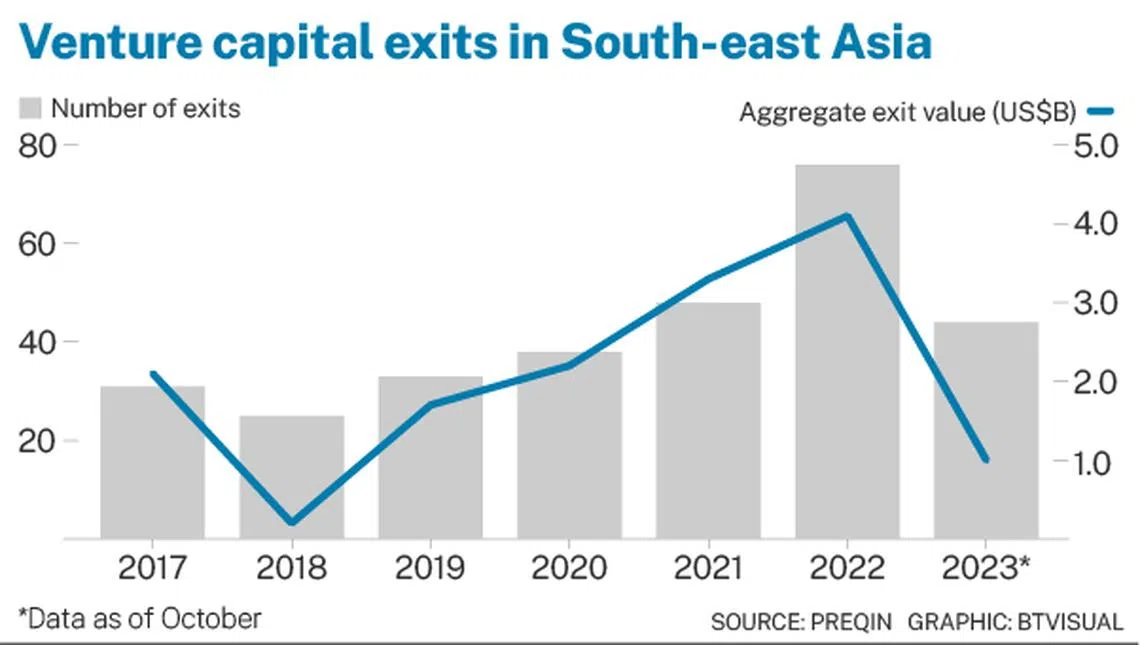
There were 44 exits from January to October 2023 – fewer than in 2022, when there were 76 exits; but similar to 2021, with 48, a Preqin report said. The total exit value for the period was US$1 billion, only a quarter of 2022’s US$4.1 billion.
Public markets could see more activity next year as the US Federal Reserve signals a peak for interest rates. Yet, many of South-east Asia’s tech players may not be in a position to utilise any opening of an IPO window.
In Asean, Indonesia alone drove the bulk of IPO activity, hosting half of all deals and 64 per cent of proceeds last year. That put the country ahead of Thailand, followed by Malaysia, an analysis by EY showed.
Unlike in 2022, when technology dominated, 2023 activity was driven by the renewable energy and metals sector, including the 10.7 trillion rupiah (S$916 million) IPO of copper and gold producer Amman Mineral.
Meanwhile, tech majors Bukalapak and GoTo are down 80.2 per cent and 76.6 per cent, respectively, since their IPOs in 2021 and 2022.
In Singapore, the first listing through a special purpose acquisition company (Spac) has tanked. Live-streaming company 17Live closed at S$1.46 on Friday (Jan 5), down from the Spac’s closing price of S$3.88 on Dec 7 before the business combination, and the Spac’s issue price of S$5 per share.
The Spac had managed to raise only S$3 million in private investment in public equity funding. Meanwhile, Pegasus Asia’s S$170 million Spac will be dissolved “after considering macroeconomic and market conditions”, the sponsor said.
Roshan Raj Behera, partner at strategy consultant Redseer, does not expect tech IPOs to revive until at least the second half of the year. Several companies he has spoken to have delayed listing plans due to market conditions.
Behera said that IPO-bound startups need to communicate with investors early and demonstrate that they can deliver consistently on key metrics over at least two to three years. His team has had to “push back on a lot of claims” made by companies about their business and market position, he added.
“Regardless of the exit route you take... you’ve got to be clear where the business is headed. But that clarity has to be there now,” Behera noted. “Let’s say the (IPO window) opens up in January for whatever reason; you should not just rush in, because that will be suboptimal from a business point of view.”
The region’s tech companies have indicated that they are still keen on going public when the time is right. Carro, an automotive marketplace valued at over US$1 billion, said that it is in the market to raise over US$100 million ahead of a possible US listing in 18 months.
Its rival Carsome said that it is waiting for the right time to revive its dual-listing plans on the Nasdaq and the Singapore Exchange.
Startups and investors are also closely watching the moves of regulators to encourage tech IPOs. In December 2022, for instance, the Indonesia Stock Exchange (IDX) came up with the New Economy Board to encourage high-growth tech companies to list.
The board was introduced in part to mitigate investor concerns about the volatility of tech stocks on IDX, and push for greater transparency from tech companies.
“Moves like these might encourage more local champions to prioritise local listings where investors are more familiar with the business and market potential,” noted Kopital Ventures’ Cendrajaya.






