

Ultra-rich families – the faceless force in startup funding

THERE is a special breed of investors behind some of the biggest rising stars in South-east Asian tech.
At times, they lie behind layers of corporate structures that end in the Cayman Islands. Their websites are sparse — if they even have one at all. When they co-invest in startups, it is often called “shadow capital”.
But despite their low profile, wealthy families and individuals are becoming a force to be reckoned with in South-east Asia’s startup funding scene.
From Indonesia’s Riady family to Facebook co-founder Eduardo Saverin’s EE Capital, a private wealth boom in Asia has made family offices an important source of funds for venture capital (VC) firms and startups.
Their growing appetite for tech has sent ripple effects to the private banking industry. Wealth managers such as Citi, Credit Suisse and UBS are jumping into the role of intermediaries to refer funds and deals to their clients, industry sources said.
“Their presence is more felt than seen,” said Jeffrey Seah, partner at Quest Ventures. “They look for new trends and categories, join in investments but do not lead, and sometimes look for capability acquisition for their family businesses.”
This approach is sparking a growing appreciation from startup founders. Due to their small corporate outfits and straightforward structure, investments are often done with little to no hassle, and no hurry for an exit. Microsoft co-founder Paul Allen’s Vulcan Capital, which opened a Singapore office in 2019, has held positions for up to 15 years before.
Family offices hardly meddle in board matters but can provide important networks if they are willing to, said startup founders The Business Times spoke to.
The younger generation of conglomerate families are driving investments in emerging and sustainable technologies. “We're seeing today the largest intergenerational transfer of wealth in human history,” noted Joel Shen, head of Asia technology at global law firm Withers.
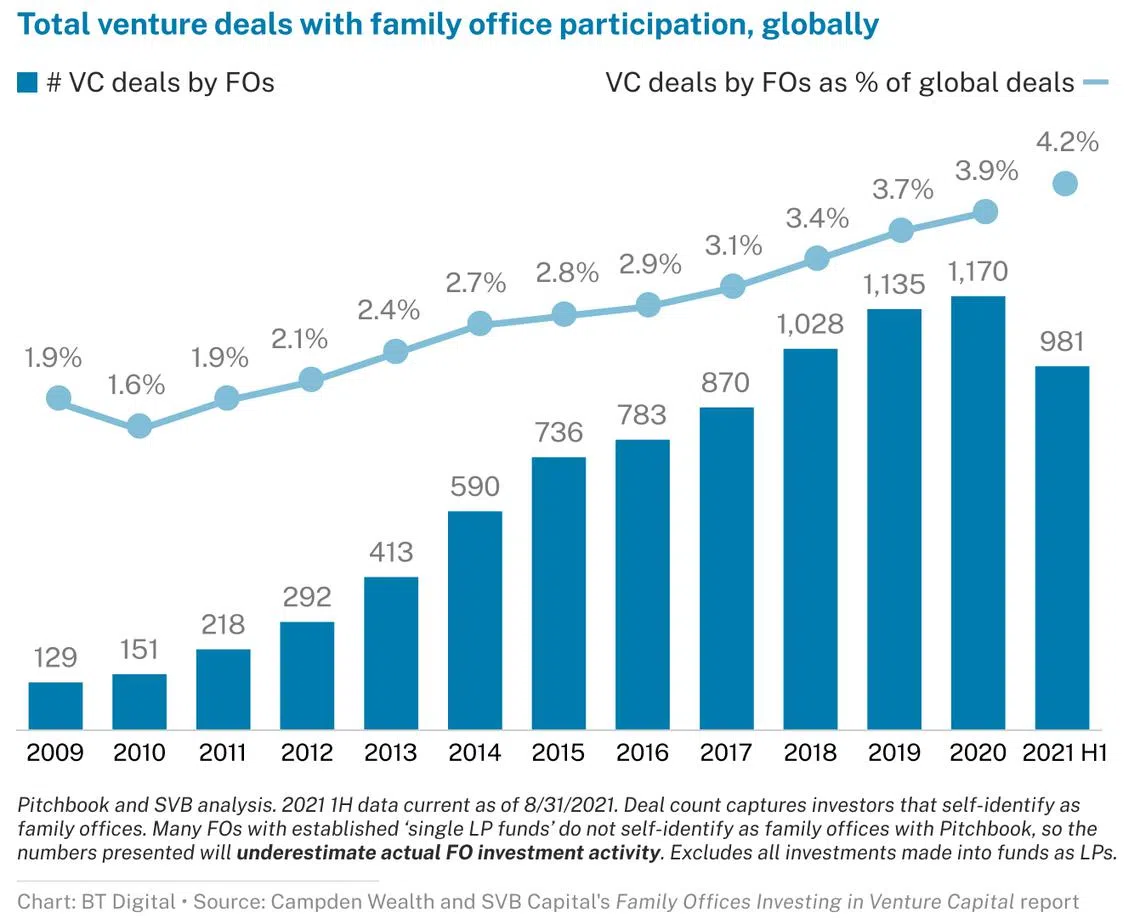
Asian family offices still lag their US and European counterparts in venture investments but their pace has picked up in recent times in tandem with South-east Asia’s startup gold rush. Research from SVB Capital and Campden Wealth suggested that globally, more family offices are investing in startups directly.
In South-east Asia, the money is trickling into early-stage deals. This year, family offices from across the globe participated in the funding rounds of mental health startup Intellect and plant-based milk company Oatside.
They also played a part in bankrolling the growth of Indonesian coffee chain Kopi Kenangan, which was founded in 2017 and hit unicorn status last year.
The Philippines’ Sy family, whose members rank among the country’s richest due to ties with conglomerate SM Group, launched the Gentree Fund just for early-stage deals.
Startup-backer Apricot Capital was started by the people behind Super Group, which became a household name in Singapore for its 3-in-1 instant coffee. The Kuok family’s K3 Ventures is found across the cap tables of several startups.
All this activity is a boon for young startups that want the professional backing of more than just family and friends, but need larger cheques than angel investors can spare.
“I see them as filling a good gap,” said JJ Chai, whose e-commerce aggregator startup Rainforest has raised from the private wealth circle.
A handful of family offices newer to the scene are actively engaging startups even at the seed and Series A stages. One founder said a family office offered him a term sheet — with a sum of money but no valuation — just 5 weeks after their first meeting.
“They told us: ‘We like what you're doing in safety and sustainability. Our families wanted to do something in this space, so whoever your lead investor is, we're happy to participate along with them,’” said the founder, who declined to be named due to the private nature of discussions. Lead investors typically set the pricing for funding rounds.
Family offices mainly invest in expansion or growth equity, yet earlier-stage investments are becoming more attractive as equity stakes get more expensive, according to UBS’ Global Family Office Report 2022.
Of those surveyed who invest in private equity, 63 per cent said they normally invest in VC — up from 61 per cent in 2021 and 53 per cent in 2020.
“There is movement away from competitive and crowded sectors such as fintech and e-commerce. Opportunities in artificial intelligence, biotech, autonomous vehicles and energy storage solutions are attracting greater interest,” said Tommy Leung, UBS’ co-head of global family and institutional wealth for Asia-Pacific.
Venture investing is relatively foreign to Asian family offices, who mostly made their money from public equities and real estate. As a result, they range in terms of sophistication — some lack dedicated investment teams and processes, while others have institutional-like setups.
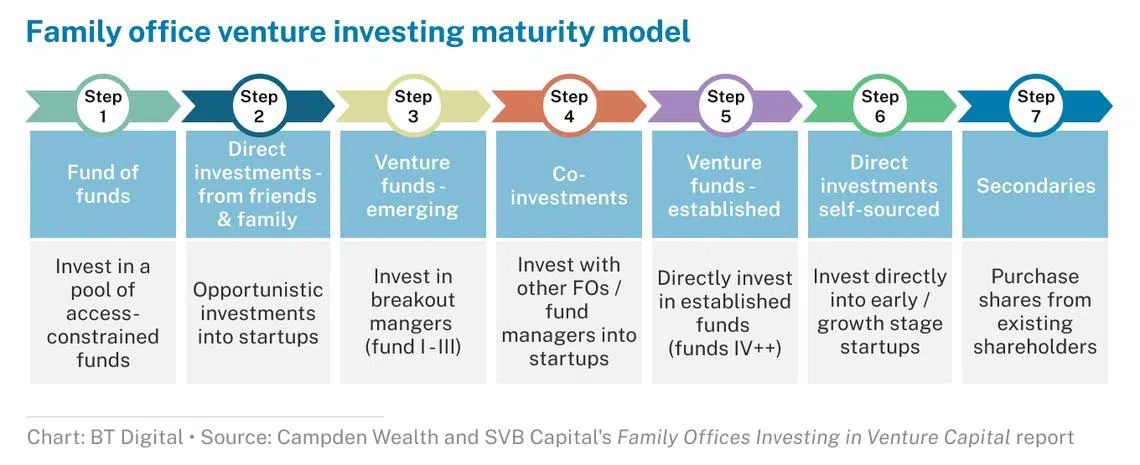
But more are acquainting themselves with the startup world, showing up at tech events and learning the ropes with the help of their network.
VC firm Insignia Ventures runs an education arm that teaches people how to break into venture capital in 12 weeks. Insignia partner Tan Yinglan said he has seen family office managers and private wealth bankers join the past 3 cohorts of the programme, and expects more to apply.
Rich families’ interest in South-east Asia is partly thanks to Singapore’s courting of billionaires to its shores with tax breaks and a friendly business environment. The Monetary Authority of Singapore estimated that there were about 700 single family offices at the end of last year, compared with about 400 as at end-2020.
Among those that have set up camp in the city-state are the family offices of Google’s Sergey Brin, Haidilao co-founder Shu Ping, and inventor James Dyson. Entrepreneurs including Facebook’s Saverin and Flipkart’s Binny Bansal have relocated to Singapore, and continue venture investing.
Chinese wealth, in particular, has increasingly found its way to Singapore shores. Their low profile is contributing to the perceived secretiveness of some family offices.
Many go to extra lengths to hide traces of their foreign investments due to capital controls back in China, said an investment manager whose anchor investor is a businessman who built his fortune from a traditional sector, but has a longstanding interest in tech.
Some other family offices are simply content with staying under the radar and relying on trusted networks to tap deals. That said, it could be a hurdle for some startups hoping to pitch to them but are going in blind.
“(Generally) they don't publish their thesis or they don't have consistent theses. So if you roll up to them and ask, ‘Hey, what is your view on e-commerce and what are the bets you're going to take?’ They pretty much won't have one, or they may have a (vague) one,” said Rohit Jha, founder of spacetech startup Transcelestial.
However, Insignia’s Tan said privacy makes it easier for family offices to be opportunistic without having to adhere to a consistent thesis or theme. This way, they steer clear of complications that could arise from such market expectations, he noted.






