

VCs in South-east Asia lie in wait, even as valuations soften
Region's US$2.7b worth of venture capital deals in Q1 was down 20.6% from a year ago: Preqin

Singapore
STARTUP valuations in South-east Asia are beginning to soften as the industry comes to terms with the economic impact of Covid-19, venture capital (VC) investors told The Business Times. But VCs aren't in a hurry to go bargain-hunting, as they keep a close watch on fundamentals while sourcing for deals.
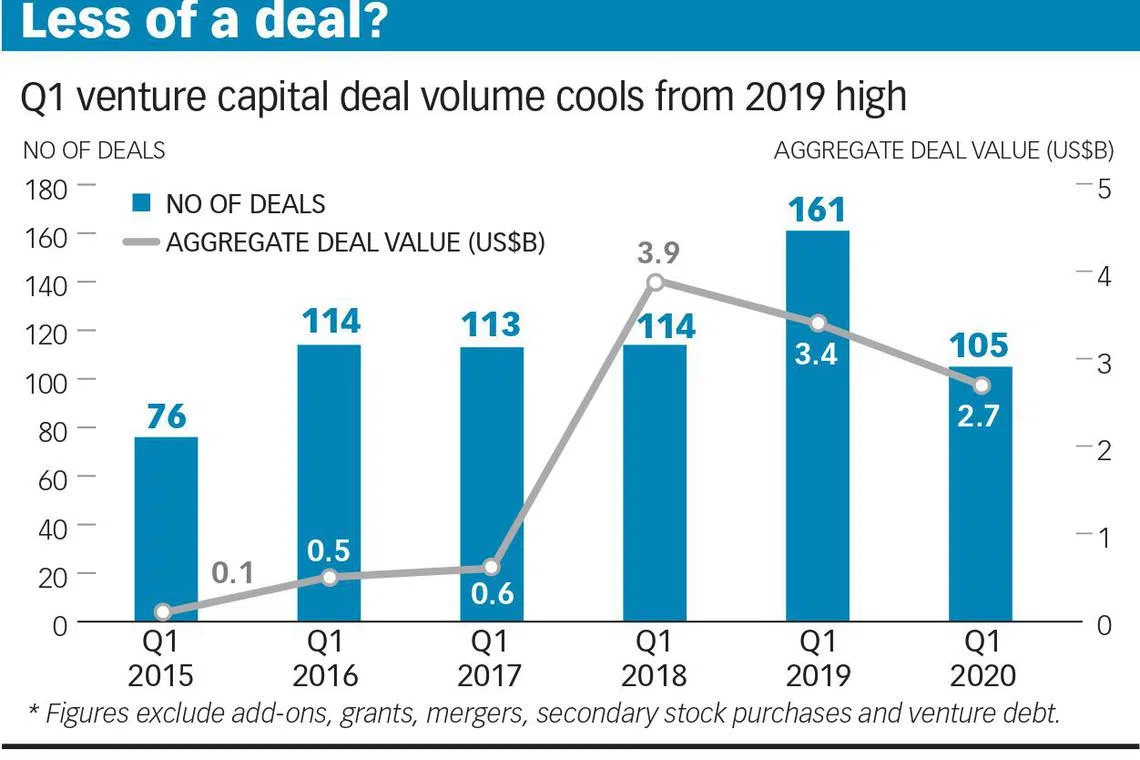
According to private market intelligence firm Preqin, there were US$2.7 billion worth of venture capital deals in South-east Asia in the first quarter of 2020, down 20.6 per cent from a year ago. The number of deals in Q1 this year stood at 105, marking the lowest Q1 deal count since 2015.
Heang Chhor, managing partner of venture firm Qualgro, sees "a beginning trend towards declining valuations", amid the current economic slowdown. This downward pressure could grow as more startups start to seek fresh capital, he said.
Valuations could especially come under pressure in the later stages of fundraising, said Dennis Wong, an associate at investment firm Koru Partners, which has backed the likes of Zilingo and ShopBack.
"Late-stage investors are more likely to benchmark valuations to the public markets, which have taken a significant hit. Uncertainty around how long the pandemic will persist and the corresponding economic damage will also lead to investors being less willing to engage in price discovery.
"There is some knock-on effect that should be expected on earlier-stage investments, although the impact will be less pronounced," he said.
Companies in sectors such as travel or retail might also face more volatile valuations compared with those in biotech or software, said chief executive and president of EDBI Chu Swee Yeok. "We are beginning to see more realistic expectations in the current climate," Ms Chu said.
The current stress on valuations may also simply be a correction of past irrational exuberance, noted Michele Daoud, a partner at Monk's Hill Ventures. Some startups are also "now a step or two back in their learning journeys" as their business models need to be reinvented for post-Covid times.
"Founders may end up accepting a flat or down round during this climate," she said. "We firmly believe in fair valuation that appropriately reflects the risk we are taking while keeping the entrepreneurs motivated. When we speak to founders, we will be stress testing the company's thesis during this downturn and they need to be prepared to justify valuation expectations."
However, one exception to this trend might be deep-tech startups, where investors approach valuations with a longer time horizon in mind.
"Experienced deep-tech investors are fully aware of the limitations and challenges faced by these companies from the get-go, and are therefore not spooked into accepting down rounds," said Tong Hsien-Hui, head of venture investing at SGInnovate, the government-funded investor in deep-tech solutions.
Even as caution takes hold, VCs are still sitting on heaps of dry powder, or undeployed capital.
VCs focused on South-east Asia raised US$1.33 billion in capital commitments in Q1 2020, more than triple from the same period a year ago, according to a report by deal news outlet DealStreetAsia.
Several VCs told BT that they have been actively sourcing for deals to deploy this capital. One of them is Monk's Hill, which closed its second fund at US$100 million in December.
Despite the regional lockdowns, Monk's Hill has been doing video calls daily with startup founders across South-east Asia. But the focus is on startups chasing growth, not those just seeking survival, said Ms Daoud.
"A key consideration for us when assessing new deals in the current climate is to ask 'Why now?' Is the company looking for an investment to merely weather the downturn, or will the funds actually be used to capture opportunistic growth during Covid-19?" she said.
James Lee, managing director of Vertex Growth, a late-stage fund anchored by Temasek's Vertex Venture Holdings, echoes this sentiment. The fund, which closed at US$290 million in September last year, is consciously managing its pace of investments, Mr Lee said.
Even as deal dynamics have shifted in favour of buyers, competition is still present for "compelling" opportunities. Recent deals Vertex Growth participated in include its lead investment in the Series D round for live-streaming player M17 Entertainment, the Series B+ round for Validus Capital and the latest fundraise for Nium - a fundraising that was also joined by Visa.
Mr Chhor of Qualgro similarly said that he is looking beyond Covid-19 to "really hone in on the fundamentals of startups", including the founders' backgrounds and their ability to build a business with a "real tech advantage". In Q1 2020, Qualgro did two investments and is finalising another two in May.
"It is our mission to support founders through tough times like this one - they need us more now, and not only in positive times. Therefore, we will continue to invest in existing and new companies. We think this is a time of opportunities and for fostering long-term partnership with entrepreneurs, while other investors may be holding back," Mr Chhor said.
However, Paul Santos, managing partner of enterprise tech and deep-tech investor Wavemaker, acknowledged that there are added obstacles stacked against VCs - especially early-stage investors - when sourcing for new deals with Covid-19 as the backdrop.
A major barrier is the uncertainty brought about by the pandemic. Mr Santos said: "Early-stage venture investing involves imagining the future. Early-stage companies don't give you much data to work with so the job is hard enough, but Covid-19 adds another degree of difficulty because VCs would now have to factor in the impact of new unknowns."
Thus, some like SGInnovate are conserving capital for the rainy days ahead. "We are saving more of our dry powder, so we are able to help some of our existing portfolio companies that may run into difficulties while raising funds in the current climate. Therefore, it is likely that we will go with more follow-on investments rather than new deals," Mr Tong said.
But SGInnovate may still go for new deals if it identifies "a company with leading-edge technologies that demonstrate a clear product-market fit", he added.
Additional reporting by Claudia Chong and Olivia Poh
TRENDING NOW

Despite the de-dollarisation debate, demand for dollar liquidity in Asia is growing

URA to review guidelines on floor space to give developers more design flexibility: Chee Hong Tat

He built the Vingroup empire. Now South-east Asia’s richest man is handing some key roles to his sons

Can a first-time homebuyer couple earning S$18,000 a month afford a new EC unit?

