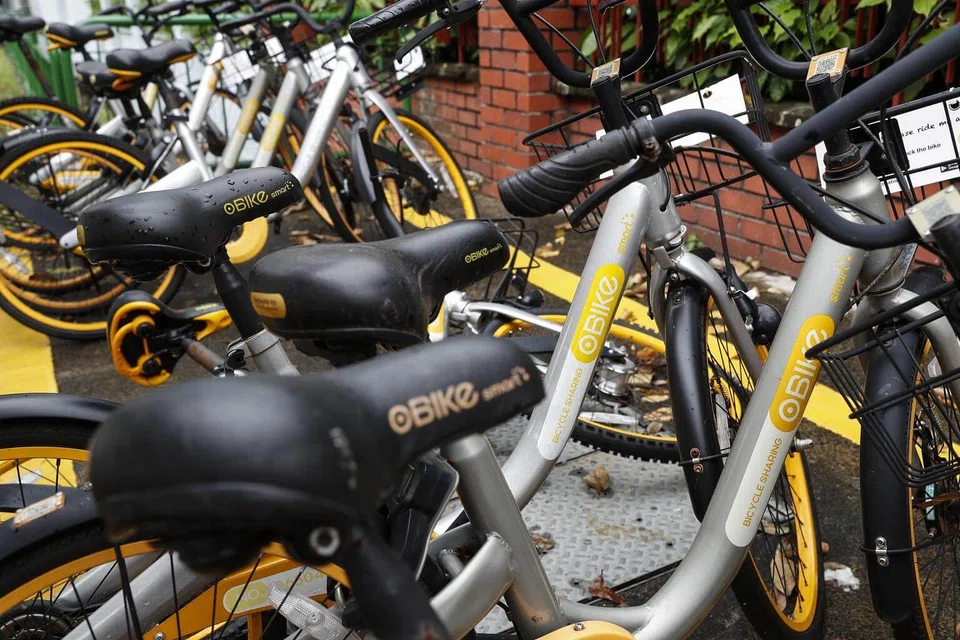
Was oBike just building to sell?
WHEN oBike exited Singapore this week, it cited difficulties in complying with the new bike-sharing regulations. But The Business Times uncovered that financial pressures could have played just as big a part in its pull-out: The homegrown bike-sharing operator had cash flow woes, had run up a loss of more than S$4 million in 2017, and had been looking for an acquirer (though that came to naught).
oBike had been hoping to get lucky, as did its rival Mobike. In April, Mobike got acquired for US$2.7 billion by Meituan-Dianping, one of China's largest providers of on-demand online services. The deal might have seemed like a feat for Mobike, but observers scorned the acquisition amount, saying it was little compared to the US$928 million in venture capital Mobike had raised before its buyout.
In many ways, oBike might just be a startup founded with the goal of being acquired someday. When it launched in Singapore in April last year, it did little to differentiate itself from the players who were quicker to burst on the scene: ofo (February 2017) and Mobike (March 2017). When the China-based players added more and better-performing bicycles across the island, oBike did the same.
Notably, when asked by BT how it planned to compete with its more well-capitalised rivals, oBike had cited "deep local knowledge" as a competitive advantage.
But in its one year of operations, oBike did not appear to have used this knowledge to create hyper-local features that would have enabled it to win more users from ofo and Mobike. (In fact, Mobike - not oBike - was the bike-sharing partner of the 2018 OCBC Cycle.)
To boot, oBike did not seem to have significantly monetised the data from its bike-sharing rides - data which could have gone into improving Singapore's transportation network or facilitated future town planning. It also had not created technological capabilities in artificial intelligence or the Internet of Things that could be valuable and applicable to transport and even other industries.
Both data and new technological capabilities have been viewed as revenue-generating assets which bike-sharing operators can develop within their profit-challenged sector.
Clearly, oBike did not exhibit a clear path to profitability. It has been compared to Uber, which also exited Singapore this year with huge financial losses. The difference is that while Uber Singapore found a buyer in Grab, oBike has yet been able to find a white knight.
But it must be noted that in the fascinating world of startups, unprofitable and indebted companies have managed to find buyers.
In November 2016, homegrown e-grocer RedMart was snagged by Lazada for reportedly US$30 to US$40 million.
It was an underwhelming deal - given that RedMart had raised more than US$55 million from investors - but a welcome one as the online grocery marketplace had run into financing troubles.
In another example, Lazada was said to have nearly run out of money when Alibaba stepped in with a US$1 billion investment offer in April 2016. That gave Alibaba a controlling stake in the Singapore-based e-commerce company. Since then, Alibaba has pumped in even more capital into Lazada, taking its total investment in it to some US$4 billion to date. But the six-year-old startup has yet to turn a profit.
Why do unprofitable, indebted startups get bought out? The theory is that a startup - because of all the promises of its ever-evolving technology and enviable userbase - is evaluated on its future. That is, a startup is valued on its ability to generate profits in the future, and not the present or past. If there is the remotest chance that a startup can yield profits even in the distant future, it will have value today.
This thinking has led many startups to spend money for years on customer acquisition and research and development, in pursuit of growth and profits. In turn, it has engendered a fervour among investors to continue to keep fast-growing startups afloat to conquer what they think is a winner-takes-all market. It is thus unsurprising today to see an ecosystem of startups that are worth billions - despite losing millions.
But oBike and Uber have proven that this thinking is flawed. Their departures from Singapore show that startups do not have free rein to be unprofitable for years and will eventually be forced to shutter. They also demonstrate that investors have a breaking point and could cut back on their investments once the startup's operations prove to be too costly and its ability to turn a profit starts to look shaky.
The good thing is that not all startups are building to sell. Darius Cheung, a local serial entrepreneur, said he reckons that the proportion of startups that do that is would be around 20 per cent.
When asked how he would identify such startups, he said: "I'd ask them how they plan to get profitable. If they don't have an answer, they are either stupid or building to sell."
He added that if one is looking from the outside, the easiest way to distinguish a startup that is building to sell is to see if it is an "opportunistic startup" or "fast-follower". The fast-follower is one that will get founded very quickly the moment news of a US or China-based startup raises a lot of money on a new model. Examples of such startups are Singapore-based Beeconomic (modelled after Chicago-based deals marketplace Groupon) and travelmob (modelled after San Francisco-based vacation rental platform Airbnb), said Mr Cheung.
Ultimately, even in the startup world where entrepreneurs are unorthodox and valuations are ludicrous, profitability matters. Building a startup to sell is not a bad thing per se - but it tends to ignore profitability, take a short-term view on innovation, and be mostly unsustainable.
TRENDING NOW
Grab CEO’s wife Chloe Tong on life with Anthony Tan and finding her purpose
Stocks to watch: DBS, DFI Retail, Frasers Property, Clint, ESR-Reit, Centurion, Coliwoo
DFI Retail to bag US$340 million, Starbucks business in Asia in deal with Maxim’s Caterers
Green fuels, autonomous ships: How Singapore is future-proofing its shipping industry