

On the bleeding edge of technology
Apple's MacBook is beautiful and forward looking, but not for everyone

Singapore
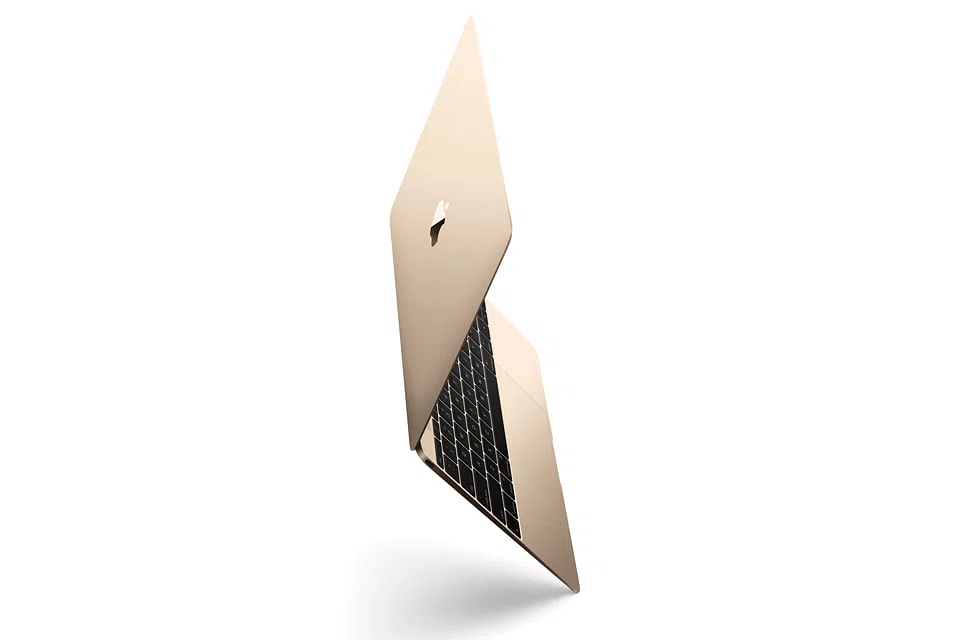
THE MacBook laptop is the sort of bleeding edge technology that Apple has not ventured into since Steve Jobs pulled the original MacBook Air out of a manila envelope at Macworld 2008. It has nothing in common with the entry-level polycarbonate MacBooks that Apple discontinued in 2011. In fact, it has little in common with other Apple products.
Although the newest 13-inch MacBook Pro also has Apple's new Force Touch trackpad, it is especially useful on the MacBook because it is more likely to be used without a mouse. The trackpad uses finger pressure to activate functions such as contextual menus; no clicks involved. It is slick and incredibly efficient. Apple trackpads were already the best in the business. Force Touch now puts them on another level. Aside from a headphone jack, only a single USB-C port mars the fanatically minimalist edges. There is not even a separate power jack. That USB-C port handles charging duties too. So if you want to charge the battery and connect a device at the same time, you have to buy an optional adapter such as Apple's USB-C Digital AV Multiport Adapter (S$118).
Actually, you will probably need an adapter even if you are happy to rely on battery power, because USB-C is completely different from other USB standards. No existing USB 1.0/2.0/3.0 cables or flash drives are directly compatible.
If that strikes you as being impractical, then the MacBook is not for you. It is for those who transfer and share all their data through the cloud - whether on Apple's own iCloud service, or popular options such as Dropbox and Google Drive. It is fortunate then that the MacBook comes with a fair bit of storage built in. The lower of the two stock configurations (S$1,788) boasts a 256 GB solid state drive, while the pricier one (S$2,288) double that.
The MacBook's true shortcoming is not its shortage of ports, but its thinness. All things remaining equal, thinner products are nicer. But laptops, and even tablets, have come to the point where thinness is no longer useful. Instead, it is a marketing tool, a bragging right and an aesthetic extravagance.
In order to achieve the MacBook's razor-thin profile (1.31 cm at its thickest, 0.35 cm at its thinnest), one of the sacrifices that Apple had to make was keyboard feel. The keys are large but have little travel, which can make fingers hurt after forceful typing. And while the 10-hour battery life is amazing given the laptop's dimensions and retina display, a bit of thickness would have been a worthwhile trade-off for even better battery stamina. A bigger battery might have hurt the 920g MacBook's claim to being the lightest Mac. Whether or not that matters depends on usage. Using it to read e-books and magazines showcases its lightness, but also draws attention to the awkwardness of reading on a laptop. Using it for hardcore Web surfing, productivity apps and multimedia, on the other hand, makes you notice that it feels only as fast as a MacBook Air did a few years ago. Intel's ultra-efficient Core M processor sips power, and vents so little heat that a CPU fan is unnecessary, but it is no speed demon.
It is a niche laptop that is not for everyone. Buying it only makes sense if you are happy to pay a premium for beautiful and austere minimalism. Its only functional advantages over a MacBook Air are its display and track pad.
The Apple MacBook is available now in Silver, Gold or Space Grey, for S$1,788-S$2,288, from Apple Premium Resellers and the Apple Store online.
TRENDING NOW

Nvidia reinstates Jensen Huang as CEO; Trump says move poses no national security risk

Indonesia’s coal tycoon Low Tuck Kwong replaced as Bayan Resources president-director

Nvidia surges 33% after reinstating Jensen Huang, reviving AI trade; stocks soar in US and Europe

Consider lowering homeownership barriers for some non-resident foreigners

