

Corporate responsibility and the trust challenge in the age of AI
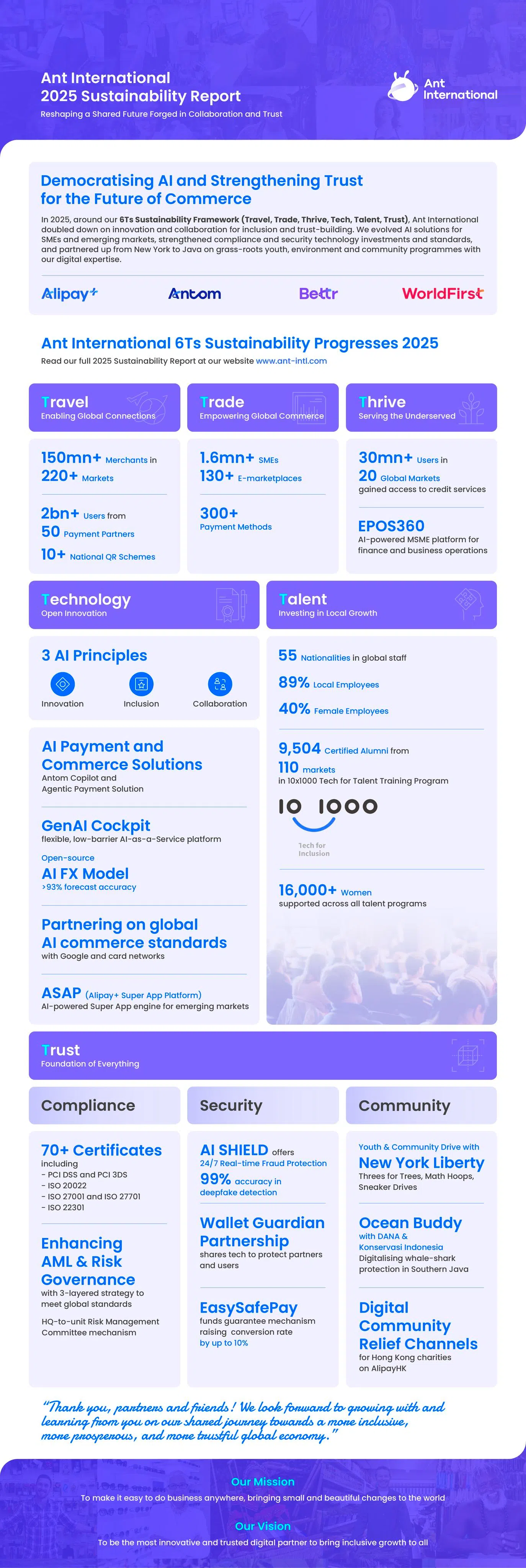
In its 2025 Sustainability Report, fintech firm Ant International shares progresses on its 6T framework linking cross-border payments, versatile agentic solutions, SME access and stronger safeguards to support a more inclusive AI economy

AS ARTIFICIAL intelligence rewrites the rules of e-commerce, the pressing question is not only how fast businesses can scale, but whether merchants, consumers, regulators and platforms can trust the increasingly automated systems underpinning digital trade.
This question sits at the heart of Ant International’s 2025 Sustainability Report, released on May 12.
The report sets out the 6T framework – Travel, Trade, Thrive, Technology, Talent and Trust – that guides how the group integrates sustainability into the way it operates.
This is important as the rules of digital commerce change, with payments becoming more interoperable and financial tools more embedded. AI has moved from back-office optimisation into other areas like customer service, treasury, risk management and agentic commerce.
For global enterprises, AI reduces manual work, speeds up payments and makes cross-market operations easier. For small and medium-sized enterprises (SMEs), it means having access to capabilities once reserved for bigger players. For regulators, it raises issues around safety, transparency and accountability.
Ant International’s answer is to place inclusion and trust at the centre of growth.
In 2025, the company integrated sustainability metrics into management performance evaluation for the first time, meaning sustainability outcomes are now valued as much as revenue growth and operational efficiency.
The clearest examples appear in the Travel and Trade pillars cited in the report. Through Alipay+, Ant International now links over two billion user accounts with more than 150 million merchants across over 220 markets. More than 90 per cent of these are SMEs.
It also works with 50 payment partners and over 10 national QR payment schemes.
These numbers highlight a practical issue: how to make cross-border commerce easier for small cafes, family-run shops, wet market stalls or tourism merchants that cannot afford multiple systems and high integration costs.

Helping SMEs compete in an increasingly AI-driven economy
In the Travel pillar, Alipay+ Voyager shows where this is heading. The AI-powered travel companion helps users plan trips, book services and pay – all through a familiar interface. For merchants, it offers visibility before and during the journey, helping them reach international customers.
That same focus on accessibility shapes Ant International’s trade business. WorldFirst, a financial services provider under the group, now serves more than 1.6 million SME customers, helping them manage multi-currency funds and connect to more than 130 e-marketplaces.
Antom supports cross-border money transfers through more than 300 payment methods, tailored to local preferences and regulatory requirements, across markets for businesses.
When cross-border operations become simpler, smaller firms stand a better chance of going regional or global, bringing diversity and inclusivity into the wider ecosystem.
This is where the Thrive and Technology pillars become central. In the AI era, the divide between large companies and SMEs can widen.
Big companies have resources to experiment; smaller ones need affordable, easy-to-use tools.
Ant International frames its AI work around this gap. Its AI-powered platform EPOS360 combines payment, marketing, operations and growth tools into one system for micro, small and medium-sized enterprises.
Antom Copilot automates complex payment tasks, improving merchant efficiency by up to 46 per cent. The Alipay+ GenAI Cockpit gives fintechs and super apps a FinAI-as-a-Service platform to build tools such as customer-service assistants and sales copilots.
The group’s Falcon AI FX Forecasting Solution, with over 93 per cent forecast accuracy, shows how specialised AI can improve treasury and foreign-exchange decisions.
The idea is clear: AI tools should help a merchant understand cash flow, manage inventory, reduce payment friction, detect risk, serve customers and make better decisions – without overwhelming them.

Why trust may become commerce’s biggest differentiator
And as commerce becomes faster, trust matters more. Ant International’s global payment, account and embedded finance services operate across different markets, rules and risk environments.
The company holds more than 70 global standard certifications covering areas such as payment security, data protection and privacy management.
It also has a three-layered anti-money laundering framework, expanded risk governance, AI-driven fraud detection and AI SHIELD, its framework for managing risks such as data leakage, model bias, deepfakes and product-level security threats.
In digital finance, users must know that their money is safe, their data is protected and the systems making decisions are fair; partners must operate within resilient networks. Regulators must see proper governance.
That said, the human touch remains essential. Through 10x1000 Tech for Inclusion, Ant International has certified 9,504 learners across 110 markets, with women making up 55 per cent of learners.
Within the company, its workforce spans 55 nationalities, with 89 per cent of employees hired locally in each market.

Its social-impact work also stretches from New York, where Alipay+ is supporting New York Liberty initiatives such as Math Hoops, sneaker drives and Threes for Trees, to Indonesia, where Ocean Buddy uses gamification to support whale-shark protection in Java.
The 2025 report tells a broader story than just a sustainability scorecard.
The next phase of commerce, as Ant International sees it, is more mobile, more AI-enabled, more cross-border and inevitably more reliant on trust.
These can be the real test for digital commerce in the years ahead: not just how quickly technology can travel, but how confidently businesses, consumers, partners and regulators can travel with it.

Share with us your feedback on BT's products and services
TRENDING NOW

Incidence of civil servants buying property near unannounced MRT stations ‘a concern’, but may not establish misconduct: PSD

Grab CEO’s wife Chloe Tong on life with Anthony Tan and finding her purpose

Income Insurance appoints former Manulife Singapore top man as new CEO

HDB reviewing ‘jumbo’ flat scheme after Telok Blangah unit listed for sale at S$2.18m

