
Deciphering the FAANG phenomenon

THIS WEEK'S TOPIC: Is the recent technology sell-off a one-off correction or does it portend sustained and broader weakness beyond the tech sector?
Published Sun, Jun 25, 2017 · 09:50 PM

    THIS WEEK'S TOPIC: Is the recent technology sell-off a one-off correction or does it portend sustained and broader weakness beyond the tech sector ?

    Kelvin Lee Chief Executive Officer Fundnel Ltd

    THE sell-off of major US technology stocks is not surprising given the tech sector's sustained rally this year.


    Tech has become a momentum play, and the recent sell-off could be due to near-term profit-taking or fund rotation, in the light of potential impending macro-events such as more rate hikes.

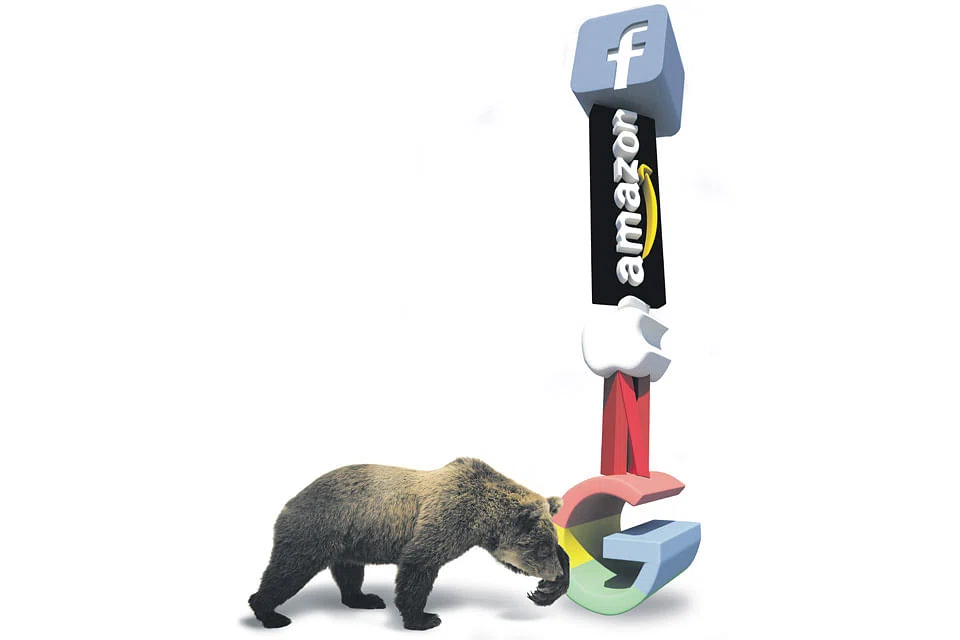
    A large amount of tech stock growth is attributed to the FAANG (Facebook, Apple, Amazon, Netflix, Google) stocks, which gives a skewed overall representation.

    Markets' reactions and views on the entire industry are heavily influenced by this handful of companies. The recent sell-off should be taken in this context, without setting off any immediate alarm bells.

    Nirvik Singh Chairman & CEO, Asia-Pacific, Middle East & Africa Grey Group

    THE recent selling of FAANG stocks could be attributed to momentum play - where there is only a short-term interest in holding a stock.

    Two companies' (Facebook's and Google's) contributions to online spending have created a digital duopoly that is rewriting the advertising business. Together they account for 75 per cent of all new online advertising spend.

    Netflix too is becoming a big content player and expanding its global digital footprint and finally, by acquiring Wholefoods, Amazon is further testing new ways of getting groceries straight to fridges - where they can lean on technology such as drone delivery, AI and Amazon Go.

    In conclusion, fundamentally all FAANG stocks are still very strong and will only become more robust in the long run.

    Jayaprakash Jagateesan Chief Executive Officer RHT Holdings Pte Ltd

    THE FAANG stock crash, so reminiscent of the tech bubble burst in 2000, certainly set off alarm bells. Nonetheless, having appreciated significantly over the past few years, the price correction can be seen as healthy as valuation had gone ahead of these companies' performance.

    Closer to home, I don't see the sell-off as portending a gloomy future for the Singapore tech sector or the economy in general. Similar to how the market shrugged off the second US Fed rate hike of 2017, it is likely to be business as usual for now.

    In fact, with the recent partnership between SGX and A*STAR, we might soon be seeing more tech IPOs in the next two years.

    Stocks such as FAANG fall out of favour but often rebound due to strong fundamentals.

    The recently announced acquisition of Whole Foods Inc by Amazon, for example, moved the latter's share price up significantly, demonstrating strong investor confidence in the company.

    In the long term these stocks are still likely to turn in above-average profit performance.

    PK Lim Managing Director (Asean) Nutanix

    NEARLY all tech companies have experienced the roller-coaster ride of the stock market. Numbers aside, we believe that adding real value to our customers' business requirements will produce solid investments over time.

    If you look after your customers' requirements, the numbers will work out.

    Efficiency and productivity are always appreciated during good times and bad; they are the basis for strong balance sheets and consistent growth.

    In this cloud-centric and data-driven world, businesses of all sizes need to have the ability to scale cost-effectively while maintaining control over their service quality and data privacy.

    Leong Boon Hoe Chief Operating Officer List Sotheby's International Realty

    THE sell-off on June 8 had started with Goldman Sachs' view that low trading volatility in the FAANG stocks might be disguising investment risks against the bull run since December 2016.

    And there are other analysts who viewed the plummet as just another market correction, as the last time it happened was a year ago. Perhaps the rout is cyclical as its impact in Asia seems limited as the Asian markets have remained stable.

    Just as quickly as prices fell by 4 per cent, shrewd investors have snapped up the shares, pushing the S&P 500 technology index to a 1.7 per cent gain on June 19, 2017.

    Goh Yang Chye Founder and CEO GYC Financial Advisory Pte Ltd

    FORECASTING is reckless, so let's look at the evidence. All-Country World Index (ACWI) Tech Sector valuations are at long-run medians, and market cap accounts for only 17 per cent of the ACWI.

    Certainly not as overvalued as in the 2000 bubble days when the sector was more than two standard deviations away from mean, with market cap at a quarter of global markets.

    Money supply, banking liquidity and the yield curve still point to favourable monetary conditions despite the Fed hike. Considering this, correlations, relative performance, and healthy scepticism, the recent sell-off can be taken as just that, not a more momentous decline.

    Helen Ng Chief Executive Officer Lock+Store

    THE big tech rout is a sign of broader weakness beyond the tech sector. The current bull market is characterised by shallow corrections that only serve to ''refresh'' the bull, but there are signs that the bull is finally running out of steam. The Volatility Index (or VIX) is at a historic low, which is usually a sign of investor overconfidence.

    From a purely technical perspective, there is more downside risk to the market than upside risks right now. The chances are high that a market correction is looming.

    Edwin Khew Teck Fook President The Institution of Engineers, Singapore

    THE latest sell-off cannot be compared to the 2000 tech bubble burst caused by overspeculation of dot.com and Internet technologies. The current tumble looks more like a shallow correction that exposes some fragilities.

    But we are far from the end of the tech sector, as it is increasingly bolstered by diverse high-value technologies such as robotics, 3D manufacturing, IoT and AI which will dictate how we live, work and play. It is not uncommon for stocks and equities markets to see such sell-offs due to sentiments and reactions towards global politics and events.

    Fundamentally, I see it as a reminder that businesses need to plan for the long term. In today's context we need to embrace technologies and constantly adapt to stay ahead or we will be left behind.

    Ronald Lee Managing Director PrimeStaff Singapore

    WE could read the latest technology sell-off as a reflection that technology companies are overvalued and the industry is a bubble.

    Or, it could be a one-off correction, with investors profit-taking before pushing the market higher. It is hard to predict at this point.

    That said, with solid earnings expectations of the big tech names, it is possible that the prognosis is tipped slightly in favour of the latter.

    There are, however, many other factors to consider. For one, how will the recent interest rate hike against the backdrop of weak economic data impact global markets? We will need to see how this plays out.

    Christophe Duchatellier CEO, Asia-Pacific The Adecco Group

    THE sell-off appears to be a one-off correction given that the tech shares have rebounded quickly.

    Moreover, with one of the lowest unemployment rates in the US in a decade and strong job creation, there is optimism that the economy and labour market will continue to improve and wages rise.

    However, one area of broad concern is an emerging talent and skills shortage as skill requirements are increasing in all sectors from tech to manufacturing. While 9.3 million Americans are unemployed, there are 4.8 million vacant jobs because businesses are struggling to find workers with the right skills.

    Apprenticeships designed and coordinated by connected stakeholders can go a long way in helping to close this gap.

    Toby Koh Group Managing Director Ademco Security Group

    IT'S most definitely a market correction rather than a downhill trend for technology stocks. The mega trend of online economy and technological advancement is here to stay.

    There is most certainly no turning back. Technology will continue to converge with real life daily needs and operations. Amazon's and Alibaba's investment in brick and mortar stores seems to be a clear trend towards a balanced business model.

    Lim Soon Hock Founder and Managing Director PLAN-B ICAG Pte Ltd

    THE latest technology sell-off is not necessarily a one-off correction nor does it portend sustained and broader weakness beyond the tech sector. Such market movements frequently follow mega mergers or buy-outs in America, a common feature of US corporate culture.

    Technological changes and advances - for example in the fields of robotics, artificial intelligence, data analytics, block chain technology - are fuelling this phenomenon, as companies lacking in such capabilities or market access, attempt to ''short circuit'', to stay ahead of the technology curve to be relevant and to compete.

    The rise in share prices in tech stocks is likely to be a consequent response to expectations of better prospects from these enlarged entities. Accordingly, I do not foresee any imminent meltdown, as investors would also have learnt from the bursting of the tech bubble in 2000.

    David Leong Managing Director PeopleWorldwide Consulting Pte Ltd

    IT'S not unusual to see a corrective blip for the technology sector and the US$126 billion vaporisation in market capitalisation of the US giants (commonly referred to as FAANG stocks) is not out of the ordinary.

    The latest technology sell-off also cannot be a one-off correction because such corrections will happen over and over again over time. The tech sector is getting into robotics, machine intelligence and artificial intelligence, moving beyond the original business scope of Facebook, Apple, Amazon, Netflix and Alphabet. When the Next Big Things come forth, changing and disrupting lives and habits, these stocks will shoot to new highs.

    What's worrying is the approach seen in US monetary policy which is tightening with rate hikes amid the wave-like ups and downs of stock prices. The Fed's tightening actions are likely to hit the market with a strong pullback as the higher interest rate may slow growth and expansion for all sectors, not just the tech industries.

    But unlike traditional stocks, the valuations of tech stocks are mostly based on a notional future value that can hike their market capitalisation to astronomical levels because investors get excited about the prospects of innovative breakthroughs.

    I hold great hopes for the tech sector as it gears up for the Next Big Things.

    Henry Tan Managing Director Nexia TS

    THE FAANG group has been an inspiration to many tech startups and this has been encouraging. However, looking at their valuations, one will wonder if it is still worth investing in brick and mortar businesses such as manufacturing, product and property companies. Going by their PE multiples (or, if not profitable, their revenue multiples), we can easily conclude that the tech stocks are overpriced.

    We can recall the dotcom bubble of 2000 and, to me, the current scenario is close to a repeat. While fundamentals are stronger now, overpricing still exists. This is a healthy correction and I hope this will start a more sustainable pricing going forward.

    Annie Yap Group Managing Director AYP Group

    THE future of the FAANG stocks, as well as the stock market as a whole, is unpredictable. The FAANG stocks have generally high PE ratios which signify investors' confidence in the growth of the stocks. In this digital age, many investors see the long-term potential for these tech giants and are optimistic that earnings will rise in the future.

    Nevertheless, it is most likely that the recent technology downturn is a telling sign that the stocks are due for a correction on their overvaluation. Besides an eye for potential, investing in the stock market should still be based on financial fundamentals.

    Zaheer K Merchant Regional Director (Singapore & Europe) QI Group of Companies

    MARKET sentiment on this sell-off has so far been that it's justified and warranted. The performance of the biggest US tech stocks has hitherto been outstanding and this erasure of about US$140 billion in market value should be seen as a defensible adjustment in what has otherwise been widely considered to be a sectoral outperformance.

    It could well be a strategic move by investors to rotate portfolios into stocks that promise higher dividends. All things considered, it therefore appears to be a healthy ''normalisation'' and should hardly create any waves of unrest. Given the tech sector's solid earnings and the trend of rotation, it will come as a big surprise should it be treated as a sign of weakness beyond the tech sector.


