

Google expands R&D footprint in Singapore, scaling teams and upskilling programmes
It launches a new engineering hub and AI initiatives

[SINGAPORE] Google will expand its research and development (R&D) footprint in Singapore, as part of scaling its artificial intelligence (AI) investment here.
In an event on Tuesday (Feb 10), the search giant announced that it will scale its teams across software engineering, user experience design and research science. There will be a strategic focus on its cloud engineering teams as well.
This follows the opening of the Google DeepMind Research Lab in Singapore last November.
Ben King, managing director of Google Singapore, said: “We are growing our engineering and R&D teams in the country – not just to bring Google’s technology here, but to (also) build solutions alongside Singapore that solve its unique challenges and drive new growth.”
As part of these efforts, the company on Tuesday launched the Google Cloud Singapore Engineering Center, a hub that will house engineers and support teams to partner firms in solving their challenges. It will include industries such as robotics and clean energy.
Google also introduced Startup School: Prompt to Prototype, an online training course to teach founders how to use its products Gemini and AI Studio to turn ideas into AI prototypes.
Moe Abdula, vice-president for customer engineering at Google Cloud Asia-Pacific, said that co-locating the company’s software engineers with the DeepMind lab in Singapore lets Google “transform research into ready-to-deploy products at rapid speed”.
The company also launched an AI Centre of Excellence for Security, which will carry out research to tackle emerging threats in the agentic AI space while advancing security, privacy and safety on mobile.
Minister for Digital Development and Information Josephine Teo said: “We believe very much that whatever it is that we create in Singapore goes so much further when others get a chance to benefit from them.”


Growing its AI footprint
To further grow its AI footprint, its philanthropic arm, Google.org, has provided US$1 million in funding to AI Singapore’s Project Aquarium, an open data platform for South-east Asia’s languages. The amount will go towards improving the quality and availability of regional data sets for developers to create culturally relevant solutions.
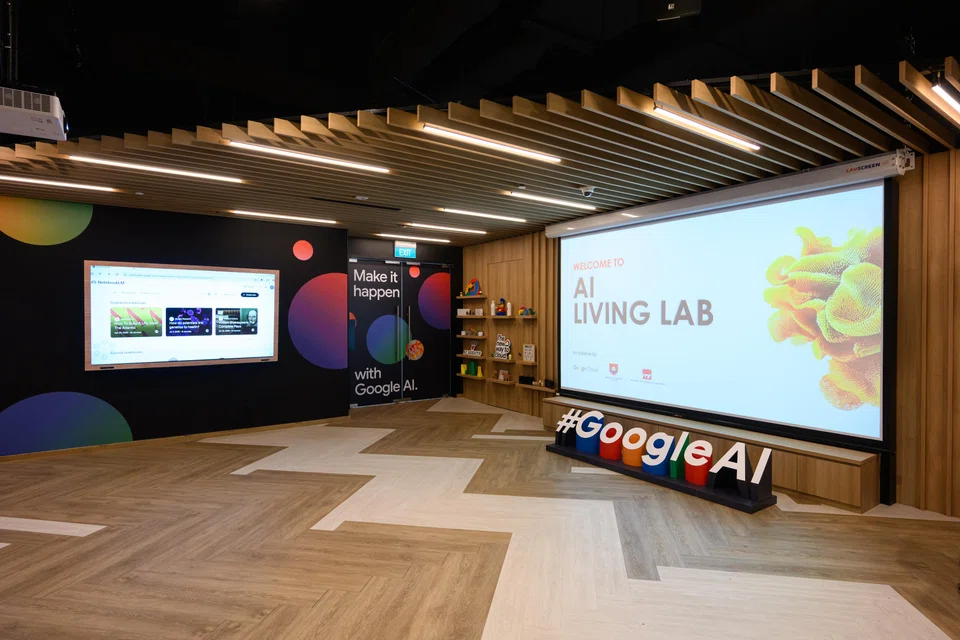
There are also plans to aid the next generation of talent, with Google AI Living Labs. Done in partnership with the Ministry of Education, these initiatives are aimed at young people and educators. At the labs, they can learn and create AI innovations through hands-on workshops and industry collaborations. The first lab has been launched at the Institute of Technical Education College East, with a second planned for Nanyang Polytechnic. The facilities have a target to reach 50,000 Singaporeans by 2027.
Separately, Google is also partnering the Infocomm Media Development Authority on the Skills Ignition SG AI Challenge. The initiative aims to train 500 graduates and mid-career professionals in AI skills. The participants will attend a two-month accelerator programme on designing AI workflows for the accounting, human resources and legal sectors, among others. They will also receive resume and interview training from Google, with the top individuals invited to apply for opportunities at the company. Applications are open until Mar 23.
The challenge builds on the Skills Ignition SG programme, which has reached 28,000 Singaporeans. King said that since 2020, Google’s upskilling programmes have helped nearly 350,000 Singaporeans.
He added: “By working with the government, schools and businesses, we’re embedding AI training everywhere – from the classroom to the workplace – to empower every Singaporean with the skills they need to stay job-ready and create new opportunities with AI.”
Decoding Asia newsletter: your guide to navigating Asia in a new global order. Sign up here to get Decoding Asia newsletter. Delivered to your inbox. Free.
Copyright SPH Media. All rights reserved.
TRENDING NOW

8 public officers referred to police over property buys near unannounced MRT stations: Chan Chun Sing

DBS tops trades in smaller board lots on debut of revised SGX framework

Grab CEO’s wife Chloe Tong on life with Anthony Tan and finding her purpose

Retrenched PMETs who return on lower pay see median 25% wage cut

