



Last to board: why travel may be AI’s final frontier
The problem is less about the tech than the industry it has to plug into

[BENGALURU] Ixigo, one of India’s largest online travel agents (OTAs), says its new artificial intelligence-powered assistant “understands you, assists you, and gets things done for you”. I put her to the test on a recent work trip.
“The Global Fintech Fest is happening in Mumbai,” I told the assistant, Tara, who speaks in an Indian-accented, faintly robotic voice. “I need to attend the first two days, stay close to the venue, and keep the entire trip within 50,000 rupees (US$523).”
Spoiler: If I had left the trip entirely to Tara, I would not have made it out of Bengaluru.
She began by showing me flights a week ahead of the event, which, as much as I like Mumbai, would have given me far more time there than I needed.
She then told me to manually select the flight, enter my personal details, choose seats, and pay. Hotels appeared only after I booked the flight, and I had to pay for them separately.
Travel looks particularly well suited to agentic AI: Planning a trip involves comparing options, coordinating bookings, and making decisions that AI agents can handle.
But as my Mumbai trip planning experience showed, a true end-to-end agentic AI booking experience remains a promise. Travel might be an industry where incumbents set the pace of AI adoption instead of being disrupted by it.
To be fair to Ixigo, I had unrealistic expectations from Tara.
The company is not planning wholly agentic discovery and booking for the time being, says co-founder and group co-chief executive officer Rajnish Kumar.



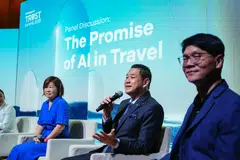
He adds that travellers still want to review and approve key decisions, something they have been used to for two decades. This also limits mistakes that could lead to booking the wrong flight or incurring cancellation charges.
Kumar acknowledges that Tara should have found out the dates for the fintech fest and suggested flights. The query failed because Ixigo instead restricted the assistant to specific sources such as Google Places, Google’s database of locations and businesses, and certain travel-related searches on the web.
He says these guardrails keep AI from doing things it is not meant to.
“The more tools you give AI, the more non-deterministic it becomes,” Kumar explains. “It might do something you don’t want.”
The many hurdles
International travellers spent a record US$2.02 trillion in 2025, according to the World Travel & Tourism Council.
Yet while 90 per cent of travel executives say their organisations use generative AI in some form, only 2 per cent say agentic AI is widely deployed across their businesses, a McKinsey survey found.
The problem is less about the tech than the industry it has to plug into.
Airline and hotel systems were built separately, often over decades, and inventory and prices can change in real time. That makes travel harder for AI than other e-commerce use cases, where prices are more stable, and platforms have greater control over rates.
Cancellation and modification policies are often written in plain text, rather than in standardised formats that AI agents can easily interpret. Payments are another stumbling block, with trickier questions around approval, spending limits, and liability.
For AI-native startups in the industry, accessing the booking systems, airfares, and hotel rates remains a challenge.
Airlines distribute fares to travel agents through established systems such as global distribution systems and New Distribution Capability that require approvals and commercial relationships.
Hotels are even more fragmented, leaving upstarts reliant on aggregators or burdened with building supplier relationships themselves.
For incumbent OTAs, the challenge is stitching together old systems while designing an interface that is genuinely better than the filters, forms, and checkout flows customers are already familiar with.
For AI agents to work reliably across travel, the industry needs greater standardisation, with inventory, pricing, and policies made available in formats AI agents can read, says Raunak Mehta, CEO and co-founder of Singapore-based insurtech startup Igloo.
“Not every hotel booking, not every flight booking, tends to have the same terms and conditions associated,” he adds.
There is also a demand problem: Travel is expensive, infrequent, and discretionary. Consumers may not be as willing to let AI pay directly from their bank accounts as they are for, say, groceries.
The changing market
Limitations aside, AI is shaking up travel. Customers are now making travel decisions through general-purpose platforms such as ChatGPT and Claude, which can plan trips. However, these platforms often take users elsewhere to transact.
“Even if you are searching for a holiday on an agentic AI platform, you will either be directed to the OTA … or you’d be directed to the website of the accommodation, hotel, Airbnb, or the airline itself,” says Albie Amankona, analyst at research firm Third Bridge.
The industry has also seen the rise of AI-native players such as Mindtrip and Layla, which Expedia acquired in 2026. Built around conversational trip planning rather than traditional search forms, they tap into established travel platforms and suppliers for much of the inventory and transaction.
Amankona adds that OTAs do not face “much of a threat” from these upstarts.
“When I asked them (OTA executives) what those AI-native platforms might be, very few of them were actually able to give me concrete names, which I think is interesting,” he recalls.
Reinventing legacy systems
The problem extends beyond OTAs to airlines, hotels, and other suppliers. If smaller hotels, tours, transfers, or other local services are missing from a platform, agents cannot plan or book them either.
AirAsia, whose parent Capital A also owns the OTA AirAsia MOVE, is a case in point.
In the carrier’s 2024 results, CEO Nadia Omer said AskBo 2.0 was “transitioning from legacy tech to an AI-powered travel concierge” co-developed with Google. By early 2026, she was still talking about continued investment in the virtual concierge.
Omer then signalled a more cautious approach.
“We’d rather wait, get all the bugs out, and use AI at a scalable stage,” she said in January, adding that MOVE would favour more tried-and-tested platforms for wider deployment.
Other players are moving at different speeds.
Klook CEO Eric Gnock Fah recently talked about AI “collapsing the fragmented booking interfaces into a single conversational layer”. Traveloka, meanwhile, has been adding conversational AI since 2024 but has so far focused largely on search and planning.
Hybrid model
In theory, the industry already has a common language.
Anthropic’s Model Context Protocol connects AI to data and tools, while Google’s Agent2Agent protocol lets agents communicate across systems. The Universal Commerce Protocol, which is also by Google, extends that to commerce.
But adoption remains a work in progress.
Overhauling legacy systems and making data ready for agent ingestion is a slow process on both sides of the OTA relationship. Doing it well also means finding the right people.
“The main cost driver of building this stuff in-house is actually hiring the top talent, attracting them from these big AI companies, and getting them to work for Booking or Expedia,” Third Bridge’s Amankona explains.
Managing the costs of running a voice AI, even without the agentic capabilities, is something companies are figuring out.
“We’re also not very aggressive about forcing people to use voice as of now,” says Ixigo’s Kumar. “These systems are not cheap to run.”
He declined to disclose the number of bookings made with Tara’s help. But according to the company’s 2026 annual report, the voice bot resolved more than 150,000 calls end to end in late 2025, triggered by the disruption and cancellations at Indian airline IndiGo.
The emerging model is hybrid: Instead of one agent overseeing the entire trip, several narrower agents handle specific tasks within the existing user experience.
Ixigo has agents that monitor fares, check passengers in, retrieve boarding passes, call hotels before arrival to reconfirm bookings, and chase airlines for refunds.
Instead of waiting for airlines and hotels to upgrade their backends or build their own agents, the OTA uses voice bots to call airline customer care or hotel reception.
“The consumer doesn’t know what an agent is,” Kumar notes. “All they want is stuff to be done for them.”
Disruption, postponed
End-to-end booking is already possible. Ixigo is testing such systems internally but is not ready to release them until it is “100 per cent sure that they are really high precision”.
Wider adoption depends on cutting AI costs, scaling to more users, and closing out the final steps of a trip, including payments.
These bottlenecks are buying incumbents time, but it will not last forever. If the industry ever reaches a point where every player speaks the same AI language, the advantages incumbents enjoy today could start to erode.
“OTAs feel quite confident that in the next couple of years there’s not going to be a major disintermediation from an AI-native challenger,” says Third Bridge’s Amankona. “They are generally of the view that travel customers are quite conservative.”
Where does that leave Tara and me? On speaking terms, with me still doing the legwork. TECH IN ASIA
Decoding Asia newsletter: your guide to navigating Asia in a new global order. Sign up here to get Decoding Asia newsletter. Delivered to your inbox. Free.
Share with us your feedback on BT's products and services
TRENDING NOW

DBS, OCBC, UOB rout lops billions off STI as inflation, rate concerns spook investors

Grab CEO’s wife Chloe Tong on life with Anthony Tan and finding her purpose

OCBC sheds S$8 billion in value as shares close nearly 6% down; analysts cautious on banks

Deal between tycoon friends sparks scrutiny of Philippine power sector

