

Makino Asia launches smart factory in Tuas
It is designed with IIoT capabilities to increase productivity, connectivity
Singapore
PRECISION engineering firm Makino Asia on Thursday launched its smart factory at 2 Gul Avenue, marking a milestone in its digital transformation journey that began in 2016.
The facility consists of an existing assembly factory and a new state-of-the-art machining factory, designed with Industry 4.0 and Industrial Internet of Things (IIoT) capabilities to increase productivity and connectivity between its systems.
The revamp is expected to nearly double the facility's machine production capacity.
It is part of Makino Asia's digital transformation plan involving a S$100 million investment over five years to expand and boost the capabilities of its facility in Singapore. As part of this plan, the company also established two new departments focused on automation and digitalisation.
Senior Minister of State for Trade and Industry Koh Poh Koon, who was the guest-of-honour at the event, commended Makino Asia for undertaking the challenge to implement a smart factory in Singapore.
"Advanced manufacturing technologies, such as additive manufacturing, robotics and augmented reality, are already transforming our production processes and supply chain configurations," said Dr Koh.
"Makino Asia clearly understands the opportunities brought about by digital technologies and advanced manufacturing, and therefore is transforming itself to collect, analyse and disseminate data-driven insights to enable greater flexibility and productivity in operations."
The smart factory's energy-saving and efficient solutions include solar panels in the compound generating about 2,400 megawatt hours of energy annually, the equivalent of taking 200 cars off the roads and avoiding 1,000 tonnes of carbon dioxide emissions over the same period.
Manual stock-taking has been reduced by a digitised inventory system in the assembly factory. Bins of fasteners like bolts and screws are kept on racks that monitor the bin weights and send out alerts when the factory's overall inventory is running low. When fully implemented, the system is expected to save up to 78 per cent in logistics costs, improve manpower productivity by 20 per cent and reduce inventory holding costs by 10 per cent.
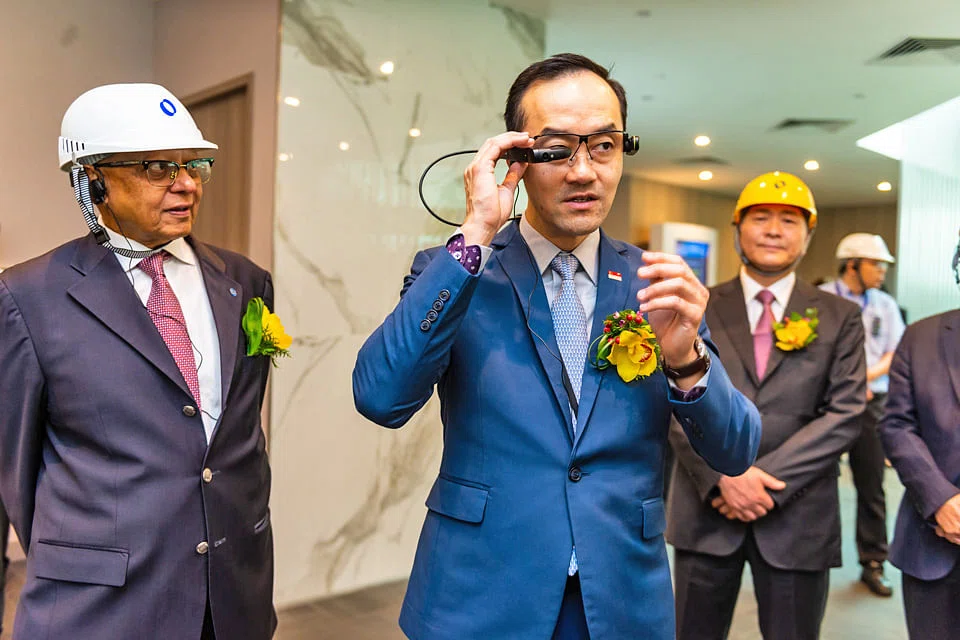
The smart factory also features an IoT Centre where customer service technicians remotely monitor Makino machines in their customers' factories around the world and use predictive analysis to proactively maintain the machines. The technicians make use of wearable Smart Glass technology and augmented reality to help guide staff in performing repairs on-site.
The Singapore factory is one of the first integrated smart factories in the Makino group, and once successful, the model will be implemented in other factories in China and India, said Neo Eng Chong, CEO and president of Makino Asia.
He advised companies looking to follow in Makino Asia's footsteps to carefully consider whether IoT and digitalisation are the right fit for their business models. And the biggest challenge in the digital transformation is not implementing new technology, but changing the mindsets of staff who are worried about losing their jobs to automation, he said.
To that end, the company worked with the Metal Industries Workers Union and Temasek Polytechnic to create a course that educated its employees about Industry 4.0 and Makino Asia's roadmap.
Mr Neo said challenges remain in the Industry 4.0 journey, such as limited bandwidth in existing network infrastructure. He expects this to improve when 5G is implemented here.
"There are still limitations, but the important thing is to take this step forward and get started," he said.
TRENDING NOW

Once staunchly pro-China, Malaysian Chinese businesses are now distancing themselves from Beijing
The middle power moment arrives in South-east Asia – but not for Asean

DBS, OCBC, UOB face rate hike reality check

Vietnam’s northern provinces, not Hanoi or Ho Chi Minh City, are powering near 10% GDP growth

