
Nasa's Ingenuity helicopter dropped on Mars surface ahead of flight
It will use own battery to run heater to protect components from freezing; first flight attempt no earlier than April 11
 Add BT as a preferred source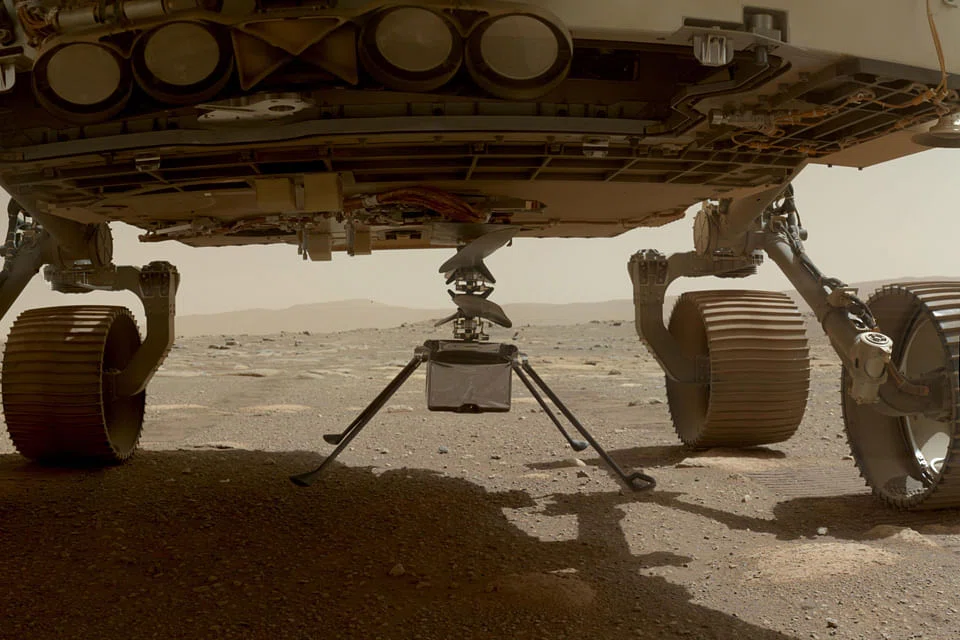
Washington
NASA's Ingenuity mini-helicopter has been dropped on the surface of Mars in preparation for its first flight, the US space agency said.
The ultra-light aircraft had been fixed to the belly of the Perseverance rover, which touched down on the Red Planet on Feb 18.
"MarsHelicopter touchdown confirmed!" Nasa's Jet Propulsion Laboratory tweeted on Saturday. "Its 293 million mile (471 million kilometre) journey aboard @NASAPersevere ended with the final drop of 4 inches (10 centimetres) from the rover's belly to the surface of Mars today. Next milestone? Survive the night."
A photograph accompanying the tweet showed Perseverance had driven clear of the helicopter and its "airfield" after dropping to the surface.
Ingenuity had been feeding off the Perseverance's power system but will now have to use its own battery to run a vital heater to protect its unshielded electrical components from freezing and cracking during the bitter Martian night.
Navigate Asia in
a new global order
Get the insights delivered to your inbox.
"This heater keeps the interior at about 45 deg F (seven deg C) through the bitter cold of the Martian night, where temperatures can drop to as low as -130F (-90 deg C)," Bob Balaram, Mars Helicopter Project chief engineer at the Jet Propulsion Laboratory, wrote in an update on Friday. "That comfortably protects key components such as the battery and some of the sensitive electronics from harm at very cold temperatures."
Over the next couple of days, the Ingenuity team will check that the helicopter's solar panels are working properly and recharging its battery before testing its motors and sensors ahead of its first flight, Dr Balaram said. Ingenuity is expected to make its first flight attempt no earlier than April 11, the Jet Propulsion Laboratory tweeted.
Ingenuity will be attempting to fly in an atmosphere that is one per cent the density of Earth's, which makes achieving lift harder - but will be assisted by gravity that is one-third of our planet's.
The first flight will involve climbing at a rate of about three feet (one metre) per second to a height of 10 feet (three metres), hovering there for 30 seconds, then descending back to the surface.
Ingenuity will be taking high-resolution photography as it flies.
Up to five flights of gradual difficulty are planned over the month.
The four-pound (1.8kg) rotorcraft cost Nasa around US$85 million to develop and is considered a proof of concept that could revolutionise space exploration.
Future aircraft could cover ground much more quickly than rovers, and explore more rugged terrain. AFP
Decoding Asia newsletter: your guide to navigating Asia in a new global order. Sign up here to get Decoding Asia newsletter. Delivered to your inbox. Free.
Share with us your feedback on BT's products and services

