
Nvidia unveils data-centre chips aimed at stretching its lead in AI
 Add BT as a preferred source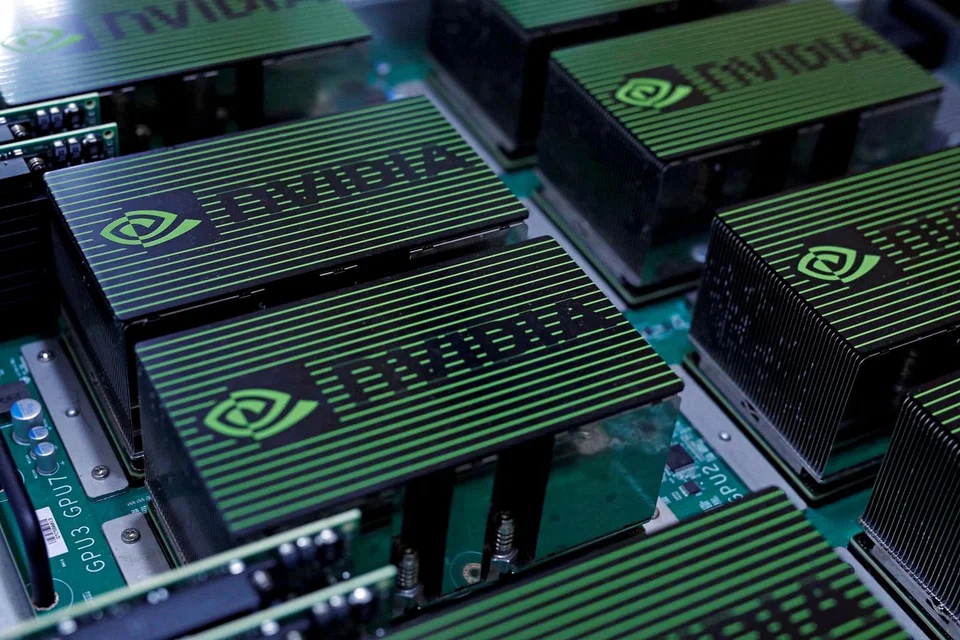
[SAN FRANCISCO] Nvidia told investors it's focused on maintaining growth with new products, including speedier data-centre chips, rather than embarking on more aggressive stock-buyback plans as some shareholders had hoped.
At the company's investor meeting Tuesday (Mar 22), chief financial officer Colette Kress said that the company's priority is using cash to expand its business. Nvidia has bought back US$2 billion in stock during the current quarter, she noted, but the company hasn't increased its budget for repurchases. Nvidia has US$5 billion of buyback authorisation left, Kress said.
Some investors had been eyeing additional buybacks after Nvidia walked away from a US$40 billion plan to acquire Arm in February, according to Citigroup and Bank of America. That deal, which failed to overcome regulatory opposition, would have been the biggest takeover in chip-industry history.
Nvidia shares slipped as much as 2.5 per cent following Kress's remarks but soon recovered. Though Nvidia is down nearly 10 per cent this year, that's in line with a broader slide for chip stocks.
Nvidia's focus now is new products and technology aimed at continuing its rapid growth in artificial intelligence (AI) processing. Graphics chips based on the new "Hopper" design will debut later this year, the company said. The processors are created with as many as 80 billion transistors and - when paired with new connecting chips - will massively speed up the development of software that understands human speech and does genomic research.
Under chief executive officer Jensen Huang, Nvidia has parlayed its dominance of graphics chips prized by computer gamers into a lucrative position in server technology. The company supplies chips to the owners of some of the world's largest data centres, which use the technology to power the artificial intelligence software needed to make sense of the growing flood of digital information.
Navigate Asia in
a new global order
Get the insights delivered to your inbox.
Huang saw the opportunity early and tasked Nvidia's engineers with adapting its product to become crucial to this growing type of computing. The company branched out with new types of semiconductors, computer systems, software and services to keep it ahead of the competition.
Nvidia's Hopper technology, named for computer science pioneer Grace Hopper, is its latest offering. It contains circuitry specifically designed to run so-called Transformer machine learning models, which are used to improve the way that machines understand and interpret human speech. Hopper will also better link with other chips, allowing it to remove some of the bottlenecks caused by transferring huge data sets between parts of a computer. Nvidia will rely on contract manufacturer Taiwan Semiconductor Manufacturing to make the chips.
Alibaba Cloud, Amazon.com's AWS, Alphabet's Google Cloud and Microsoft's Azure are among the large companies that will adopt the new chips, Nvidia said. In addition, computer makers such as Dell Technologies and Hewlett Packard Enterprise will offer machines based on the silicon.
Nvidia also announced the availability of the Grace CPU Superchip, its brand name for a new central processing unit for high-end data-centre computing. That product is its initial foray into the bigger market for CPUs - a field where Intel technology remains dominant but is facing greater pressure from new entrants.
It's been 6 weeks since Nvidia walked away from its plan to acquire Arm, an influential UK chip designer, from SoftBank Group. SoftBank is now pursuing an initial public offering for the business instead. BLOOMBERG
Decoding Asia newsletter: your guide to navigating Asia in a new global order. Sign up here to get Decoding Asia newsletter. Delivered to your inbox. Free.
Share with us your feedback on BT's products and services

