

Prioritisation Matrix launched to help companies transform
It will list out all the things they can do in a sequential manner
Hannover, Germany
COMPANIES unsure of how to embark on their Industry 4.0 transformations now have a clearer guide in the form of a Prioritisation Matrix planning tool developed by the Economic Development Board and its knowledge partners.
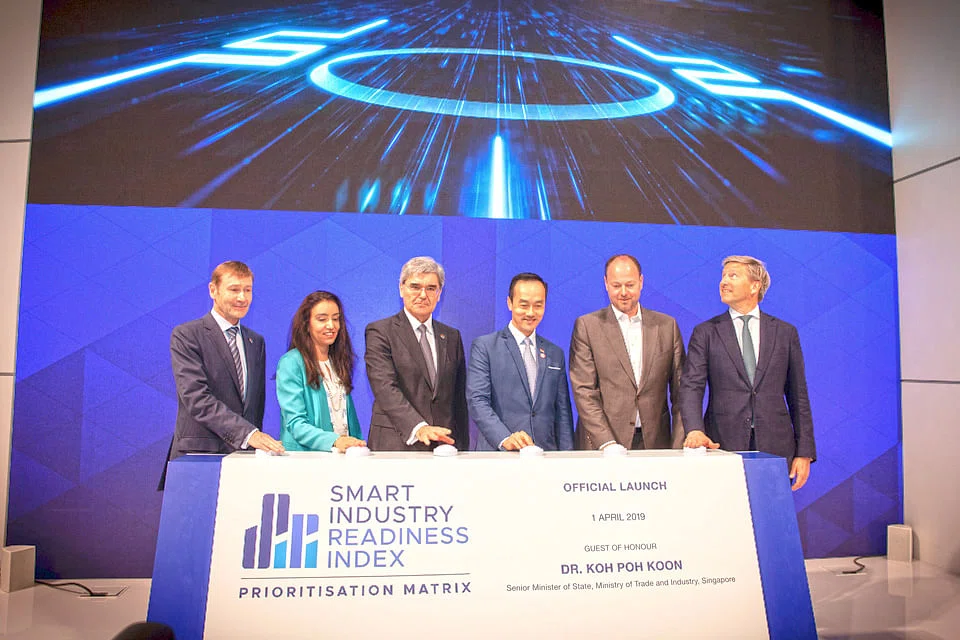
Launched by Singapore's Senior Minister of State for Trade and Industry Koh Poh Koon at the Hannover Messe tech show on Monday, the Prioritisation Matrix builds on the Smart Industry Readiness Index (SIRI) and accompanying Assessment Matrix established in November 2017.
Companies are first evaluated on their Industry 4.0 readiness levels across 16 dimensions using the existing Assessment Matrix. Then, the Prioritisation Matrix takes into account the Assessment Matrix scores, revenue-cost profiles, key performance indicators and proximity to the best-in-class in each to identify which dimensions they should focus resources on to gain the greatest benefits to their businesses.
"The planning and execution of an Industry 4.0 transformation plan is not a simple task," Dr Koh said in his speech at the launch. He noted that it requires investing significant amounts of time and resources to identify key focus areas, select the right technologies and vendors, and oversee the entire transformation process.
"It is therefore not surprising that very few companies have taken the plunge, unless they themselves have a high level of confidence and clarity about what is needed to implement the projects that can help to achieve their desired business outcomes."
The SIRI index has served as a useful diagnostic and descriptive tool, helping businesses understand where they stand in relation to competitors and the rest of the industry, as well as helping them visualise what the different stages of Industry 4.0 look like, Dr Koh told The Business Times. However, companies that know what Industry 4.0 means and where they stand still have difficulty identifying the next step to bridge the gap.
"This is where the Prioritisation Matrix helps them to list out all the things they can do in a sequential manner, according to where the low-hanging fruits are, so they can better actualise business outcomes as they undertake each step of the transformation journey."
The matrix, said to be the world's first such tool, was developed in partnership with McKinsey & Co, SAP, Siemens and TUV SUD. With the inclusion of more commonly used standards and definitions, it could also prove useful in other countries.
"It's meant to be a platform that can involve companies from across different jurisdictions and countries, which is why we chose to launch it here (at Hannover Messe)," Dr Koh said.
One of the 10 manufacturers involved in the pilot was precision manufacturing firm Shine Precision Engineering. After receiving their Prioritisation Matrix report, they implemented an overall equipment efficiency (OEE) system to calculate and analyse the efficiency of their machines, as well as a real-time monitoring system to ensure the factory is operating at full capacity as much as possible.
"In our industry, time is money. Robots don't take leave, they don't fall sick and their quality control is quite fixed. It's much better than a human being," said business development manager Daniel Chua.
However, Shine is keen to ensure its employees know that they will not lose their jobs in this Industry 4.0 transformation. Mr Chua noted that while the robots can take over much of the manual work, they still need human operators to closely monitor them and replace raw material or tooling as needed.
"In other words, our people now need to upgrade themselves to run more sophisticated machines. It's good for them, and they also understand that Singapore is undergoing digitisation. If Shine doesn't keep pace, we'll be thrown out of the industry very soon."
TRENDING NOW

Indonesia’s coal tycoon Low Tuck Kwong replaced as Bayan Resources president-director

OCBC names Ang Eng Siong as global corporate banking head in rejig of wholesale banking business

Consider lowering homeownership barriers for some non-resident foreigners

DBS opens flagship investment strategy to retail investors with new fund

