Privatisation energises Dell in Asia Pacific
APJ head Amit Midha says Dell has a compelling value proposition for customers in the region
Singapore
WITH market demand shrinking every quarter at an unprecedented rate, most of the world's top personal computer makers are scrambling to adapt their business models.
Research agency IDC's preliminary data on PC sales in the Asia Pacific excluding Japan (APEJ) region for the third quarter of this year shows sales declined 5 per cent year-on-year.
Of the top PC makers, only three have managed to buck the trend and grow in a declining market, thanks primarily to aggressive marketing and innovative designs and form factors.
Lenovo remained in the lead, driven by its huge market share in China. The Chinese brand grew 5.8 per cent in Q3 to take its APEJ PC market share to 21.4 per cent. Dell took the No 2 spot with an 11.1 per cent share, growing 6.2 per cent in the quarter. The other big gainer was Taiwanese brand Asus, which had a 7.7 per cent market share, growing 13.3 per cent in Q3.
Dell's performance contrasts sharply with the other big US manufacturer, Hewlett Packard (HP), which till recently was the world's top PC maker. HP lost a massive 16.1 per cent market share to garner 10.1 per cent of the APEJ market in Q3.
Analysts reckon one of the reasons Dell has been able to grow in a difficult market is that it's now a private company and can respond to market changes much faster.
In October last year, Michael Dell, founder, chairman and CEO of Dell, took the company private after a prolonged battle with shareholders. In an interview with The Business Times earlier this year, Mr Dell said that he was savouring the prospect of taking on his competitors without having to worry about "89-day planning cycles" (that is, quarterly reporting).
He said: "We've been on a path to help our customers solve real problems for a number of years . . . As a private company, we think we can do that faster as we answer only to our customers. We have a great capital structure, strong cash flow and healthy profits, and we don't have to worry about anything else now. This is an industry where you change or you die, and we are changing aggressively. We are building all kinds of new capabilities in the right areas, and that's what we will keep doing."
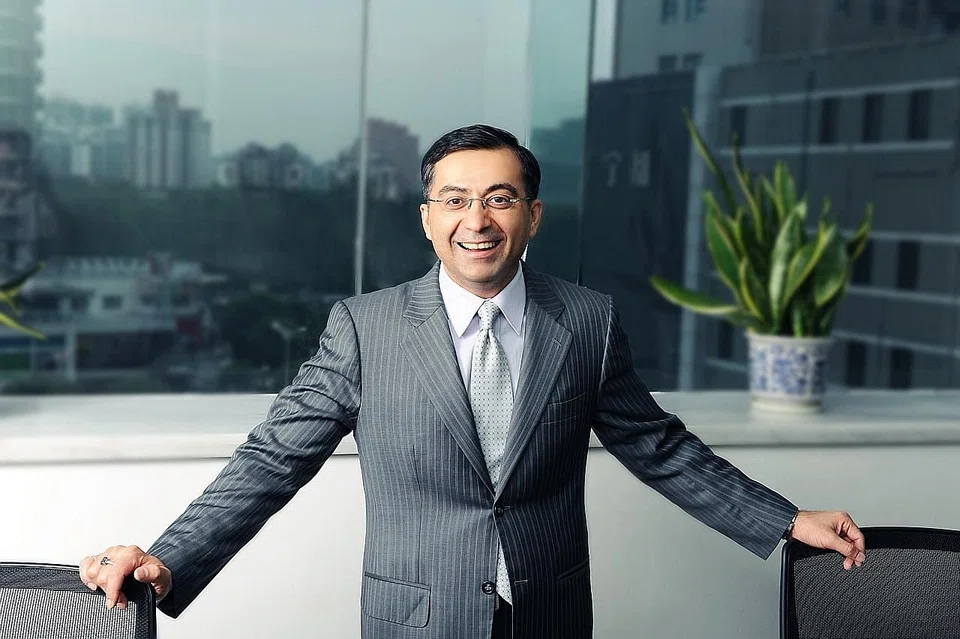
Amit Midha, Dell's boss in the Asia Pacific including Japan (APJ) region, agrees that privatisation has energised the company. "Since we went private, we have done exceptionally well. While our past has been fantastic, we think what's going to come ahead is even brighter. The reason for this is that the dynamic within the industry is changing; the technology is becoming the business, and we believe we have the right vision and the right set of technology tools to deliver end-to-end solutions," the president of Dell APJ Region and chairman of Dell Global Emerging Markets told BT.
IDC Asia Pacific's research manager Handoko Andi noted Dell had raised its market share by over one per cent from a year ago in APJ, right before it went private in Q4 2013. "While it sounds small, it's actually quite an achievement considering the market contracted by 7 per cent in the same time frame," Mr Andi told BT.
He added: "Dell is in a good position right now as (demand for) commercial PCs, which is an area of strength for Dell, is eroding at a much slower pace than consumer PCs since disruption from other devices like smartphones or tablets is still rather mild.
"Combine that with the XP migration and competitors like Sony or Samsung diverting their business from PC. With privatisation, Dell is definitely becoming more agile in answering customer demand, which is of great benefit to them in the APJ region."
Mr Midha noted that the company's current focus is primarily on three areas. First, Dell is continuing to innovate at the devices layer. He pointed out, for example, that the company came out with the thinnest tablet with a 3D sense camera which can measure distance in a photo.
The second area is software. "There are three stacks of software that go with this. First is the security layer. If you use Android devices, then we give you a kernel where you can do your office work within the phone. Within the software stack, I have mobile device management which allows corporations to wipe the data clean or monitor how the technology is being used within their infrastructure. Then we have data deduping and disaster recovery, inscription and all of that comes with our PC automatically preloaded."
Last but not least, Dell has what Mr Midha calls "client cloud computing". "Now you can see your information anywhere in the world, even on a TV screen . . . I can ensure that it's securely visualised without transfer of data. We are today No 1 in the thin client computing as well as the client computing side."
Another area of focus is IoT (Internet of Things), which refers to interconnected devices and items such as cameras, traffic lights and refrigerators that are connected to the Internet. "We just launched our IoT Lab in Santa Clara in the US. The idea is how do we innovate and create standards that help these devices to interact with each other such that it leads to meaningful quality of life or outcome. We are working with Samsung, Intel and others to create standards. This will lead to positive benefits for society."
He said the company has an even more compelling proposition on the enterprise side. "Virtualisation has improved server utilisation dramatically and the worry was that hardware would become commoditised. However, that didn't happen, and now we have software-defined storage and networking.
"Dell has a uniform-looking server form factor. However, in the inside, it is virtually defined architecturally. That means within it there is a separate server, storage and networking. All of it is stacked up together. It can be redeployed completely in a flexible and cost-effective manner."
Globally, Dell was the No 1 storage supplier in the first half of 2014, based on total terabytes sold for internal and external storage, according to IDC. The company also maintained its No 2 market share position in the global x86 server market.
Speaking to BT, Cynthia Ho, IDC Asia Pacific's senior market analyst for enterprise servers, noted that in the APEJ region, x86 server sales reached 654,000 in Q2 with an 11 per cent year-on-year shipment growth. "Dell held the unit market leadership of 20.3 per cent whereas HP was No 2 with a market share of 18.3 per cent. IBM came in No 3 with a 12.7 per cent share in that period."
Ms Ho said that Dell has been leading the market for the past three quarters. "This is partly contributed by the aggressive approach of going after channel ecosystem after it went private."