'Reinventing tomorrow' with SWITCH and new tech consortia
Singapore
DEPUTY Prime Minister Teo Chee Hean kicked off the inaugural Singapore Week of Innovation and Technology (SWITCH) on Tuesday by unveiling two national-level consortia in cybersecurity and synthetic biology, as part of Singapore's efforts to further strengthen integration between the industry and R&D community.
DPM Teo told a crowd of global entrepreneurs, technologists and investors at SWITCH: "While we have invested significantly in innovation inputs, such as enhancing human capital and creating a pro-business environment, we can do more to bring innovations from R&D to market, seeding and growing enterprises, and further expanding high-tech exports."
The chairman of the National Research Foundation (NRF) and coordinating minister for national security added that the two new consortia would connect industry partners and researchers, help focus applied research to develop new products, and facilitate the growth of startups with deep expertise and adoption of such technologies by local enterprises.
The new consortia are Singapore Cybersecurity Consortium (SGCSC) and Singapore Consortium for Synthetic Biology (SINERGY). Set up to promote research, commercialisation and training in cybersecurity and synthetic biology, both will be hosted at the National University of Singapore (NUS) and supported by NRF.
SINERGY head Matthew Chang said that his consortium aims to encourage frequent interactions and co-development among industry, universities and research institutes, as well as catalyse the translation of expertise in synthetic biology for industry applications, such as in waste management and medicine.
The associate professor and director of the Synthetic Biology for Clinical and Technological Innovation programme at NUS told The Business Times: "It is essential for researchers to know what is needed in the industry. SINERGY brings every player together, puts all the pieces in the right places, and sees what synergies can be created."
To date, more than 10 industry partners including GlaxoSmithKline and Wilmar International have committed to join the consortium as founding members. SINERGY activities will include tech talks, strategic retreats and networking with global synthetic biology consortiums.
SGCSC head Abhik Roychoudhury, a professor at the NUS School of Computing, said that his consortium aims to promote greater awareness and translation of cybersecurity technologies, and lower the entry barrier for the adoption of relevant solutions by Singapore companies.
He told BT: "While there is huge general interest in cybersecurity, SGCSC is aiming for a more targeted translation of solutions in special-interest areas such as mobile and fintech (financial technology). Companies in the consortium can protect their core interests, but the consortium will also expose them to other forms of cybersecurity they won't know about."
SGCSC has brought on board industry partners such as Banff Cyber Technologies, Singtel and Standard Chartered Bank. Its activities will include an annual cybersecurity camp, certification courses and tech talks.
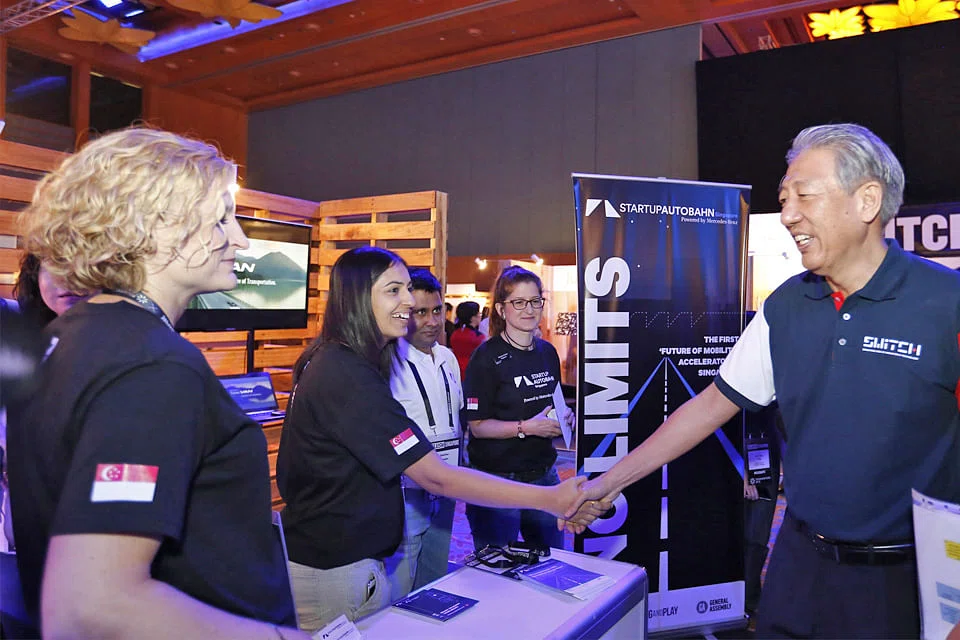
On Tuesday, DPM Teo described SWITCH as a showcase of Singapore's vibrant innovation and enterprise ecosystem, and how it is "reinventing tomorrow". He also pointed to SWITCH's anchor event Techventure X Slush Singapore - noting that Techventure (a longstanding Singapore startup and investor event) "is reinventing by partnering Slush Singapore" (a non-profit, youth-driven tech startup movement from Finland).
He added: "Our innovation and enterprise ecosystem will benefit from the increasing exchanges between innovators, entrepreneurs, investors and enterprises . . . Singapore can also play a role to connect global enterprises, and serve as a launchpad into the region and beyond."
On Tuesday, San Francisco-based tech company Stripe (which powers commerce for businesses) announced that it had officially entered the Asian market via a Singapore launch. Stripe said that for the past 11 months, it had been "in beta" here, with clients including homegrown startups Grab , Oddle, and 99.co.
Stripe president and co-founder John Collison said Singapore is a natural hub for entrepreneurs, given an active venture capital landscape, a supportive local ecosystem, and "breakout successes" such as Grab, Lazada and PropertyGuru.
He said: "This city is spurring a new wave of economic opportunity. We hope to be a catalyst to help more businesses get started here in Singapore and a springboard to support them as they expand globally."