Riding the digital payment wave
Mastercard has opened an innovation lab space in S'pore to brainstorm new ideas and test out different prototypes

Singapore
THINK of Mastercard, and images of plastic credit cards emblazoned with the global payments company's famous overlapping red and yellow circles come to mind.
These days, however, it is becoming more common to see someone using digital wallets, mobile phones or cloud-based systems to settle their everyday goods and services transactions.
As more consumers around the world embrace e-payment modes, Mastercard is busy thinking of new and different ways to stay well ahead of the digital payments curve.
Last April, the company opened a new innovation lab space for research and development at its DUO Tower office in Bugis. Singapore is Mastercard's headquarters in the Asia-Pacific region.
The facility is a constant hive of activity as Mastercard's employees and clients gather to brainstorm new ideas and test out different prototypes.
Among the many innovations that have been churned out are the ability to make payments by taking a selfie via an app that has biometric authentication.
There is also a cashless vending machine that allows a person to buy items and pay for them using a mobile device that is linked to one's Masterpass digital wallet.
Those who pop into the innovation lab for a visit might come across Pepper, a cute humanoid robot that can perform a variety of everyday functions such as taking food orders at a restaurant through one's voice commands.
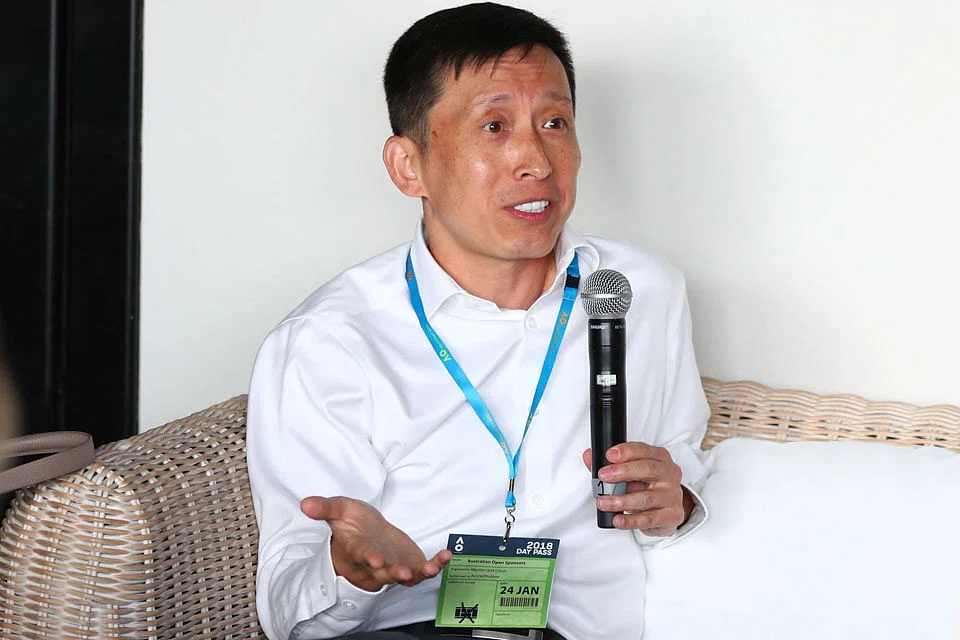
Ling Hai, Mastercard's co-president of Asia-Pacific, said that the innovation lab has been well-received by clients over the past year.
The senior executive, who also sits on Mastercard's management committee, has been based in Singapore for the past two-and-a-half years. He overseas all of Mastercard's activities in North-east Asia (South Korea, China, Japan, Hong Kong, Taiwan) and Australasia.
"I remember that the first customers I hosted (at the lab) were from the Central Bank of Mongolia. We see this as an ideal way for us to engage all our customers, whether they are commercial or from the government," he said in an interview with The Business Times on the sidelines of last month's Australian Open tennis tournament in Melbourne.
"It's a great way for our customers to understand what we're doing, and how it can benefit them in their respective industries," he added.
Mastercard is the official payment partner of the Australian Open, having began a three-year partnership in 2017.
Said Mr Ling: "We have customers who are not sure whether to adopt QR code, or whether they should launch a new credit card programme. So what we do is form a team, we'll come up with some quick insights, answers and prototypes for them."
During the Australian Open, Mastercard took the opportunity to preview some of the new digital payment technologies in the market, including a unique smart ring that is linked to one's bank account and can be used to make payments with just a simple tap.
The ring, named the Halo, is waterproof for up to 50 m and does not need to be charged or require a mobile app in order to operate.
Recently made available to Bankwest customers in Australia, the payment ring has the same security as a Bankwest Mastercard and comes with round-the-clock fraud protection.
Asked about Singapore's ongoing push to go cashless, Mr Ling said that he was "impressed" with the country's pro-active approach to think ahead and introduce new e-payment options for both retailers and consumers.
"Going cashless is a continuous journey. I don't think Singapore, or any other country, will ever get to 'zero cash'," he said.
"From what I see so far, what Singapore is, for instance, trying to do with hawker centres and having payments done by scanning QR codes, I think that's just one great example of how even the smaller businesses out there can be a part of this ongoing journey."