
Robots may emerge as heroes in Covid-19 war
They are fast and have zero risk of falling ill as they go about their work
 Add BT as a preferred source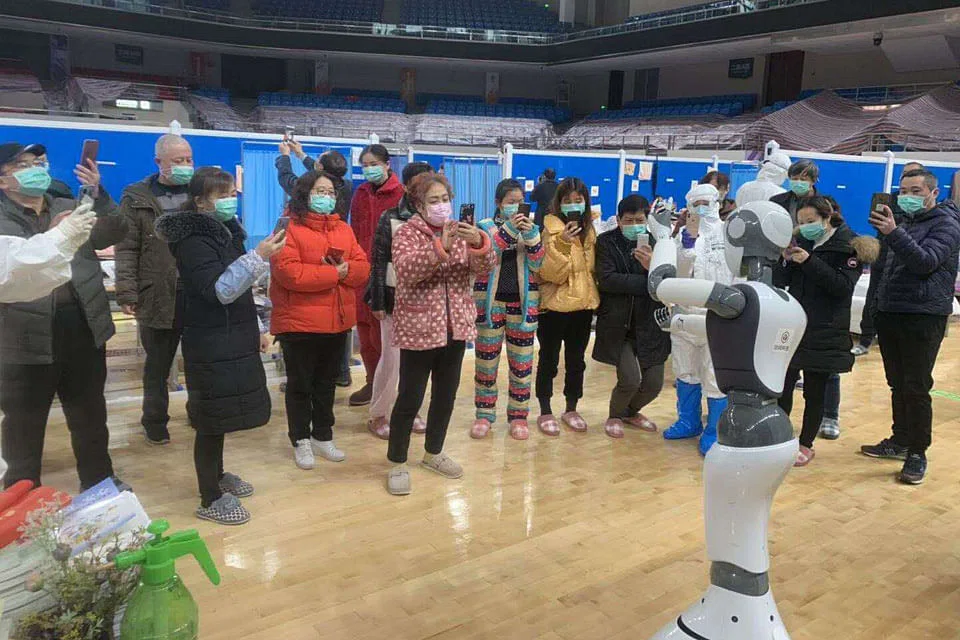
San Francisco
LONG-maligned as job-stealers and aspiring overlords, robots are being increasingly relied on as fast, efficient, contagion-proof champions in the war against the deadly coronavirus.
One team of robots temporarily cared for patients in a makeshift hospital in Wuhan, the Chinese city where the Covid-19 outbreak began.
Meals were served, temperatures taken and communications handled by machines, one of them named "Cloud Ginger" by its maker CloudMinds, which has operations in Beijing and California.
CloudMinds president Karl Zhao said of the humanoid robot: "It provided useful information, conversational engagement, entertainment with dancing, and even led patients through stretching exercises.
"The smart field hospital was completely run by robots."
Navigate Asia in
a new global order
Get the insights delivered to your inbox.
A small medical team remotely controlled the field-hospital robots. Patients wore wristbands that gathered blood pressure and other vital data.
The smart clinic, which handled patients for only a few days, foreshadowed a future in which robots tend to patients with contagious diseases while health-care workers manage from safe distances.
Patients in hospitals in Thailand, Israel and elsewhere meet with robots for consultations done by doctors via video-conference.
Some consultation robots even tend to the classic checkup task of listening to patients' lungs as they breathe.
Alexandra Hospital in Singapore will use a robot called BeamPro to deliver medicine and meals to patients diagnosed with Covid-19 or those suspected to be infected with the virus in its isolation wards.
Doctors and nurses can control the robot by using a computer from outside the room, and can hold conversations with the patient via the screen and camera.
The robot reduces the number of "touch points" with patients who are isolated, thereby reducing risk for healthcare workers, the hospital's health-innovation director Alexander Yip told local news channel CNA.
Robotic machines can also be sent to scan for the presence of the virus, such as when the Diamond Princess cruise ship cabins were checked for safety weeks after infected passengers were evacuated, said the US Centers for Disease Control.
Additionally, hospitals are turning to robots to tirelessly rid room, halls and door handles of viruses and bacteria. US firm Xenex has seen a surge in demand for its robots that disinfect rooms, said the company's director of media relations Melinda Hart.
Xenex's LightStrike robots have been used in more than 500 healthcare facilities, with the number of deployed bots rising due to the pandemic, she said.
"We are getting requests from around the world.
"In addition to hospitals, we're being contacted by urgent care centres, hotels, government agencies and pharmaceutical companies to disinfect rooms."
Shark Robotics in France began testing a decontamination unit about a month ago and has already started getting orders, said its co-founder Cyril Kabbara.
Lesley Rohrbaugh, the director of research for the US Consumer Technology Association, said the coronavirus pandemic has accelerated robotics innovation.
"We are in a time of need for some of this technology, so it seems like its benefits outweigh its costs," she said.
Artificial intelligence, sensors and other capabilities built into robots can push up prices, as can the need to bolster high-speed Internet connections on which machines often rely, said Ms Rohrbaugh.
Innovations on the horizon include using drones equipped with sensors and cameras to scan crowds for signs of people showing symptoms of coronavirus infection.
A team at the University of South Australia is working on just that, in collaboration with Canadian drone maker Draganfly.
University professor Javaan Singh Chahl said: "The use will be to identify the possible presence of the virus by observing humans.
"It might form part of an early-warning system or to establish statistically the number of people afflicted in a population."
His team is working on computer algorithms that can spot sneezing or coughing, say in an airport terminal, and remotely measure people's pulses and temperatures. AFP
Decoding Asia newsletter: your guide to navigating Asia in a new global order. Sign up here to get Decoding Asia newsletter. Delivered to your inbox. Free.
Share with us your feedback on BT's products and services

