

South Korea unveils US$450b push for global chipmaking crown
Samsung, SK Hynix among 153 companies to drive semiconductor research, production from now till 2030
 Add BT as a preferred source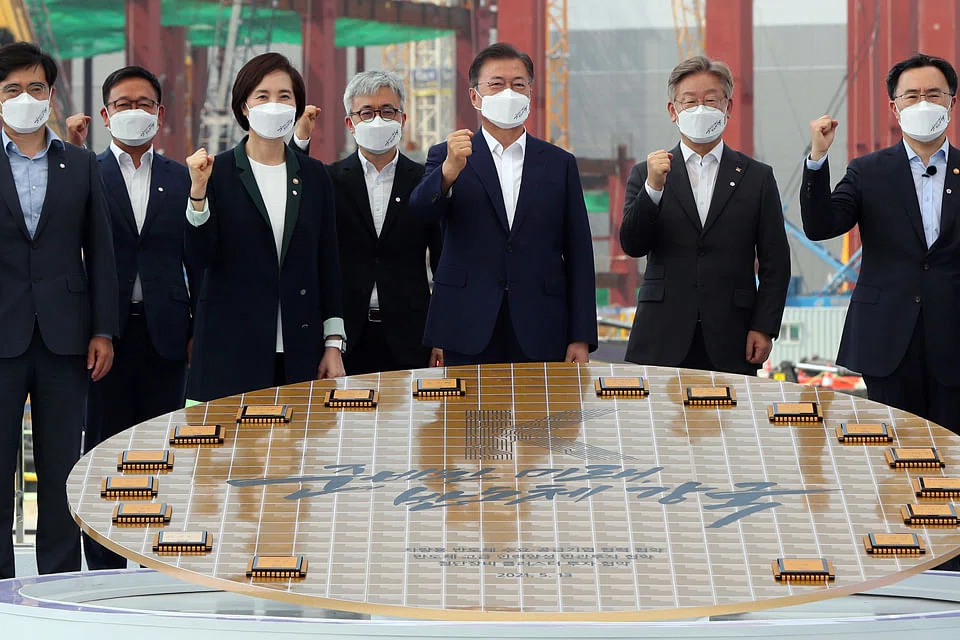
Seoul
SOUTH Korea unveiled ambitious plans to spend roughly US$450 billion to build the world's biggest chipmaking base over the next decade, joining China and the US in a global race to dominate the key technology.
Samsung Electronics and SK Hynix will lead more than 510 trillion won (S$601 billion) of investment in semiconductor research and production in the years to 2030 under a national blueprint devised by President Moon Jae-in's administration. They will be among 153 companies fuelling the decade-long push, intended to safeguard the nation's most economically crucial industry.
Mr Moon on Thursday got a briefing from chip executives on the initiative during a visit to the country's most advanced chip factory, a Samsung plant south of Seoul.
Samsung is boosting its spending by 30 per cent to US$151 billion till 2030. Hynix is committing US$97 billion to expansion at existing facilities in addition to its US$106 billion plan for four new plants in Yongin, co-chief executive officer Park Jung-ho said during the event.
"Major global competitors are pressing ahead with massive investment to be the first to take the future market," Mr Moon said in a speech. "Our companies have been taking risks and innovating as well and have completed preparations for tumultuous times."
The effort comes at a time when the US, China and the European Union seek to shore up their semiconductor capabilities after a global chip shortage exposed a reliance on just a handful of Asian manufacturers and hobbled efforts to repair pandemic-scarred economies. The shortages are now spreading from cars to smartphones and displays, elevating semiconductors onto the agendas of governments from Washington to Brussels and Beijing.
At stake is a technology fundamental to groundbreaking advances from artificial intelligence (AI) to autonomous vehicles and connected homes. South Korea, a security ally of the US and a major exporter to China, has been walking a tightrope between the two while bolstering its own production prowess. Semiconductors account for the largest share of South Korea's exports and chip exports are expected to double to US$200 billion by 2030, the Ministry of Trade, Industry and Energy said.
Likening semiconductors to rice - a global dietary staple - the ministry called them "strategic weapons" in a race for superior technology intensifying among not just firms but also nations.
The government seeks to build a "K-semiconductor belt" that stretches dozens of kilometres south of Seoul and brings together chip designers, manufacturers and suppliers, said the ministry.
Samsung and Hynix make the majority of the world's memory chips, basic semiconductors that handle storage for all devices. But one area South Korea has been lagging in is the ability to produce advanced logic chips that handle complex calculations for tasks such as AI and data processing, a speciality dominated by Taiwan Semiconductor Manufacturing Co, which makes Apple's iPhone processors.
Samsung aims to compete more aggressively in this area, securing some of Nvidia's graphics card business and pursuing a bigger share of Qualcomm's mobile chips. Hynix too has announced ambitions to get into logic chips.
The South Korean government will incentivise its domestic industry with tax breaks, lower interest rates, eased regulations and reinforced infrastructure, hoping to see its chipmakers make up the distance from the global leaders, the ministry said.
The government will also secure adequate water supply for the next 10 years in the targeted region and reinforce power supplies, both essential to advanced chipmaking factories.
South Korea's blueprint echoes efforts underway around the world. US President Joe Biden wants to dedicate US$50 billion to US semiconductor research and production, part of an overall ambition to safeguard America's supply chains. China has earmarked hundreds of billions of dollars toward developing its own chipmaking industry, wary of a reliance on Western-designed imports.
South Korea also aims to attract additional foreign investment in advanced technology. Dutch semiconductor equipment maker ASML Holdings signalled it intends to spend 240 billion won to build a training centre in Hwaseong, while California-based Lam Research plans to double its capacity in the country, the ministry said.
"South Korea is essentially beckoning global suppliers to come and work with its homegrown chipmakers so it can build an ecosystem on its soil rather than see them relocate to the US and elsewhere," said Kim Yang-paeng, semiconductor analyst at the Korea Institute for Industrial Economics and Trade.
"Broadening its investment to foundries and logic chips also guarantees that it has something to fall back on should anything go wrong with the memory chip industry that it's dominant in."
In terms of direct contributions, the country wants to help train 36,000 chip experts between 2022 and 2031, contribute 1.5 trillion won towards chip research and development and will start discussing legislation tailored to assist the semiconductor industry. BLOOMBERG
Decoding Asia newsletter: your guide to navigating Asia in a new global order. Sign up here to get Decoding Asia newsletter. Delivered to your inbox. Free.
Share with us your feedback on BT's products and services
TRENDING NOW
Taiwan’s wealthy seeks diversification to Singapore, sparking private banking race: Bloomberg

Palm oil stocks set to surge as Indonesia said to be scaling back export overhaul: analysts
Serenity Park condo owners lower asking price to S$440 million in second shot at collective sale
Malaysian tycoon Vincent Tan’s sell-downs point to pruning rather than an exit plan

