
The ulti-mutt pet? Chinese tech company develops robo-dogs
 Add BT as a preferred source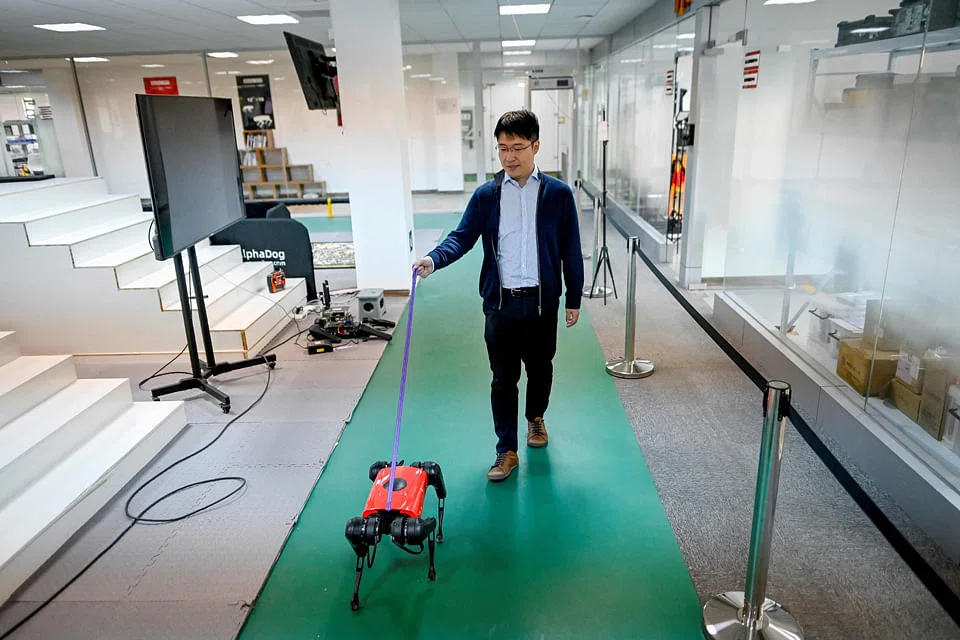
Nanjing, China
IT'S whip fast, obeys commands and doesn't leave unpleasant surprises on the floor - meet the AlphaDog, a robotic response to two of China's burgeoning loves: pets and technology.
The high-tech hound uses sensors and artificial intelligence (AI) technology to "hear" and "see" its environment - and can even be taken for walks.
"It's really very similar to a real dog," said Ma Jie, chief technology officer at Weilan, the company behind the product.
The Nanjing-based creators say their robot dog - which moves at a speed of almost 15 kmh and spins on the spot like an excited puppy - is the fastest on the market.
With four metal legs, it is more stable than a real dog, Mr Ma explained as one of his team swiftly kicked it to prove the point.
Navigate Asia in
a new global order
Get the insights delivered to your inbox.
"It can predict the friction and height of the ground (to) adjust its height, adjust the stride frequency, and adapt to the environment," he said, as the robot slowly navigated going up a set of stairs.
Its creators are using 5G technology, super-fast Internet speeds with immediate reaction times, to make the robot operate autonomously.
Mr Ma studied reinforcement learning - the study of how to reinforce actions through reward or punishment - at the University of Oxford and said he has used that knowledge to inform how the AI dog mimics canine habits.
Dog ownership was banned under the leadership of communist China's founder Mao Zedong - but has since boomed dramatically.
In the first month of sales, more than 1,800 AlphaDogs have trotted off the shelves, despite the hefty price tag of 16,000 yuan (S$3,273).
"Orders are mostly from computer developers, tech geeks, and also kids, who really seem to like it," said Mr Ma.
As China seeks to upskill its workforce, Beijing has been making huge investments in robotics and AI.
Robots are already used to deliver parcels, serve in restaurants, offer information at stations and even take throat swabs for Covid-19 tests.
The Weilan workshop is staffed by young tech enthusiasts, filled with pencil design sketches and a central obstacle route of stairs and slopes for the machines to clunk over in testing.
Developers there hope that future uses of their four-legged friend could benefit the visually impaired.
"To help the disabled is a important developing direction for us," said Mr Ma. "When the robot dog has the function of vision, hearing and dialogue too, it can easily interact with disabled people, and lead them to the supermarket or the bus."
Future software updates will include the dog "barking" - and beyond that, even add human voices to allow conversations between pet and owner.
There is also a larger "enterprise" dog model, designed for industrial inspections of machinery or pipes.
The next generation of the AlphaDog in pet form could also introduce "personalities" to the dog's toolkit to make them even more canine-like, as well as extend its somewhat brief battery life. AFP
Decoding Asia newsletter: your guide to navigating Asia in a new global order. Sign up here to get Decoding Asia newsletter. Delivered to your inbox. Free.
Share with us your feedback on BT's products and services

