US drug giant Amgen opens first next-gen facility in Tuas
Singapore
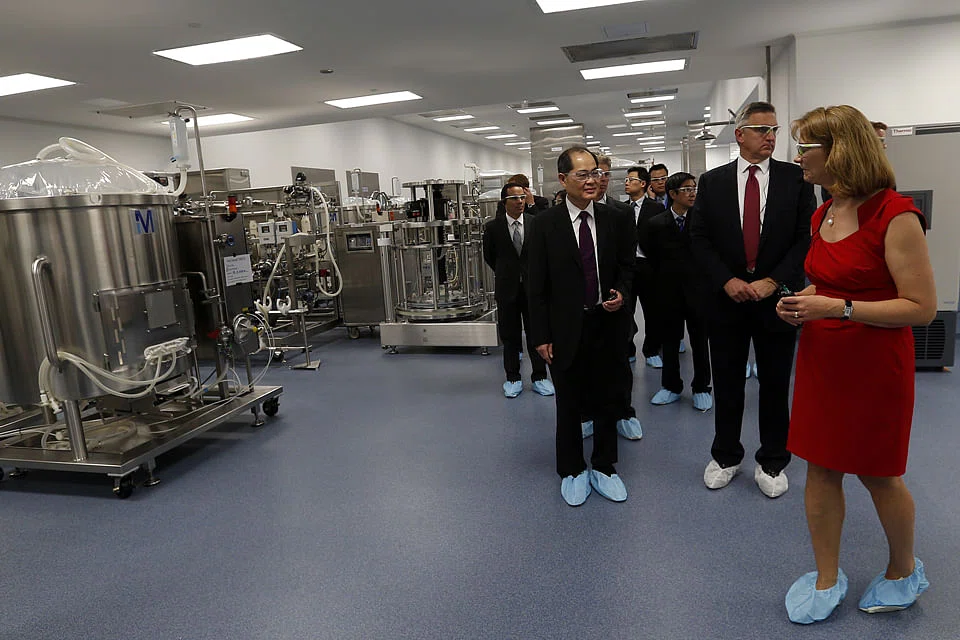
AMERICAN drug-maker Amgen expects to roll out its products for treating osteoporosis and bone cancers from its new plant in Tuas by the end of 2016. The S$200 million plant in Tuas Biomedical Park is the first next-generation biomanufacturing facility in the world, and is the company's first investment in Singapore and in Asia.
A model of efficiency, it is cheaper to build and run than conventional facilities; it took only a quarter of the capital cost to construct, and will need only a third of the operating expenses of a conventional facility. And 15 months was all it took for it to be built - half the time it takes to build a traditional plant.
Despite this, it will still be able to churn out about a tonne of products annually, the same output as that of a conventional facility.
The flexible, modular design means that the 120,000 square foot plant can be replicated in future locations; production capabilities can also be ramped up to accommodate the production of future cell-culture products.
On top of this, the plant will run with more than 75 per cent reduction in the usage of energy and water and in carbon dioxide emissions; solid waste generated and chemical usage will also be lower, which dovetails with Singapore's commitment to sustainable and innovative economic development.
The company has 70 employees now, and plans to grow its staff strength to 200 in about two years.
Amgen disclosed on Thursday its plans for a second synthetic-molecule plant, to be ready in about three years. This plant will be near the first one and will produce the active pharmaceutical ingredient for a drug that treats multiple myeloma.
Multiple myeloma is a cancer that forms in a type of white blood cell called a plasma cell. Plasma cells help the body fight infections.
Speaking at the launch of the Amgen plant, Minister for Trade and Industry Lim Hng Kiang noted that Singapore has become home to nine world-class, commercial-scale biologics manufacturing facilities.
He said that the knowledge and skill-intensive industry has created more than 6,000 jobs, of which more than 80 per cent are held by locals.
The manufacturing sector accounted for nearly 20 per cent of the Republic's gross domestic product last year; the government will make further investments in the coming years to build up research capabilities and drive innovation, he said.
Already, the Singapore Economic Development Board (EDB) is working closely with the Biopharmaceutical Manufacturers Advisory Committee to organise programmes to develop industry-ready talent.
On top of this, the EDB and the Singapore Workforce Development Agency are mapping out a biologics manpower development masterplan, along with Amgen and other key biomanufacturing companies, he said. The details will be released in December.
TRENDING NOW
Grab CEO’s wife Chloe Tong on life with Anthony Tan and finding her purpose
Jacqueline Loh to step down as MAS deputy MD in senior leadership reshuffle
Why 1 in 2 young Singaporeans who said ‘no kids’ now say ‘yes please’: new study
Private home prices accelerate with 1.4% rise while HDB resale values dip further in Q3: flash data