Who's afraid of flying? (Or why aircraft engines explode)
Of exploding engines, snoozing pilots and other trivia that won't keep you awake at night because you're probably not flying these days.
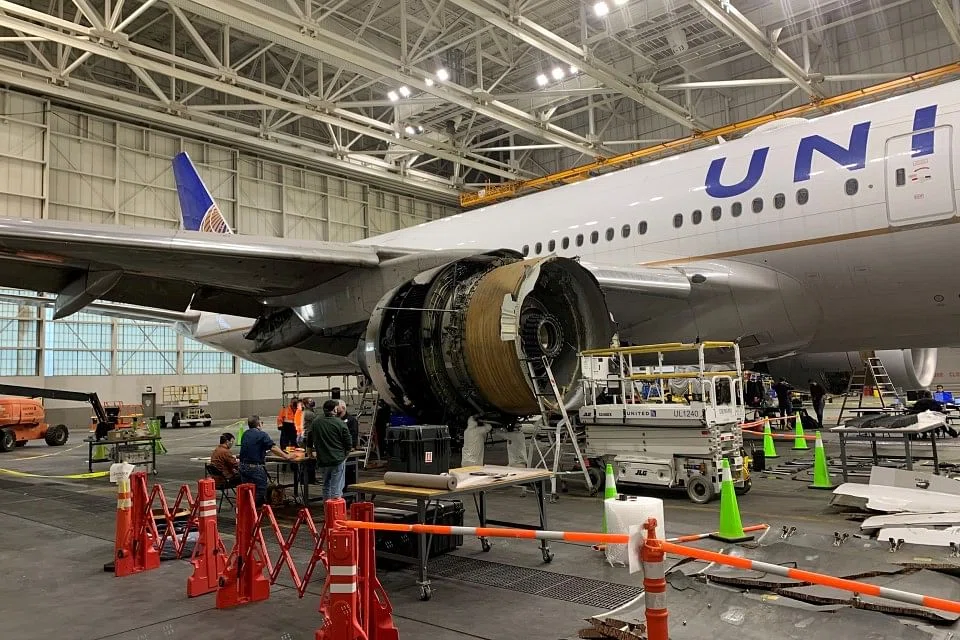
THE often quoted bromide that it is safer to fly by air than to cross the road does little to salve the nerves of frequent flyers and disconsolate chickens when aircraft engines start exploding. After all, the engine is what keeps these metal cylinders aloft in a precarious tussle with gravity as weight, thrust, lift and drag battle one another.
Yet, aircraft engines do give out, and quite frequently. But all is not lost. Despite the spectacular Feb 20 United Airlines (UA) engine blowout over Denver that resulted in the grounding of several older B777-200s and 300s using Pratt & Whitney 4000 engines, most such failures in recent years have not resulted in fatalities.
This is due in part to lessons learned after a tragic crash landing at Sioux City, Iowa, in 1989 involving a UA DC-10 whose tail engine exploded sending deadly shrapnel through the fuselage, crippling hydraulics. Aircraft manufacturers took a long hard look at jet engine design and placement to better protect vital control systems and to limit catastrophic failures.
On Nov 4, 2010, a Qantas A-380 flight en route from Singapore to Sydney suffered a midair engine blowout that ripped the rear cowling, showering debris over the Indonesian island of Batam. The plane turned around and executed a safe landing at Singapore's Changi Airport. No one was hurt in that incident. Rolls-Royce had a long hard look at its Trent 900 engines to uncover a fault in the turbine oil feed.
The most recent incident over Denver with UA points to metal fatigue involving the giant fan blades. A few years ago a broken fan blade in a PW4000 engine disrupted a flight from San Francisco to Honolulu.
More recently, in December 2020, a Japan Airlines B777-200 bound from Naha to Tokyo suffered two broken fan blades. Both flights landed without further incident. Boeing estimates 120 aircraft, half of them currently grounded due to Covid-19, use this particular engine. All are in Japan, South Korea, or in the United States (with UA).
The PW4000 is not the only gear under scrutiny. On Sept 30, 2017 a GE-Pratt & Whitney engine blew up on an Air France A-380 en route from Paris to Los Angeles, forcing an emergency landing in Newfoundland. The culprit once again was a broken fan blade.
Why do aircraft engines keep exploding? It is not the most reassuring thought for a would-be passenger who must now factor in yet another potential calamity on top of Covid-19 quarantines and general travel stress.
Unlike a car engine, a jet engine is capable of withstanding extraordinary punishment, especially during the takeoff and climb when the power demand is up at 100 per cent. Even while cruising, the engines are severely taxed, working at 75 per cent of capacity or more. Cars accelerate with a burst of power that then drops dramatically while cruising. Car engines are not built to withstand 2,800 revolutions per minute (rpm) non-stop.
Aircraft engines perform complex functions with few moving parts. The entire process could be described simply as - inhale, squeeze, ignite, exhale.
A PW4000 engine may have fan blades running at up to 5,000rpm with the high-pressure spool doing 20,000rpm. That is a lot of wear and tear. And this is where most of the problems have occurred. The fan blades suffer inevitable fatigue and develop cracks. The good news is that these cracks can be detected through ultrasonic or thermographic testing and maintenance procedures are tightening up all the time.
The bad news is that even with an engine in tiptop condition, aircraft can suffer mysterious maladies. Pilots have fallen asleep at the cockpit (missing their destination entirely), fuselage skins have peeled off leading to a sudden drop in cabin pressure, passenger aircraft have landed at the wrong airports (more often than you think), bird strikes have given us heroic headlines (Miracle on the Hudson with Captain Chesley Sullenberger's riveting water landing), planes have disappeared (MH370), and some simply ran out of fuel (Air Canada's Flight 143).
On July 23, 1983, an Air Canada B-767 found its fuel tanks empty 40,000 feet aloft, a bit far from the gas station. With the recent switch to the metric system, there had been a catastrophic miscalculation on fuel intake. Halfway between Montreal and Edmonton, things "got quiet - real quiet".
Fortuitously, with an experienced glider pilot at the controls, the plane landed, sans power and instruments, at an abandoned military airfield in Gimli that had been converted to a racetrack. All 61 passengers deplaned safely without serious injuries. Those on the ground had a miraculous escape too.
The Gimli Glider, as it came to be known, is cause for celebration. That impossible gliding feat carved its name in the annals of aviation history, proving that a large and heavy unpowered metal canister can indeed fly. The two Air Canada pilots were briefly suspended and demoted but were later presented an award for "outstanding airmanship".
So let us focus on the bright side. Chickens still cross the road. And we should be flying soon, swabbed, tested, certified, sprayed, wiped, vaccinated and in full personal protective equipment, like American footballers heading for a samurai convention.
- The writer is a Hongkong-based journalist, columnist and the editor of AsianConversations.com and SmartTravelAsia.com