Europe: Stocks sapped by weak economic data, travel curbs
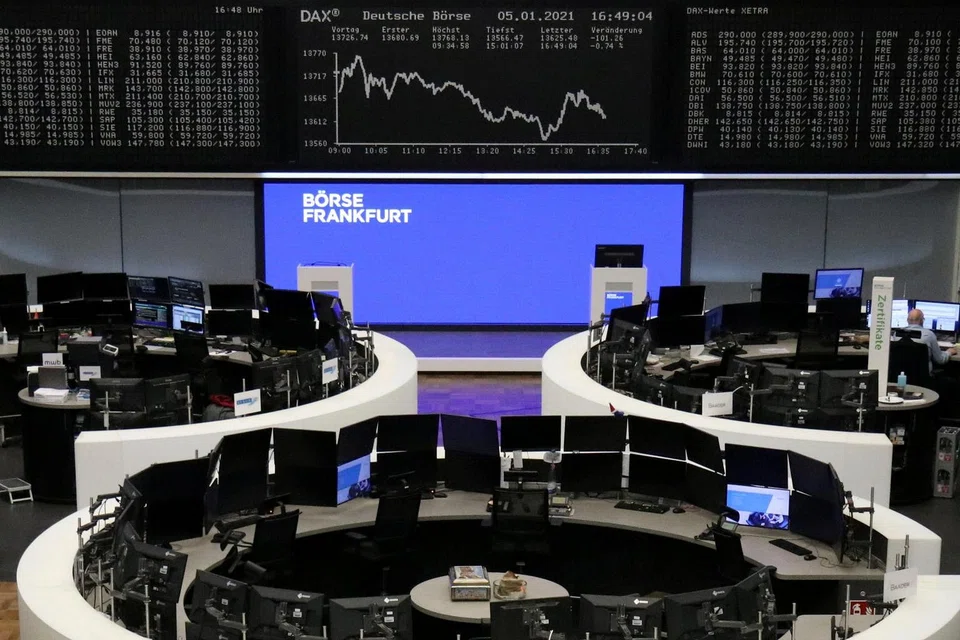
[BENGALURU] European stocks ended lower on Friday, closing out another lacklustre week as business activity in the euro zone shrank in January after stringent lockdowns to control the coronavirus pandemic shuttered many businesses.
The pan-European Stoxx 600 index fell 0.6 per cent, but clung to a small 0.2 per cent rise for a week, dominated by hopes for massive US stimulus under President Joe Biden.
Travel and leisure stocks fell 2.5 per cent, leading declines among sectors amid concerns over fresh travel restrictions in Europe. Other economically sensitive sectors like banks, oil & gas and mining shed more than 1 per cent.
IHS Markit's flash composite Purchasing Mangers' Index (PMI) for the euro zone fell further below the 50 mark separating growth from contraction, hitting 47.5 in January from December's 49.1.
The bloc's dominant service industry was hit hard with hospitality and entertainment venues forced to remain closed, but manufacturing remained strong as factories largely stayed open.
The auto-heavy German DAX fell 0.2 per cent, France's CAC 40 dropped 0.6 per cent, and euro zone stocks were down 0.6 per cent.
The sealing of a post-Brexit trade deal, unprecedented stimulus measures from central banks and governments, and hopes that Covid-19 vaccines will spur a faster economic rebound drove the Stoxx 600 to a near 11-month high this week.
"There is quite a big discussion in the market on whether the consensus is too bullish, or if we need to have a pullback," said Graham Secker, chief European equity strategist at Morgan Stanley.
"I think this is more about the fact the markets had a strong run over the past few months. Maybe it gives people an excuse for some profit-taking.
"While the long-term narrative is intact, the market tends to give the benefit of doubt."
A European Central Bank survey showed the euro zone economy is likely to rebound this year - but at a slower pace than expected only a few months ago - before making up the lost ground in 2022.
Germany's Lufthansa, Air France and British Airways-owner IAG fell between 2.5 per cent and 3.4 per cent, while holiday group TUI tumbled 17.2 per cent after the European Union proposed to label hotspots of Covid-19 infections as "dark red" zones.
Travellers from those areas will have to take a test before departure and undergo quarantine.
The UK's FTSE 100 fell 0.3 per cent and midcap stocks slid 1.0 per cent after Britain's retail sales marked a weak end to their worst year on record in December, while business activity contracted sharply in the latest month.
Italian stocks fell 1.5 per cent after the country's main ruling parties flagged snap elections as the only way out of its political impasse if Prime Minister Giuseppe Conte fails to drum up a parliamentary majority after scraping through a confidence vote this week.
Helping limit losses in Germany's DAX, engineering group Siemens AG jumped 7.3 per cent on stronger-than-expected preliminary results for its first quarter.
The world's largest carmaker Volkswagen rose 1.9 per cent as a rebound in premium car sales in China and stronger fourth-quarter deliveries helped keep it in the black last year, though its profit almost halved due to the impact of the pandemic.
REUTERS
Decoding Asia newsletter: your guide to navigating Asia in a new global order. Sign up here to get Decoding Asia newsletter. Delivered to your inbox. Free.
Share with us your feedback on BT's products and services