

Palm oil stocks may shine with CPO prices out of the woods
After plumbing lows last year, palm oil prices have kicked off 2019 strongly as India cuts import taxes and inventories run down

Singapore
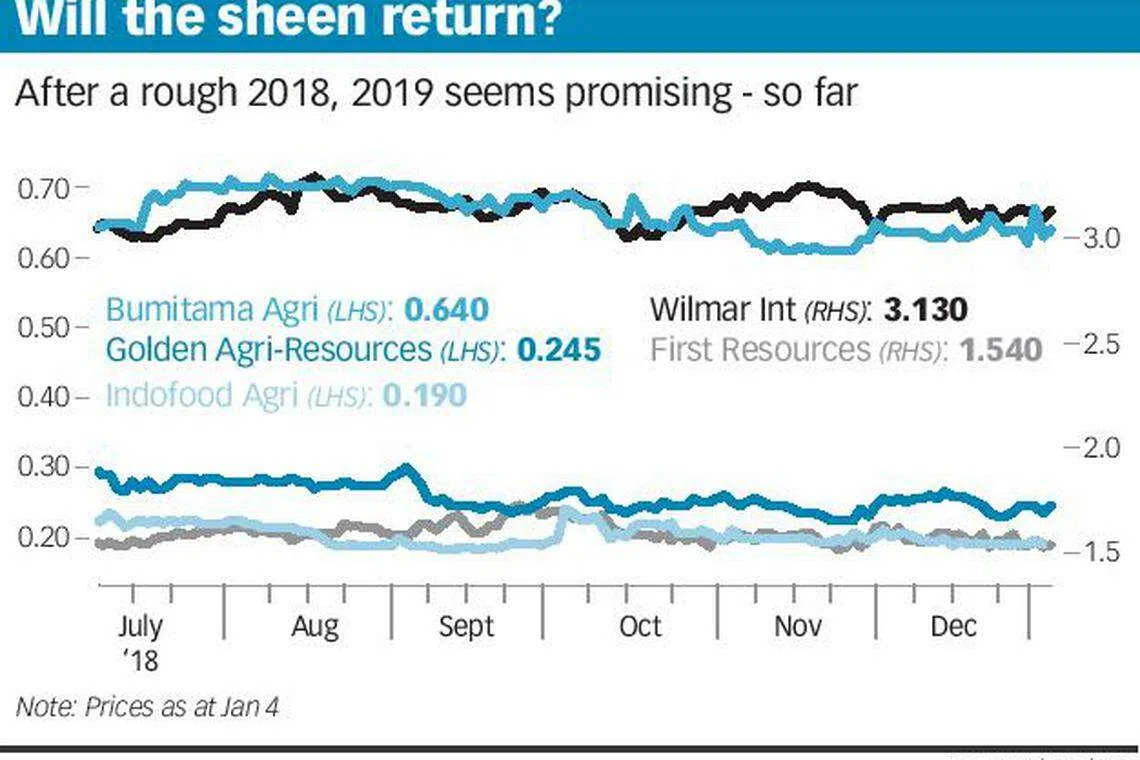
AFTER languishing for much of 2018, Singapore-listed palm oil stocks could be looking at a new dawn this year on renewed demand, sliding inventories and other factors.
For palm oil majors like Wilmar International, Golden Agri-Resources, First Resources, Bumitama Agri and Indofood Agri Resources - together, they command a market capitalisation of over S$27 billion - the key driver reigniting interest is India.
The country cut import taxes on the commodity on Jan 1, which shifted the price needle as it is the world's largest consumer and importer of the edible vegetable oil. The move has flowed through to crude palm oil prices (CPO), which could tick even higher after falling over 18 per cent last year to new lows in late-2018.
Fuelled by the CPO price gains, the Singapore-listed "agri-plays" are up nearly 2 to 5 per cent in just the first trading week of 2019.
According to DBS Group Research, CPO prices tend to peak in March, deemed a seasonable sweet spot, and bottom out just before mid-October followed by a 2-3 month price recovery.
Last year, CPO spot prices plumbed a low of RM1,717 per tonne on Nov 21. But the factors behind the fall - elevated CPO stock levels, bumper crops out of Indonesia and falling Brent crude oil prices - have since abated. Crude oil competes with CPO demand in the biofuel market, with the latter accounting for nearly 30 per cent of global palm oil consumption.
Since the low, CPO prices have rebounded and capped the year at RM1,952 per tonne while CPO three-month futures are currently trading around RM2,159 on the Malaysia Derivatives Exchange.
Maybank Kim Eng is among the brokerages that believe the worst is over for the crude palm oil market. The house is hopeful that the latest move by India, which gets most of its supply from Malaysia and Indonesia, will give palm oil a "good chance" to regain market share after losing ground to sunflower oil following India's more punitive import duty hike on palm oil in Nov 2017 and again in March 2018.
India cut its import duties this year on crude and refined palm oil from South-east Asia to comply with preferential trade pacts with the region agreed upon years ago.
While the south Asian nation is a major driver, other factors are also at play to back the sanguine outlook for the sector this year.
Early last month, Indonesia tweaked its palm oil export levy such that there will be zero export levy if CPO prices are less than US$570/tonne, hence creating a more level playing field for Malaysian refiners/exporters. This could also help reduce high stockpiles faster and lift prices further.
Inventory restocking by another big consumer, China, following weak imports last year arising from trade wars could also be a boon for the sector, said Indonesia-based analyst at DBS Group Research William Simadiputra.
On the back of the more rosy supply and demand dynamics, he expects CPO prices to recover by 7 per cent year-on-year to US$610 (RM2,560) a tonne this year. But one analyst did not share the exciting prospect and dismissed the possibility of such a sharp spike in 2019.
UOB Kay-Hian said the upturn could most likely happen in the second half as inventories are drawn down on lower production growth for 2019, as Indonesia slows production increase after two straight years of bumper crops. It pointed out that global palm oil production is expected to grow 5.1 per cent year-on-year this year versus 6.1 per cent in 2018; in 2017, it grew 14.8 per cent.
A stronger US dollar could also benefit firms like First Resources and Wilmar International as they report their revenues and earnings in US dollars while their cost is mostly in rupiah. But the impact may fade as the greenback has recently come under pressure on expectations the US Federal Reserve may apply brakes on its tightening cycle in 2019.
One factor that is harder to predict is the weather.
In terms of weather disruptions, the National Oceanic and Atmospheric Administration's (NOAA) climate scientists recently warned of a 90 per cent chance of El Nino forming in the first quarter of 2019 and a 60 per cent chance that it will continue into the spring 2019.
Analysts say the risk of El Nino weather could be a potential price catalyst as this will disrupt production patterns in general, and is price supportive. The last strong El Nino in 2015 had led to a 5.6 per cent drop in global palm oil production.
However, the probability of another strong El Nino, based on past occurences, is low, opined UOB Kay-Hian.
On the negative side, "external risks still abound", said RHB Research in a report last month, referring to trade war uncertainties, direction of crude oil prices and potential policy changes by producing and consuming countries.
For the big regional planters, DBS' Mr Simadiputra said they will continue to face challenges on how to grow their business on the back of limited available land bank as well as the environmental and health concerns raised in developed countries on palm oil consumption, some of which have been disputed by CPO producers.
TRENDING NOW

Easy to rent out, hard to sell: Are buyers losing interest in Singapore’s one-bedroom condos?

GovTech retrenches another 38 staff in second round of layoffs

Stocks to watch: Seatrium, CapitaLand Investment, Keppel DC Reit, Suntec Reit, CLCT, TSH Resources

World’s largest offshore wind platform by Seatrium consortium on track to be completed by 2028

