

SGX RegCo to get more powers to speed up disciplinary action
It's proposing to take on powers to mete out public sanctions, except for fines


Singapore
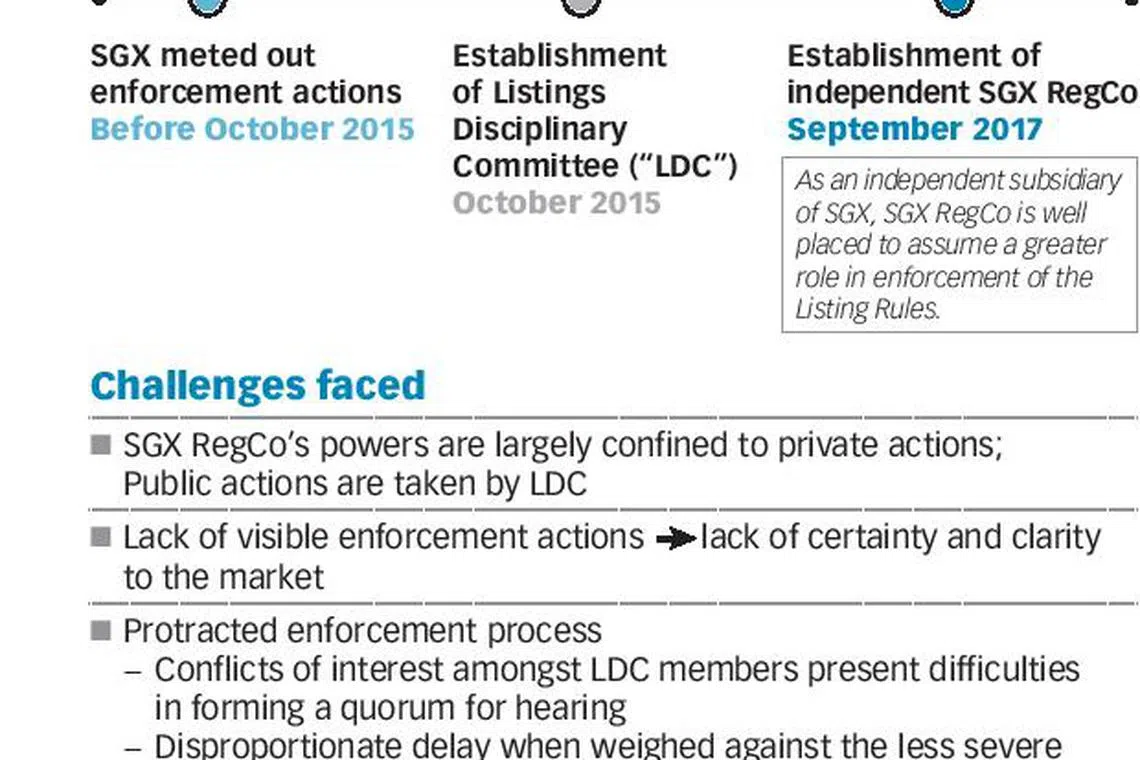
THE Singapore Exchange Regulation (SGX RegCo) is looking to sharpen its enforcement teeth by taking on some of the disciplinary powers that previously resided in what market observers say has been a rather ineffective industry-led Listings Disciplinary Committee (LDC).
On Thursday, the frontline market regulator unveiled proposed changes to the listing rules relating to its enforcement and disciplinary framework as well as whistleblowing regime. It said there is a need for SGX RegCo to be able to independently exercise a broader range of sanctions in order to deal swiftly with breaches of the listing rules. This would allow SGX RegCo to maintain investor confidence and preserve market integrity.
Tan Boon Gin, SGX RegCo's chief executive officer, said the regulator's current enforcement power is confined to private actions. Harder-hitting public actions - such as fines, suspensions or expulsions - can only be exercised by the LDC.
The latter consists of independent professionals and corporate bigwigs, and has not been able to act as quickly as investors would wish.
"SGX RegCo is acutely aware of the perception that few public enforcement actions have taken place in recent years. We are proposing to widen the scope of direct disciplinary actions available to us so as to speed up the disciplinary process," Mr Tan said.
"Our proposal is therefore for SGX RegCo to have the powers to impose all the public sanctions that the LDC can impose, except for fines. Fines are the most severe sanction in our arsenal and one of the reasons why we introduced the LDC, so the LDC will continue to have the exclusive ability to administer fines."
Delays in enforcement actions
Since the formation of the LDC in October 2015, there have been 18 notices of charges pending before the LDC. Only three have been heard.
"The process of arriving at an outcome for each public enforcement action has taken far longer than anticipated," Mr Tan said. "To the public and the media, this has been interpreted as a lack of enforcement altogether."
The LDC already has a heavy caseload as it has to hear all cases that involve public sanctions and fines. In addition, requirements to ensure the independence of the LDC members have caused delays in getting the quorum for a hearing.
This is compounded by the fact that the community of corporate finance professionals in Singapore is small. This results in conflicts of interests in the form of dealings or engagements with the alleged offender or their counterparties.
Giving SGX RegCo the powers to impose all public sanctions excluding fines will make "a very big difference", Mr Tan told The Business Times.
"We are doing two things: Spreading the caseload out between RegCo and the LDC, and this will also address directly the conflict issue that is slowing down the process currently."
Mr Tan shared that the conflicts went beyond links to a company, but also links to the company's bankers, lawyers, auditors, consultants and all the company's counterparties.
When there are conflicts, members recuse themselves, even if they discover the conflict late and it means that the process of trying to form a hearing committee that satisfies quorum and independence has to start all over again.
Mr Tan said: "Because RegCo is independent, we will not face the same conflicts issues as the LDC. And by sharing a large part of the caseload, we also free up the LDC to focus solely on the cases involving fines, thereby achieving the speedier enforcement outcomes that the market is asking for."
Faster enforcement
The formation of LDC in late 2015 was largely welcomed by market watchers as it addressed the perception of conflict of interest between SGX's own commercial and regulatory roles. But since then, SGX has hived off its regulatory function from its commercial operations with the creation of SGX RegCo in September 2017. As an independent office, SGX RegCo is able to enforce the requirements of the listing rules and fulfil its regulatory functions, as well as maintain market integrity and discipline.
Given that other regulators, such as the Monetary Authority of Singapore, the Accounting and Corporate Regulatory Authority, and the Commercial Affairs Department, have the statutory authority to impose civil penalties, criminal fines, and jail terms, SGX RegCo can place more emphasis on speed and clarity of enforcement outcomes.
It also wants to introduce a rule requiring an issuer under investigation to seek its approval before directors can be appointed or re-appointed to the issuer's board.
Similarly, directors under investigation will need SGX RegCo's approval before their appointment or reappointment to the board.
These amendments would enable SGX RegCo to prevent potentially culpable individuals identified in special audit reports from remaining on the board of directors to impede regulatory investigations or actions. It also gives the regulator the discretion to take pre-emptive action to prevent the appointment or re-appointment of dubious characters.
In addition, SGX RegCo is proposing that companies disclose in their annual reports how they implement their whistleblowing policy and ensure that the identity of the whistleblower is kept confidential.
READ MORE: A resounding Yes! to faster SGX enforcement actions
TRENDING NOW

Olivia Lum, ex-CFO not giving evidence in their Hyflux trial

Bank on AI-resilient Singapore property via deep-value listed property groups

Positive pivot or premature? Analysts split on Keppel Reit’s S$610.9 million buy

Once staunchly pro-China, Malaysian Chinese businesses are now distancing themselves from Beijing

