Spreading trade war, Dow dive spark Asia markets sell-off
But prognosis for regional markets not dire given their relatively low valuation

Anita Gabriel
Singapore
THE overnight bloodbath on Wall Street triggered sell-offs in Asian equities on Thursday, unsettling markets already mired in poor global data, a spreading trade war, Brexit jitters and Washington's impeachment saga.
Oil prices also tanked after an unexpected rise in US official crude inventories, adding to the string of worrying economic news and heightened recessionary fears.
"The trade winds of the dispute between the US and China have blown chill across the world for much of 2019. Those same winds appear to be upgrading to cyclone force now as they approach the United States," remarked Oanda's senior analyst for Asia Pacific, Jeffrey Halley.
A new battle shaped up on the trade front after the US said it will impose tariffs on the European Union goods from Oct 18, sending chills across Asian markets.
The single biggest uncertainty remains US President Donald Trump, whose trade war game plan eludes the market. Does he deem an active trade war good or bad for his political ambitions as the 2020 election looms?
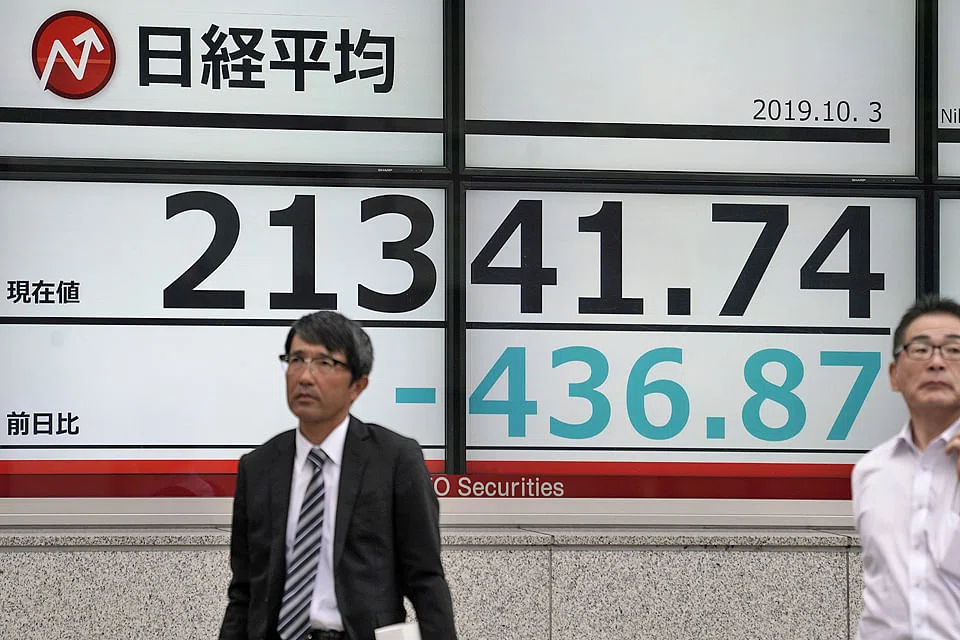
On Thursday, Japan's Nikkei 225 tumbled 2 per cent, Malaysia's key gauge lost 0.7 per cent while in Singapore, the Straits Times Index closed 0.5 per cent lower and Australia's ASX 200 fell 2.2 per cent. Contrary to expectations that Hong Kong would be most vulnerable given the negative economic impact of prolonged protests, the Hang Seng bucked the trend and gained 0.3 per cent.
Markets in China and South Korea were closed on Thursday for holidays.
Asian markets succumbed to losses after all three US stock indices plunged between 1.6 and 1.9 per cent on Wednesday New York time; UK's FTSE clocked its worst performance since 2016 on Wednesday, plunging 3.2 per cent, spooked largely by the looming Brexit.
CMC Markets' analyst Margaret Yang noted that the downside for major Asian equities looks limited compared to that of the US market.
"Major Asian markets like Shanghai, Hong Kong and Singapore are trading at a price-to-earnings ratio that is at least one standard deviation below their seven-year average. Relatively cheap valuation will help to cushion the downside to some extent," she said.
With stock markets hammered, safe haven assets picked up - spot gold prices topped a key psychological mark of US$1,500 per ounce and the Japanese yen snapped a four-day losing streak and rebounded against the greenback.
Earlier US economy figures had inspired hope over its resilience amid a slew of dismal manufacturing data from its developed peers.
But its latest private-sector employment data missed expectations and ignited worries that consumer spend, the US economy's brightest spot, may be starting to crack.
This further stoked fears that the global economy was steadily deteriorating as a result of the trade wars.
Schroders chief economist and strategist Keith Wade has cut global growth forecasts for this year and 2020 to 2.6 per cent from 2.8 per cent and 2.4 per cent from 2.6 per cent respectively.
"If the forecast is realised, global growth in 2020 would be similar to 2008, just before the great recession of 2009," he said, adding that a "global recession" scenario where there is a synchronised slowdown in global activity may be the "likeliest risk".
All of that has raised expectations of a rate cut by the Federal Reserve but there are outliers. "...with Markit Manufacturing PMI's ex Europe printing respectable figures this week - lost in the noise - I think it would take a major miss by Friday's non-farm payrolls (for September) to make the Fed blink," Mr Halley reckoned.
In Singapore, amid a stagnating economy and low core inflation, analysts say it's a shoo-in for the Monetary Authority of Singapore (MAS) to ease its monetary policy stance at the mid-October meeting. If this happens, it would mark the central bank's first easing since April 2016 and would follow two consecutive rounds of tightening in April and October 2018.
The renewed policy easing by global central banks coupled with resultant near-zero to negative cash and bond yields could draw the pool of global savings towards equities, opined DBS Bank chief investment officer Hou Wey Fook.
"We argue that institutional funds - the likes of sovereign wealth, pension, insurance, and endowment portfolios - have little choice but to turn to equities.
"Barring a full-blown trade war, this prospective rotation in asset classes is one of the principal reasons why we stay constructive on equities," Mr Hou said.