

Deep tech, clean tech bring the cool to CES
Las Vegas
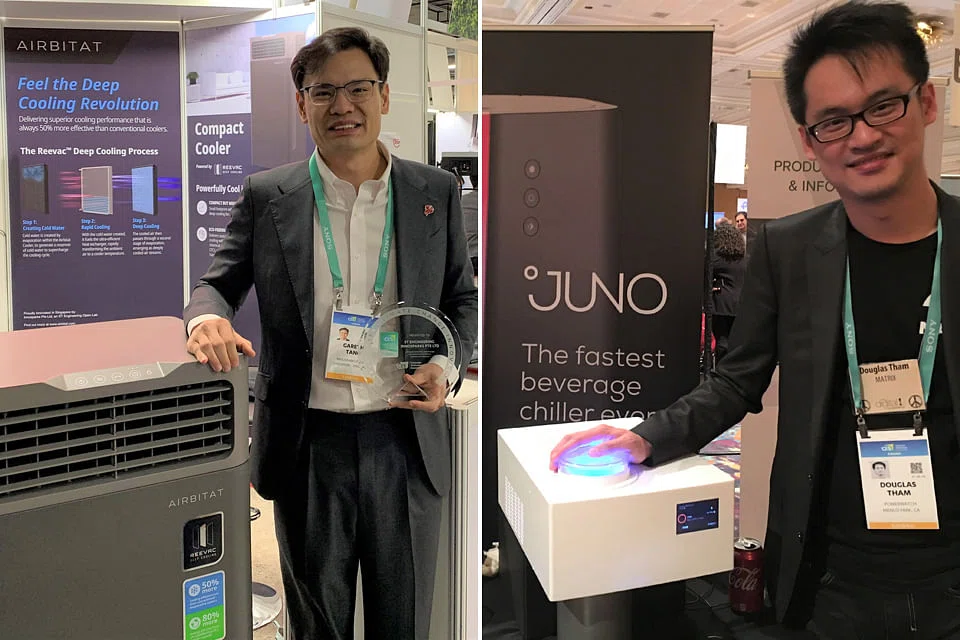
THEY call it a microwave, but for cooling. Place a bottle of soda in the new drink cooler designed by deep tech firm Matrix and in 60 seconds, it's ice cold. A bottle of champagne can be chilled in less than five minutes.
That's the power of thermoelectric cooling, explained Matrix chief technology officer Douglas Tham at the CES tech show in Las Vegas where the gadget was launched this week.
Matrix's Juno cooler makes use of the fact that when a voltage passes through a thermoelectric material, it heats one side and cools the other, creating a huge temperature difference on either side.
Matrix has found an efficient way to use this effect - the Peltier effect - to refrigerate drinks.
In the prototype on display, a can of Coke is spun in a water bath controlled by a spinning algorithm while heat is sucked out. The Coke didn't explode in anyone's face when the can was opened, and was cool down the throat.
The heat sink on the prototype may be quite large, but it's smaller in the final product that ships in August.
Mr Tham wants consumers to picture Juno next to their coffeemaker, instead of a mini-fridge.
"We believe that Juno has a role to play toward reducing our environmental impact with its on-demand rapid cooling technology using no harmful chemicals and greenhouse gases," he told The Business Times.
Mr Tham, a Singaporean based in Silicon Valley, co-founded Matrix with Akram Boukai in 2011. They both have PhDs in Chemistry from Caltech, and have used their research to build Matrix's core competencies in materials science, chip design and thermal engineering.
In 2018, they delivered their first consumer product, a smart watch powered by body heat which never requires charging - thermoelectric material is used to generate electricity from heat instead.
From there, the Juno cooler was a natural progression, Mr Tham explained: "We looked at our Power Watch and thought, why not reverse it?"
Other projects that Matrix has in various stages of development include self-cooling garments for firefighters, electric vehicle coolants and better ways to cool server farms.
Another company that's playing it cool at CES is Innosparks, the open innovation lab of Singapore's ST Engineering.
Innosparks won a Climate Change Innovator Award from the show organiser for its new Airbitat Compact Cooler, which it describes as the world's coldest portable evaporative cooler that consumes 80 per cent less electricity than an air conditioning unit of similar capacity.
The first Compact Cooler units will be ready for distribution in June. Gareth Tang, head of Innosparks and one of the engineers behind Airbitat, was at CES to look for distribution partners in the US.
The booth was busy when BT visited on Tuesday, the first day of the show.
Mr Tang said: "Climate change is a real thing and air conditioning use is the number one driver of electricity usage in households. The more we use air conditioning, the hotter is the environment. This is the urban heating effect. We want to champion sustainable cooling solutions."
Whereas standard air conditioning units require energy-hungry compressors to circulate the refrigerant, which results in waste heat production, Airbitat runs on its own deep cooling technology.
This technology requires no compressor or refrigerants. Cold water is used as a natural refrigerant.
When water is poured into an Airbitat cooler, it's chilled by evaporation to create a reservoir of cold water that rapidly cools the ambient air. The cooled air then passes through a second stage of evaporation, emerging as "deeply cooled" air streams.
In tropical Singapore, if it's 32 degrees celsius outdoors, Airbitat can bring it to as low as 24.7 degrees celsius, Mr Tang said.
"We're bringing industrial strength to cooling in a compact form factor," he said. The Compact Cooler improves on Airbitat's earlier design for the outdoor City Cooler.
For his next act, Mr Tang wants Airbitat smaller, and further indoors: "Our next generation solution will be an indoor, building-integrated solution to reduce air conditioning loads in buildings."
TRENDING NOW

Singapore identifies 7 firms responsible for haze fires, notices issued urging action: Grace Fu
‘How many will survive?’: Bubble fears arise as China’s humanoid robotics face reality check

GIC-backed Bank Jago sees wealth management as next growth engine as Indonesian investor base grows
Ageing in Asia: Huge potential for the consumer economy

