Excelpoint rides Vietnam's tech boom as more firms adopt a China+1 supply chain model

Singapore
BACK in 2008, homegrown Excelpoint Technology made its foray into Vietnam and set up its first representative office at Ho Chi Minh City. Around the same time, Samsung Electronics and Intel opened large semiconductor manufacturing plants in Vietnam.
Then, the country's basic infrastructure was at its infancy. The Internet connection was so slow and unstable that its staff preferred to work from hotel rooms instead of the office.
Fast forward 13 years, and the Singapore Exchange mainboard-listed company finds itself strategically at the epicentre of the tech boom in Vietnam, where the semiconductor market is projected to grow by more than US$6 billion in the next 3 years, at a compound annual growth rate of almost 20 per cent according to Technavio.
"Our goal then was to gain a foothold in Vietnam as we saw Vietnam as a gateway to the Indo-China market. Little did we know back then that Vietnam's global electronics and semiconductor industry was to grow at such a massive scale," says Albert Phuay, 64, Excelpoint's chairman and group chief executive officer.
Phuay founded Excelpoint in 1987 and built it from a one-man operation into a thriving electronics component company with more than 700 employees.
Its distribution channels spans over 50 cities across more than 10 countries, including China and the US.
Today, Vietnam is one of Excelpoint's fastest growing key markets, where it has 20 employees, mainly Vietnamese, based at its Ho Chi Minh and Hanoi offices.
"It will continue to remain an important market for our business. In the next few years, we want to grow our Vietnam market in the areas of artificial intelligence (AI) and Internet of Things (IoT), industrial automation, urban development, telecommunication equipment and more," he says.
Growth will be driven by the Vietnam government's strong push to drive technology adoption and economic transformation, fuelling rising demand for solutions in 5G and wireless connectivity as well as in infrastructure projects and e-government applications.
From a low-income status in 2008, Vietnam is now among the 40 largest economies in the world and the fourth largest among the Asean economies.
Per-capita income has risen seventeen-fold to more than US$3,500, putting Vietnam on par with middle-income countries.
The country is also among the world's fastest developing countries in information technology (IT), with 70 per cent of the population having access to the Internet.
While China currently dominates as the world's largest factory, Phuay reckons that this is likely to change in the future, as companies diversify away from a single source, and seek a China+1 model.
"We are seeing the manufacturing power rapidly shifting from China to Vietnam," he says, noting that multinational corporations like Qualcomm, Intel and NXP Semiconductors are setting up representative offices in Vietnam to be strategically and geographically close to their customers.
"We foresee Vietnam emerging to be a global logistics and manufacturing hub. This means that in future, we can avail ourselves of more manufacturer options and be less reliant on a single source," he adds.
According to Vietnam's General Statistics Office, the country attracted an estimated foreign investment of US$23.8 billion in the first 10 months of this year, up 1.1 per cent year on year.
Among places with newly licensed investment projects in Vietnam during the period, Singapore was the largest source of registered capital.
Phuay says: "The electronics manufacturing service (EMS) providers are next to follow suit. This trend will likely coincide with the local government rolling out tax incentives to spur the manufacturers and EMS providers to procure their parts directly in Vietnam, instead of from overseas. This would definitely bode well for our Vietnam business."
The Covid-19 pandemic has resulted in a surge in digitalisation, which in turn has led to a shortage in global chip supplies.
"This has worked out to be favourable for our business as our sales across all our regions have surged above our expectations and have resulted in better profit margins," Phuay said, adding that product delivery lead times and planning are more crucial than ever to ensure customers' orders are met.
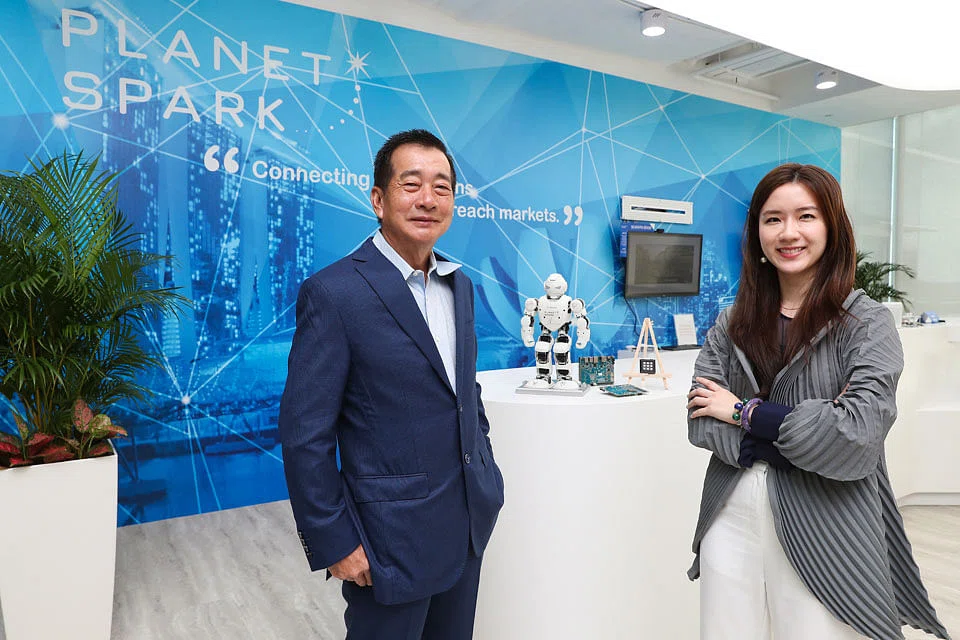
Recognising the importance of developing its own intellectual property to move up the value chain and to increase its business resilience, Excelpoint launched PlanetSpark Innovation Centre this year.
Phuay's daughter, Phuay Liying, oversees the hardware accelerator, which has a co-investment value of S$5 million from Excelpoint and Enterprise Singapore, and aims to enable technopreneurs to make a rapid transition from concept to production and commercialisation.
It has since launched its own flagship single board computers and has embarked on a number of initiatives with ecosystem partners. One of these initiatives is the Vietnam Smart City Consortium.
Since August this year, Excelpoint has collaborated with Enterprise Singapore to be the lead organisation of the Vietnam Smart City Consortium tasked with leading 18 Singapore SME members to spearhead market development efforts in Vietnam.
Phuay likens Excelpoint's role to that of a "big brother" to the consortium members, providing guidance, and facilitating project activities, evaluating and match-making members to work on proof-of-concept projects to fulfil customer requirements.
As the lead organisation, Excelpoint also supports consortium members by sharing its valuable market intelligence, sales channels and research and development facilities, as well as helping members connect with ecosystem partners of PlanetSpark to spur collaborations.
Phuay says collectively, the consortium can offer a much more robust technology portfolio.
"With our complementary technology portfolio spanning image detection, high speed data connectivity, energy management, edge computing, and more, the consortium members (including Excelpoint) have a higher chance of successfully bringing their solutions to the Vietnam market to address Vietnam's Smart City problem statements in the Smart Security, Smart Sustainability, Smart Mobility and Smart Community space," he says.
As with any overseas ventures, the road is never bumpfree. Phuay says one of the challenges Excelpoint faces is to entice employees to stay for a longer term.
"The millennials are generally more restless, and they tend to make choices based on short-term goals. We place great emphasis on employee engagement and welfare, working with them on career planning and nurturing them. Our country head even goes the extra mile to plan social and match-making activities to help our employees meet their future spouses," he shares.
Over the years, the company also learnt about the cultural differences between people from North and South Vietnam.
"The Southern folks are more Westernised whereas the Northern folks are still influenced by their Communist past. This subtle divide can create some barriers in communication and team building, so this is something to be mindful of when doing business and working there," Phuay shares.
READ MORE: Singapore is top investor in Vietnam for 2nd year running