

I, Robot
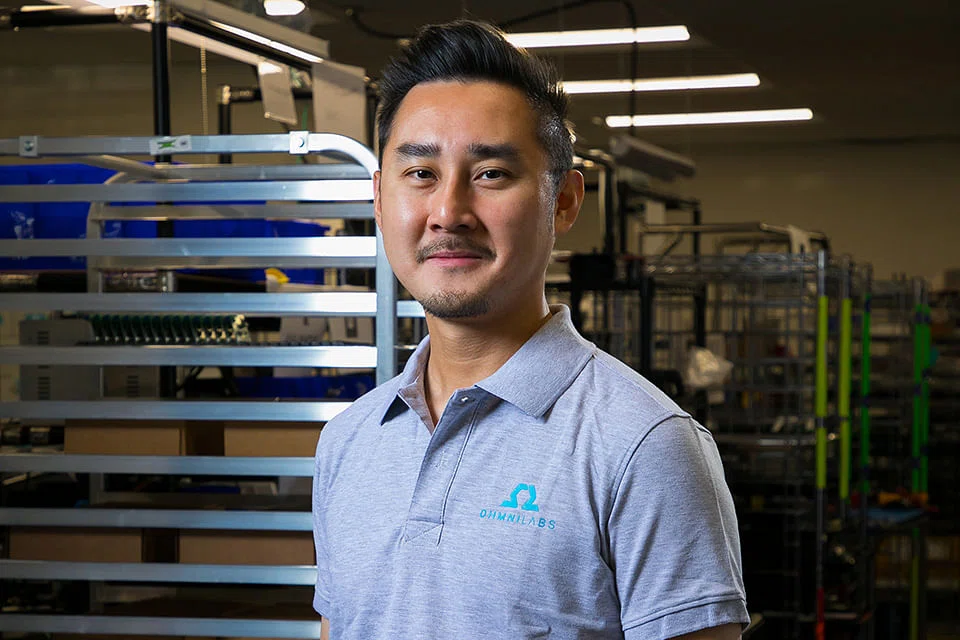
Tan Tingxi, chief product officer and co-founder of OhmniLabs, says the current global situation has resulted in surging interest in the firm's telepresence robots.
YOU are separated from your family, with no means of getting to them physically. You miss a call from them in the dead of the night. When you try to reach them again, nobody picks up. Panic ensues.
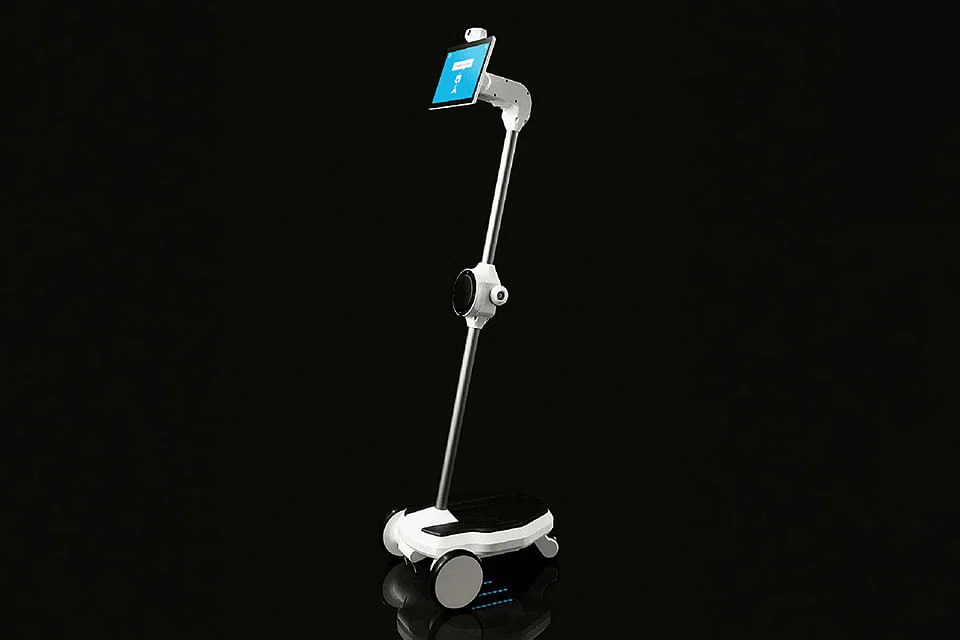
Vancouver-based Tan Tingxi never has that problem. He simply logs on to the remote-control robot docked in his parent's Singapore home. It is his eyes and ears as he directs its movements between rooms. When he finally locates his folks, he communicates with them through the robot, too.
"You can think of telepresence as video calls on wheels, but it is more than that. The human-height of the unit, the tilting neck that allows the user to change his perspective... it all makes the experience more emotive and natural. And it beats paying neighbours to keep an eye on your family when you are far away!" says the Singaporean chief product officer and co-founder of OhmniLabs, a Silicon Valley-based telepresence robotics company.
Opening up new markets
Holding a Master's in Computer Science, the robotics enthusiast previously worked in a research lab specialising in large-scale distributed computing and cloud computing methodologies. He was also the engineering director at an enterprise networking start-up, where he led a multidisciplinary team to make hardware and software products for cellular networks.
Mr Tan co-founded OhmniLabs with two other partners in 2015. They were all based in North America while their parents resided in Asia, and they wanted a better solution to communicate with their families. "The telepresence robotics industry was not entirely new then, but the options on the market - largely targeted at business users - were not accessible to the domestic consumer. You have to fork out US$100,000 for top-of-the-line models and US$50,000 for mid-tier options. The most 'affordable' option was US$5,000. But few individuals and even homes for seniors would spend that kind of money," notes Mr Tan. "Being techies, we decided to build one ourselves, and made a low-cost telepresence robot that retains, or even surpasses, the functionalities of the expensive robots."
Launched in 2017, some 2,000 units of OhmniLabs' telepresence robots have been deployed all around the world and the current global situation has resulted in surging interest in them.
"Before, robotic telepresence was more of a novelty than a need. Now, more people are seeing it as an alternative way of interacting with the world while not being able to travel," says Mr Tan. "Since the start of the pandemic, we have deployed more units for telemedicine purposes that allow doctors and caregivers to provide consultations and diagnostics when they cannot be in the same room as patients. Some hospitals are also using them to improve the quality of care for patients in isolation wards by providing them with a means to interact with friends and family."
Not limited to medical and domestic uses, Business Breakthrough University in Tokyo, Japan, recently held a virtual convocation ceremony in March via telepresence robots using OhmniLabs technology. Museums - closed during lockdowns - have also contacted OhmniLabs with an interest to create virtual guided tours.
"With the pandemic, telepresence is getting a lot of traction. People now have a better understanding of the technology," observes Mr Tan, "and will be more interested in contactless solutions that bridge virtual and physical worlds. Teleoperation and telemedicine will also be a big focus and companies already working in that space will see their markets take off."
And, while the world is now plagued with news of pay cuts and lay-offs, the five-year-old company is going through the opposite. "Other companies are firing, but we are ramping up hiring," shares Mr Tan. "Our production has definitely been affected by global supply chains afflicted by social distancing practices enforced in workplaces, but we are diverting all our resources to fulfilling orders for hospitals and clinics using Ohmni to provide urgent care."
The company, which employs 3D-printing technology to produce their telepresence robots, is also using spare production cycles to produce face shields that it donates to medical facilities.
The new normal
The technology's application goes well beyond pandemic times. In Australia, OhmniLabs works with an organisation called Missing School to deploy robots to schools so bedridden children can join classes and connect with friends. It also works with a consortium of children's hospitals in the United States that use the robots to allow young patients in isolation to take part in activities conducted within the hospitals. Such interaction has proven to be critical in keeping them motivated during their recovery.
OhmniLabs also builds custom units for clients, including ANA (All Nippon Airways) Holdings. Dubbed "Newme" robots, the remote-controlled units are designed with virtual tourism in mind. "As people live longer in isolated conditions, they will realise that there are a lot of things they can still do without physically being present. Concerts are streamed online. Museums are offering virtual tours. When airlines are grounded, virtual tourism takes off. I believe telepresence is poised to greatly enhance all these experiences."
Mr Tan also foresees that more will be receptive to robotics after the pandemic. "They will see the good side of using robots that don't spread viruses or break quarantine rules." He predicts: "The proliferation of robots in our daily life will accelerate and new robotics-enabled markets will be made."
As it is, OhmniLabs is already developing robotic tools that will enable businesses to conquer new markets. And, apart from building telepresence robots, the company is also working on "a better robotic stack with autonomy, AI (artificial intelligence) and telepresence programmatic interfaces that allows a business to implement and test its ideas in record time," according to Mr Tan. In non-tech speak: starter kits that allow businesses to customise robots to perform specific functions.
Does this mean we will soon see a telepresence robot in every home and institution? Ironically, Mr Tan thinks otherwise. "Some sources predict that the telepresence robotics market will reach US$312.6 million by 2023. I think that number isn't too far off. The market has expanded because of the situation right now but, in my view, robots with purely telepresence capabilities will always be niche." He adds: "The market isn't going to expand greatly for companies that are just selling telepresence robots. People will start considering telepresence but they will want more from them. Any company that is currently doing telepresence will be looking at ways to have new iterations of its product. I predict that telepresence will become a common feature in other devices in the future."
So, yes, one day - perhaps not too far along - you will be looking for things under your bed through the telepresence function on your vacuum robot. THE PEAK SINGAPORE
Decoding Asia newsletter: your guide to navigating Asia in a new global order. Sign up here to get Decoding Asia newsletter. Delivered to your inbox. Free.
Share with us your feedback on BT's products and services
TRENDING NOW

Britain’s mansion tax shows the difficulty of targeting wealth

Once staunchly pro-China, Malaysian Chinese businesses are now distancing themselves from Beijing

The only common thing in S-E Asia is that we all eat rice: Cisco’s Asean president
Singapore data centre operator DayOne opts for US IPO at likely US$20 billion valuation

