

Advocate for sustainability
If ESG-centred products and practices don't quite yet provide a pricing advantage to firms, they will in the future - fuelled by consumer demand, says Joris Dierckx, BNP Paribas' regional head.

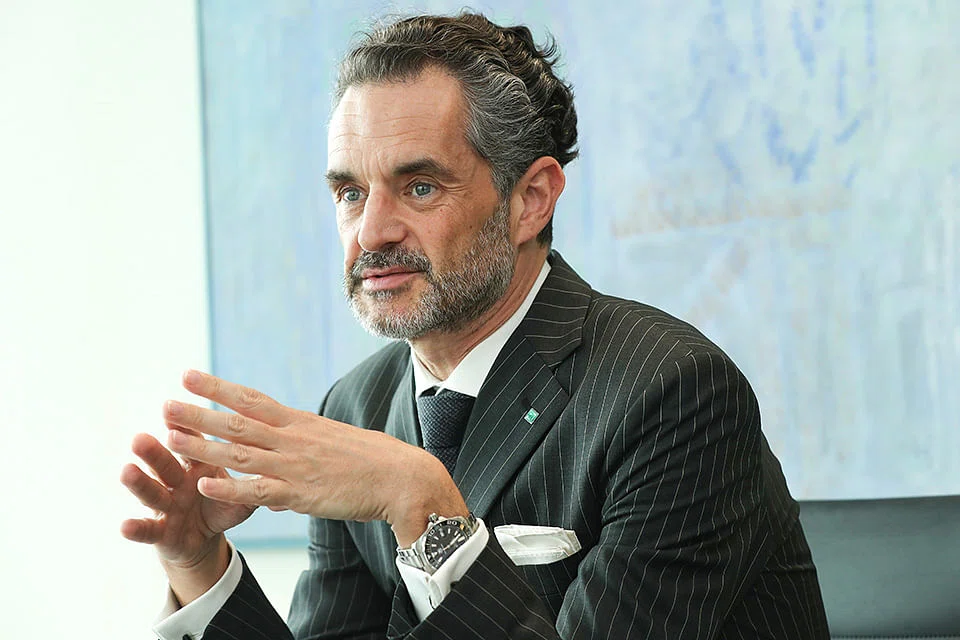
GROWING up in Belgium's port city of Antwerp in the 1980s, Joris Dierckx witnessed village homes disappearing under concrete - his ancestral village was one of those that had to make way for the Port of Antwerp's expansion.
Today, the city is home to Europe's second largest seaport, but all that remains of the village is a lone church tower, Mr Dierckx remarks nostalgically.
Currently the head of Southeast Asia and Singapore chief executive for BNP Paribas, Mr Dierckx takes a keen professional interest in issues relating to environmental, social and corporate governance (ESG), but he says that interest had taken root since his youth.
His encounters with the challenges of economic development continued to be sharpened during the early years of his banking career, especially during a stint in India in the 1990s.
Mr Dierckx recalls: "My role in project finance comprises interactions with grassroots groups and non-governmental organisations, and I saw first-hand the social and environmental issues related to developmental projects.
"These experiences led to a conviction that there is a need for balance - while nurturing economic development for growth is necessary, it is even more imperative to ensure that social and environmental impact is mitigated," says the 51-year-old.
'%3e%3cpath%20d='M12.1475%2025.5262C13.7713%2025.4295%2014.94%2023.913%2014.94%2021.8832C14.94%2019.5359%2013.474%2018.093%2011.5917%2018.093C11.3745%2018.093%2010.9582%2018.093%2010.8393%2018.1413V25.2086L11.8891%2025.5745C11.8891%2025.5745%2012.207%2025.5262%2012.1475%2025.5262ZM11.4934%2017.6281C13.2567%2017.6281%2014.3843%2016.4292%2014.3843%2014.4501C14.3843%2012.372%2013.275%2011.2973%2011.4339%2011.2973H10.8393V17.6305H11.4934V17.6281ZM6.66078%2025.6482L7.39265%2025.5492C8.02617%2025.4502%208.26403%2025.3053%208.26403%2025.1097V11.6149C8.26403%2011.4193%208.1451%2011.3709%207.23484%2011.249L6.68137%2011.173L6.6219%2010.7588H11.9508C15.7153%2010.7588%2017.0624%2012.0797%2017.0624%2014.1578C17.0624%2015.9666%2015.7748%2017.1909%2013.4969%2017.6305V17.7041C16.111%2017.948%2017.6571%2019.5382%2017.6571%2021.7636C17.6571%2024.3318%2015.8937%2026.0417%2012.1109%2026.0417H6.60132L6.66078%2025.6482Z'%20fill='%232B2B2B'/%3e%3cpath%20d='M20.6287%2025.6505L21.5596%2025.5515C22.1725%2025.4779%2022.4104%2025.3076%2022.4104%2025.112V11.249H21.9346C20.073%2011.3479%2018.982%2013.0095%2018.408%2014.6227L18.1907%2015.5018H17.6555L18.1701%2010.7588H29.3837L29.6421%2015.4787H29.1664L28.9491%2014.6227C28.3728%2012.8645%2027.3047%2011.2743%2025.5002%2011.249H24.9856V25.1856C24.9856%2025.3812%2025.1251%2025.4548%2025.9965%2025.5515L26.7695%2025.6505L26.829%2026.0417H20.5693L20.6287%2025.6505Z'%20fill='%232B2B2B'/%3e%3c/g%3e%3cdefs%3e%3cclipPath%20id='clip0_5242_21648'%3e%3crect%20width='24'%20height='16.8'%20fill='white'%20transform='translate(6%2010)'/%3e%3c/clipPath%3e%3c/defs%3e%3c/svg%3e)
Despite the early interest in sustainable development, it was only in 2010, in the midst of his career at BNP Paribas, that Mr Dierckx found time to enrol in a postgraduate diploma course on sustainability studies, offered by the SOAS University of London.
Greening the supply chain
Mr Dierckx, who took over as BNP Paribas' regional head of Southeast Asia in August 2018, says his team has been working closely with the Singapore authorities to deepen cross-sector collaboration on the sustainability front.
This is the second time the career banker has been based in Singapore. Earlier, from 2004, he served an eight-year stint here as the bank's head for export and project finance in Asia.
In November last year, Mr Dierckx's team launched a sustainable supply chain financing framework in Singapore aimed at engaging with large multinational companies and their extensive supply chains to adopt more sustainable practices.
The framework's launch was in conjunction with the Monetary Authority of Singapore's new grant scheme for green and sustainability-linked loans, and it is supported by the scheme.
At the heart of BNP Paribas' framework is a matrix that measures the sustainability performance of corporates in their supply chain processes. Corporates that demonstrate better sustainability performance based on this matrix will be "rewarded" with more favourable terms.
Mr Dierckx hopes the usage of this framework will eventually extend to other parts of South-east Asia. The bank is currently engaging with its network of over 500 corporate clients and 100 treasury centres in the region, and is in talks with more than 20 clients who are "very keen" to come on board, he says.
He notes that the Covid-19 pandemic has spurred public and corporate awareness of the importance of a sustainable economy. The question for the banking sector, he says, lies in how it can continue to transform its model to better service a new economy in transition.
"I think with the pandemic, this trend is now accelerating, with far more attention on environmental and social concerns. I think the drive and demand for sustainability will come out much stronger after this," he says.
Despite that, he observes that the sustainability movement is "still very much driven" by global multinational corporations.
"Although BNP Paribas lends primarily to MNCs, we hope that frameworks like this can incentivise local corporates and their vendors with attractive pricing to adopt sustainable practices," he says.
"As sustainability and ESG are still fairly new and moving fast, we also hope that regulatory frameworks like ours will provide transparency and accountability, help standardise disclosures, reinforce risk management, and provide learnings from ratings agencies."
In February, BNP Paribas was named ESG House of the Year by the International Financing Review (IFR) Asia for its efforts in promoting a green and sustainable recovery across Asia in 2020. In particular, IFR Asia highlighted how the bank helped clients access a growing pool of sustainable liquidity in response to the coronavirus crisis, and how it expanded the use of sustainability-linked pricing to new industries and asset classes.
The bank is also one of the nine founding members of the Singapore Green Finance Centre, a research institute launched last October dedicated to green finance research and talent development, and that seeks to equip professionals with new skills and create a strong pipeline of green finance talent.
"Mainstreaming" sustainability
However, the sustainability journey is not without hurdles. Even as financial institutions work to advocate for corporate sustainability, many clients are still more fixated with the numbers.
"Some corporates are very keen on developing that, but a lot of others prefer to wait for the (sustainability) market to be created before they start participating. Not everyone is an early adopter.
"When a chief financial officer continues to look at (sustainability) from a funding perspective, if it doesn't help provide different sources of liquidity, if it doesn't quite create a track record for the company, then there is no advantage in implementing it," Mr Dierckx notes.
He adds that while sustainability-centred products and practices may not currently provide a pricing advantage to firms, they will in the future - with sufficient consumer demand. "The incentive, ultimately, is driven by consumer preferences. For example, in mature economies today, a certain category of consumers is willing to pay for organic produce. So that gives you a pricing differential that can be translated throughout the supply chain."
Where banks and financial institutions come in, he notes, is to help companies and individuals look at how sustainability fits into each of their organisational journeys.
"We give our perspective, but in the end, sustainability is a journey that the client has to go through themselves. All we can do is to provide a lot of information and create a lot of awareness," he says.
Mr Dierckx stresses that ESG initiatives are not just climate-centred, and that BNP Paribas places equal importance on both social and environmental issues.
Amid the pandemic, for instance, the bank helped capture growing interest in social instruments to promote financial inclusion in markets such as India. Early last year, it helped a transport finance company in India launch a US$500 million, 3.5-year social bond - a new form of financing that allows money raised to be put towards projects that improve livelihoods.
Amidst the buzz around ESG, Mr Dierckx points to another obstacle in pulling off sustainability efforts - the lack of a standardised taxonomy to track performance. For instance, BNP Paribas may have a certain methodology developed in-house, but another financial institution will have its own way of measurement, he says.
"The real challenge is that we all need to be talking about the same thing. How do you measure progress? What is the baseline? And that's something that the whole industry still struggles with."
Nevertheless, his management team has been looking to equip more staff with knowledge and skills to better engage clients on sustainability issues.
"The BNP Paribas group differs from a lot of other banks in that we don't have a sustainable finance team or a sustainable finance department. We very much pursue what's called a 'mainstreaming' strategy, which means that we make sustainability part of our mainstream business. So we are training all our staff in topics of sustainability with a view of embedding the sustainable approach in all our business endeavours and processes," he says.
For instance, the bank has a partnership with the Cambridge Institute for Sustainable Leadership, where the institute would offer masterclasses covering a myriad of topics, from the Sustainable Development Goals to more technical issues like green bonds and sustainability-linked bonds.
Some 500 staff have gone through the programme since the partnership started one-and-a-half years ago.
"What we're really striving for is for each and every one of our relationship managers and salespeople to be equipped to have that first conversation with the client. They need to be able to detect those needs, opportunities and possibilities with our clients," Mr Dierckx says.
Walking the talk
Internally, the bank started a Green Company for Employees programme in 2019, which saw members of the senior management walk the talk by cutting single-use plastic from their routines for 21 days. Mr Dierckx, who eliminated single-use plastics from his life since watching the film A Plastic Ocean, led this effort.
Since then, the organisation has sworn off single-use plastic on a permanent basis - vending machines within its building at Collyer Quay are free of single-use plastic cups, for example.
An ESG-centred organisational ethos pays off in hiring and retention too, Mr Dierckx says, as the younger generation of employees are increasingly interested in working for a responsible corporate citizen.
He adds that BNP Paribas' top management has been stepping up on efforts to enhance diversity and inclusion in the bank. For instance, the banking group hopes to increase the proportion of women on its executive committee, as well as among its top 100 managers, to 40 per cent by 2025. The proportions for both currently stand at one-third.
Asked if efforts to foster inclusion may be dismissed as tokenism, Mr Dierckx says the bank ensures close tracking of key performance indicators around its gender initiatives at various levels of the organisation.
Turning to his personal interests outside work, Mr Dierckx lets on that he is a photography enthusiast, and has been shooting for the past three decades.
"Photography to me is about the observation, interpretation and filtering of reality and a sharp focus on what you want in the picture. I now have a Singaporean photography teacher from whom I'm learning. I also read a lot about photography, attend exhibitions, and collect photographs. It's certainly a more affordable art form for collectors," he says.
Mr Dierckx has also taken to long-distance running since the partial lockdown in Singapore mid-last year. "I didn't much enjoy it but that changed when I started running with a friend and discovered that running is about regulating one's breathing and not simply about putting one foot in front of the other," he says.
He now runs 10-15km thrice a week.
"My recent discovery of the joys of running is a reminder of how an open mind can help overcome resistance, especially when learning something new," he says.
JORIS DIERCKX
Regional Head of Southeast Asia BNP Paribas
1969: Born in Merksem, Belgium
EDUCATION
1993: Universiteit Antwerpen - International Business, Trade and Tax Law
1994: University of London - Master of Laws, International Finance
1995: KU Leuven - Postgraduate Finance, Corporate Finance and Capital Markets
2013: SOAS University of London - Postgraduate Diploma in Sustainable Development, Sustainability Studies
CAREER HIGHLIGHTS
1995: Generale Bank - Graduate Management Trainee (Brussels, Belgium)
1996: Generale Bank - Resident Trade Finance Manager (Mumbai, India)
1998: KBC Bank - Project Finance, EMEA (Dublin, Ireland)
2004: BNP Paribas/Fortis - Head of Export and Project Finance Asia (Singapore)
2007: BNP Paribas/Fortis - Country Manager Japan and Head of Merchant Banking Asia
2010: BNP Paribas - Country Head Greece
2012: BNP Paribas - Country Head Korea
2015: BNP Paribas - Country Head India
2018: BNP Paribas - Regional Head for SE Asia (based in Singapore)
Decoding Asia newsletter: your guide to navigating Asia in a new global order. Sign up here to get Decoding Asia newsletter. Delivered to your inbox. Free.
Copyright SPH Media. All rights reserved.
TRENDING NOW

Olivia Lum, ex-CFO not giving evidence in their Hyflux trial
Bank on AI-resilient Singapore property via deep-value listed property groups
Positive pivot or premature? Analysts split on Keppel Reit’s S$610.9 million buy

Once staunchly pro-China, Malaysian Chinese businesses are now distancing themselves from Beijing

