Cloud evangelist
Teresa Carlson, global head of Amazon Web Services' public sector practice, waxes lyrical about government-run cloud services, and is out to build a Women in Tech movement.
ONE interesting aspect of technology usage and understanding in this millennium is that it has outgrown the late 1990s' stereotype of something that only smart but nerdy folks, wearing big black glasses and perhaps having questionable personal hygiene, were immersed in. The typical popular culture (via Hollywood) typecast of the IT expert was invariably male, a bit of a social outcast and very geeky in both language and mannerisms.
Fast forward today and tech has become mainstream and all manner of interesting (but still brainy) people of both genders are practitioners and leaders in the field. A good example is Teresa Carlson, the Worldwide Public Sector vice- president of Amazon Web Services (AWS).
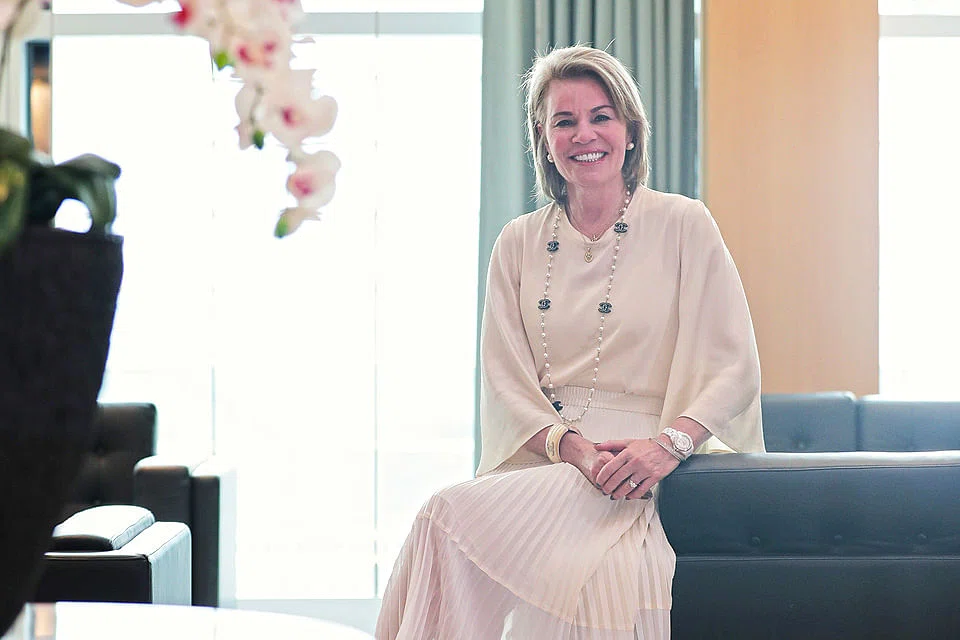
The immaculately dressed Ms Carlson, who is trained as a speech and language pathologist, has built up AWS' global public sector practice from scratch, talking with governments across the world and listening to their requirements and often retooling AWS' own work processes in order to provide the necessary services.
Ms Carlson may not fit the typical tech nerd profile but she is smart and just as excited about how technology can change lives - and stoked about how she can contribute to that change.
"I like to tell people that I'm not very mathematical but very scientific. When I was doing practice as a language pathologist, we didn't have any technology really that worked well in healthcare; we definitely didn't have anything called workflow or document management," she recalls. She decided to do something about it.
Her first job in technology was with a company called Keyfile Corporation that did workflow and document management.
"We were a Microsoft Exchange partner and why I tell you this story is because it was the first time where I realised that technology could really enable a mission. So think about it, doing workflow and document management in a world where I had done everything with paper and pen; all of a sudden it was like the sky had opened up for me and that was 23 years ago.
"Now fast forward today. I started my career in AWS in December of 2010 and prior to that I spent 10 years at Microsoft running government practice. I saw customers back then, 10 years ago, buying a bunch of licences that they didn't necessarily need.
"Then I met Andy Jassy (AWS CEO) and we talked about Web services and how that was a different paradigm where you only pay for what you use. You can scale it up, you can scale it down, and you can do experimentation... Once I really started understanding AWS and cloud computing, my world changed yet again in a very different way," Ms Carlson recalls.
She adds that what makes her really excited is when she sees the progress made by her customers and what they're able to accomplish and the kind of economic development and jobs creation that cloud computing is providing around the world.
"I've had conversations with young researchers and educators in small communities who are doing amazing work because they now have access to data sets and free tiers of compute and cloud storage to get going. I meet young individuals who started companies on AWS because they said to me: 'I use the free tier to set up my company'.
"Earlier, these things weren't possible, and even imaginable; workloads are now running in the cloud and just moving faster and it's fun. I mean it's fun to see when your customers are having success and I think especially in the space where we work, in the public sector, such success is often hard to come by," she adds.
Helping to solve problems
A major part of Ms Carlson's job involves travelling around the world and meeting customers to understand their needs and also see their success stories. "If I were sitting at a corporate office all day, I would shrivel away like a prune probably, but fortunately I don't. I get excited because our customers have problems they're trying to solve for citizens, they have real problems and real opportunities and we are helping them," she says.
According to Ms Carlson, one of the biggest breakthroughs in public sector cloud computing is that it has put information technology in the hands of ordinary people.
"I've seen this happen in my career. Previously when technology raced ahead, the individual did not have an opportunity to go and try out a particular piece of cutting-edge technology," she notes.
One common problem used to be access to data. There were all these important data sets sitting somewhere in a government data centre, that researchers had their eyes on but which nobody could access because it would cost a lot of money.
"We (at AWS) said, let's take a data set and using our own money we will move it or copy it to the AWS cloud; it should be open and accessible to all. The first thing we tried was the first data sequencing for the human genome... We made a copy and put it in the cloud. In the first week that we opened that data set up, we had 3,400 new researchers crowdsource the data set. That was back in 2011, 2012 when nobody could do that. If you wanted to access such data you would have had to buy a lot of servers, the computation, the storage, the processing and analytics.
"Now there's been thousands of articles and research papers written about this data set, but that's just like one simple example: If you take information and open it up, people will use it and consume it and they'll do their own research and that just creates cycles of both transformation and innovation to solve problems," she points out.
She notes that this kind of research, made possible because of greater access to data and information, has tremendous possibilities.
Giving another example, she adds that University of Berkeley's AMPLab has been sequencing every possible cancer type and "they believe that in the next 25 years most people will be able to live with cancer as a chronic disease versus a terminal disease (as is the case today) because we will understand it much better and we will be able to apply the right medication or therapeutic treatments".
"They're finding crazy therapeutic treatments for cancer now that can be used for other types of the disease that they've never even dreamed of, and that is only because they're able to process, manage, analyse this data much more rapidly and they have the ability to say, 'Okay I'm examining this faster, I have the right information, I can make better decisions'," she says.
Wooing the public sector
Breaking into the public sector for cloud computing services was a big challenge given that, particularly for government departments, security of the data sets is a major consideration.
"Initially we would go out and talk to customers, and literally we couldn't get through the door. We would build these beautiful presentations to go talk to the customer about cloud computing and its application in government; literally we couldn't even open them (the presentations) as within two minutes into the meeting the conversation went straight to security.
"I remember sitting with my teams, they would get frustrated and I would say that we have to be patient. This is new, it's a new model, and we have to work with them (government departments) to understand and to answer every imaginable question," she adds.
A big boost for AWS came when it bagged a contract with the US intelligence community. In 2013, it signed a deal with the US Central Intelligence Agency (CIA) to provide cloud computing services. The deal was hailed as a major breakthrough for the public sector in cloud computing.
"The intelligence community in the US have always been innovators and they have lots of smart builders and they asked themselves, 'Could we build a cloud computing network?'
"Sure, they could have built the cloud infrastructure but then they asked themselves again, 'Can we keep innovating and going fast?' And they said the answer was no," she notes. They then turned to AWS.
Understandably, this CIA contract for AWS was a watershed moment - not just for the company but for the public sector cloud computing business as a whole. "The world kind of went like 'Wow!'. If the US intelligence community can choose AWS and cloud computing, why can't we use it?" Ms Carlson recalls.
According to her, another major reason for the surge in interest for cloud computing within the public sector has been because most governments "like Singapore" want to move fast.
Governments are telling themselves that "they need agility and new capabilities", she says. "So I think the world is changing and a lot of this is, as we like to say, you can't fight gravity; at some point you just can't fight what's happening on a global scale."
She says she is very impressed with the strides taken by the Singapore government sector in embracing cloud computing. And it's part of a global trend.
Across the world, there is not any city, state or local government that is not talking about public sector cloud services to provide "smart" services, in keeping with the Smart City trend that is sweeping across the world.
"If you go to India, you're talking about state governments looking to put services online. In the US, every state is like a country and they are all interested, especially the large ones that have traffic problems. Among the large cities, in California, New York, Florida, Texas; Chicago, Washington DC and Seattle are all interested in how they can build a more efficient city or community, so that they really understand what's happening and that they can do things much more, in real time.
"We are now seeing a lot more pilot projects... Now people are using the cloud to test things out. They are testing everything from elections to transportation, to just location services, justice and public safety," Ms Carlson adds.
"As a result, we're actually seeing governments partnering more with smaller companies since they no longer have to wait till a large tech company or integrator comes along to support their needs.
"They (governments) are now finding agile ways to look for new companies (through the cloud network) that can come in, while at the same time they are now saying to themselves, I'm not going to outsource everything. I'm going to have a set of my own builders that can look at things more in-depth, like security applications that are required.
"I think we're going to continue to see governments get more agile, and think about how they partner with both companies like us but also smaller technology companies that have cloud-based solutions that they can use in areas that are important without relying just on a small set of large integrators that really aren't helping them do innovation," she adds.
Women in tech
As a female tech leader, Ms Carlson is very passionate about the need to get more women into technology. "We need them because they are huge consumers of technology and they're also big purchasers of technology goods.
"But the thing that I like to tell women is that they are actually perfect for tech because of the way they think and their ability to multi-task. In the tech industry, there are jobs across the board that they can do and of course we need more women doing the coding and development.
"There's absolutely no doubt that we need them in these jobs and I see more (women in technology) in this part of the world and in the Middle East. There are actually more women in computer science in these regions than there are in the US," Ms Carlson adds.
Two problems need to be tackled, she says. One is getting women into tech and the second is ensuring that they move up the rungs to leadership roles. The latter is still a challenge, she observes.
"What I'd like to tell the women is that they have got to take a chance when they get in there. Take on new roles, ask for more things that they can be doing, and don't be afraid to apply for positions that they feel like they might not be able to do, because I would never be here today if I didn't kind of say, 'OK I'm going to do that'.
"I think it is really important for them, once they get a seat at the table, to have a voice, have a smart voice at the table, and make sure that their ideas get illuminated out there."
Breaking through cultural barriers is also important for women in places like India and other countries in Asia, she says.
But Ms Carlson is optimistic about the future. Citing the women in technology whom she's interacted with in Asia, especially India, she notes: "I think they're bolder. I think they're beginning to understand that they're smart, they can make a good living and be an earner both for themselves and a family that they may create;; that they have a mind and they have a voice in what they're trying to achieve. So it's changing.
"Again, slower than all of us would like, but I'm very vocal about it and I don't intend to stop being vocal about this when I go around the world."
TERESA CARLSON
Vice-President Worldwide Public Sector Amazon Web Services
Place of birth: Kentucky, USA
Education
1985-1987: Undergraduate and Masters of Science degrees in Communications and Speech and Language Pathology, Western Kentucky University.
Career
1998-2001: VP for Worldwide Marketing and Business Development, Keyfile Corporation
2001-November 2010: VP for Federal Sales and Operation, Microsoft Corporation
Since December 2010: VP, Worldwide Public Sector, AWS
Accolades
2019: Inducted into the 2019 edition of Wash100. Five-time Wash100 recipient.
2018: Appointed to the White House Historical Association's Board of Directors.
2016: Recipient of the Ellis Island Medal of Honour.
2011: Washingtonian's "100 Most Powerful Women"
2010: "Most Influential Women in Technology FAST Company" and "Most Influential Women in Technology"; "Outstanding Achievement in Industry" Government Initiatives Excellence Award from the Armed Forces Communications and Electronics Association.