

Crystal ball gazer
At Cognizant's Center for the Future of Work, Benjamin Pring helps clients see what technology is bringing in their fields, and points them to what they should be focusing on.
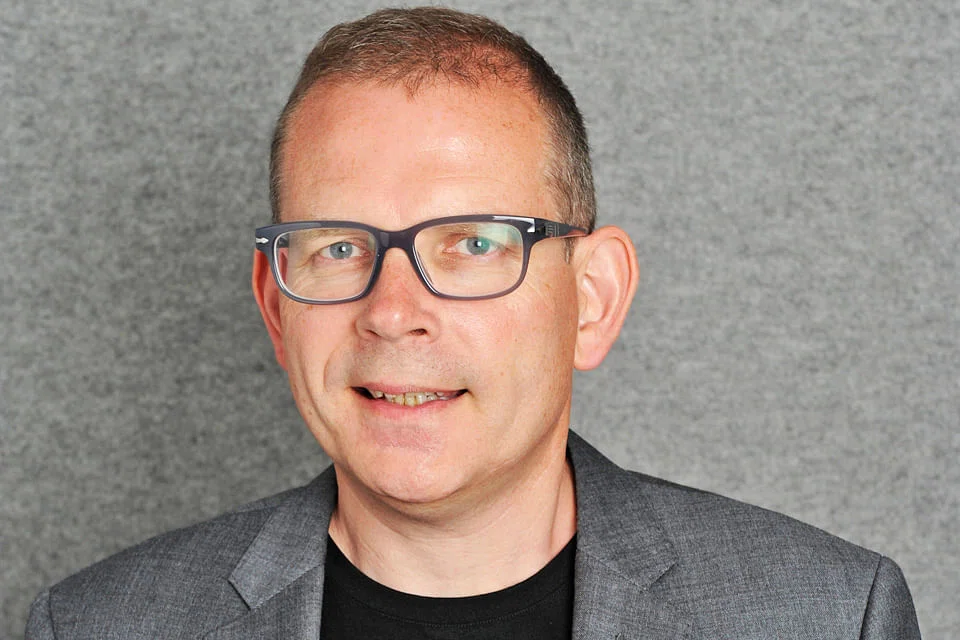
WHENEVER he binge-watches Netflix, Benjamin Pring likes to open a completely random movie every now and then just to throw off Netflix's ever-vigilant viewing algorithm, so that it can't build a profile on him and give him "ten Scandi thrillers that all look exactly the same".
He's hoping to confuse what he calls a "code halo" - interactions in cyberspace which can create a digital fingerprint unique to you, and only you.
He laughs it off as a silly example, but it's an example which belies the darker reality underpinning the future of the Internet, and one which the Englishman is all too aware of.
As someone who is known as a futurist, Mr Pring keeps his ear firmly to the ground, to better see what lies ahead.
He is vice-president and managing director of professional services firm Cognizant's Future of Work Center, having joined the company in September 2011 after spending 15 years with industry stalwart Gartner, where he was a senior industry analyst researching and advising on areas such as cloud computing and global sourcing.
The centre examines how work is changing, and will change, in response to the emergence of new technologies, new business practices, and new workers
"I'm an early warning, a sort of radar for the executives at big businesses," Mr Pring describes of himself. At Cognizant, he helps clients see what the future of technology is in their respective fields, and gives them an idea of what they should be paying attention to.
"My role is to be able to translate the technology," he tells BT. "I understand enough of the technology, and I can go have a conversation with the insurance executive or somebody in government so I can then go between that (technical) world and the world of business and people who are not technologists."
At Cognizant, Mr Pring is currently focused on taking superior user experiences across applications or computer programs, and applying them to the technology deployed by big businesses.
"This disconnect is a big issue in a lot of big businesses," he notes.
He calls it the "Sunday-night-Monday-morning" phenomenon, where a user is surrounded by well-designed iPads and phones on a weekend, but has to return to badly designed - "crappy" - technology at the office on Monday.
"So we're going to take this style and the cool technology on Sunday night and injecting it into how you get your health, your insurance, banking, or even how government divisions provide services to people, which will make people want to use more," he says.
As an example of the ease-of-use revolution he hopes will be sparked off, he gives an example on his iPhone, showing off an app called Hotel Tonight, which gives users discounted deals on hotel accommodation, even if you book at the last minute.
It's the "Uber-isation" of the hotel model, Mr Pring says, the kind of frictionless and attractive experience that users should have when they use technology.
"Now when I fly anywhere in the world, I never make a hotel booking. I just get to the airport, go on Hotel Tonight and I get fantastic hotels. All of the reconciliation to my expense management system's all done at the press of a button," he says, with a smile.
Blending the layman's understanding of technology with complex systems is something Mr Pring has related to all his life.
Growing up in the United Kingdom, he wasn't one of the "nerdy" kids who stayed in the computer lab, preferring instead to indulge in music and surf the crest of the next hot wave in music. "I was always interested in what the next hot band was, what people were listening to, or what's the next gig to go and see," he says.
A turning point, Mr Pring recalled, was reading Arthur C Clarke's 2001: A Space Odyssey in his backyard one summer, during the school holidays.
In his words, that book "blew my mind".
"Spending day after day reading it obviously tapped into some element of my DNA, which was interested in the sort of big questions and the big imponderables," Mr Pring recalls.
"I think I relate that into everything I do in my day job. What's next, what's exciting, what's new or different."
A combination of being interested in the future of things and how technology changes things set him off on the course he is on today, and he's fortunate enough to have a job which pays him to be engaged in these issues, he quips.
And as a self-confessed media junkie, his chat with BT is liberally peppered with references to pop culture and things outside the world of technology, showing how much they have informed his technological worldview.
Educating the masses about tech
As a result of his non-linear introduction to the tech world, he adopts a more circumspect worldview - rather than a hardline do-or-die approach - towards educating future generations, advocating that children be grounded in the basics rather than be taught pure STEM subjects.
STEM - science, technology, engineering and mathematics - education is generally geared towards producing graduates for the technology world, in fields as diverse as engineering, computer science and statistics.
"There's a huge existential debate in every part of the western world at the moment about education and the curricula for kids. There's basically two schools of thought - one is we need to have more STEM, but there's a counter argument saying that technology is changing so fast, so why would you teach kids C++ (a coding language) when in 10 years' time when the kid gets into the workforce, C++ is probably gone by then?" Mr Pring says.
"In your life you are going to work (for) at least 50 years. And by that logic, it's better to have very good foundations at 22, than to know C++ at 22. Let's really double down on the foundations because you have 50 years to build on that."
He cites himself as an example: at 56, he continues to develop and grow in his career, and get better.
"And my point is, you may not do particularly well in the first 10 or 20 years, but you may with good foundations be able to do very well in your last 10 years. For a lot of people that's the curve, the arc of their career."
He points to American businessman and investor Mark Cuban and his television show Shark Tank, where people pitch their business ideas to industry titans - the "sharks" - in the hope of getting funded.
"The other day, he (Mark) said if he was 22 now he'd rather be graduating with a degree in philosophy than accounting because accountants can be very structured. There's no flexibility, or very little creativity," Mr Pring claims.
A philosophy degree - like what he himself has - enables people to see things more broadly, and put different things together in unique ways, a standout attribute in an age of technological automation.
Companies playing their part
A recent Gartner analysis put the number of job openings for data scientists in the United States at some half a million. It's a job with growing demand in fact around the world. Overall, industry analysts estimate that some 20 per cent of the global workforce is in some tech-related field. But the manpower supply isn't keeping up, and there's a growing talent shortfall particularly in hot areas such as data science.
To exacerbate matters, hiring practices have not kept up with the rapid changes the industry is undergoing, and Mr Pring reckons that corporate human resources (HR) departments require a sea change to do their job.
HR is struggling to come to terms with this delta - or gap - between hiring practices and people who possess the technical talent that the company needs.
Part of the reason, Mr Pring says, is that HR has occupied a sort of "grey area", where they and the rest of the company don't "speak the same language".
"HR is sort of sitting in this awkward position whose function is absolutely integral to getting the next generation of talent in and the next wave of skills into a big business, and yet it's really complicated for them," Mr Pring notes. "HR needs to take a look at itself and reinvent itself if it's going to really play the role that's needed in this transformation."
He suggests that companies could perhaps cross-train staff and let them get a feel of what their colleagues in the other units do, with rotation and secondment schemes.
It's this idea "where you take an HR person and put him in the engineering division for six months, and take someone from the data science division and put him in HR for six months", thereby getting a pollination of ideas and culture, Mr Pring says.
However, there could be spectacular blowouts sometimes because "it's like mixing oil and water", he concedes. "It's like that old book 'Men Are from Mars, Women Are from Venus'. You might end up with all these sorts of clashes. But that in a way is what leaders have to do. They have to force these pieces of the jigsaw puzzle together."
One concept he's taken to is to break up teams of people so that the physical floor plan - where each staff member sits - mirrors their workflow, in contrast to the traditional layout where people who work in the same department generally sit together in a group.
"As an example, we run a research group but we have to work with marketing, PR (public relations) and social media people. You could mirror that physically in the office so you could have the HR person sitting next to the coder, who is sitting next to the lawyer, who is sitting next to the accountant, because that's part of the workflow," Mr Pring says.
"The bourgeois white collar office sort of mirrors the production line of making a car, but very few white collar bourgeois workers work like they're just working on a production line and making a car. It's much more complicated, more fragmented. It's much more of a composite of different skills. Mirroring how people work will probably make a lot more sense," he says.
Oiling The Terminator
The definition of intelligence is the ability to change, says Mr Pring, referencing the late professor Stephen Hawking.
"I think that's very profound because what it means is that we've always had to adapt to a changing environment whether it's the weather, or the emergence of machine learning. We can pivot, navigate in these choppy waters with our creativity and our human qualities."
Asked if one of the most human of qualities - the emotional quotient - will end up being automated, he scoffs at the notion.
He doesn't buy the idea that machine intelligence completely supersedes the human psyche and soul.
"This notion that we'll only end up oiling The Terminator - that's just a fun dystopian view to have of the world and fun to talk about at a dinner party over some nice wine, where everyone gets excited about it, but that's not the reality of what's going to happen and it certainly is not the reality of what's going to happen for big businesses in the next few years," he says.
In his view, artificial intelligence - the buzzword of late - isn't this sort of mythical unicorn that some people imagine it is, but just the next generation in productivity tools, in the same vein that people progressed to word processors from typewriters.
AI is to make your job more efficient and easier, so that you can do more, he says.
"I went to journalism school in the 1980s after my philosophy degree and they spent the first three months of this training course teaching me shorthand," he recalls. "Who needs shorthand when you got that?" he says, pointing to my digital voice recorder on the table.
"It's the automation of skill and some people think, well that's the end of the world, but that's how society changes."
Going back to his example of the code halos earlier, Mr Pring highlights how customer data could be used and abused, drawing attention to recent instances of election interference through social media engineering.
Data is a resource that humans have to manage, he points out. The problem is not with the data itself, but the way the data is managed.
"The original name for the Internet was the information superhighway. We've spent the last 25 years building this highway, laying the tarmac of the highway, but there are literally no road signs or stop signs. There are no lines on the road. In the next 25 years, we will put the rules of the road on the road. That's the story of what's ahead of us - creating lanes, stoplights, signs and having speed limits and fines," Mr Pring envisions. "That's the transitional point that we're in. That's the point we're at now as a society, and as responsible, educated people, we realise that we've built incredible powerful technology, but if we're going to use it responsibly and not just blow everybody up, then we need to put in place the rules of the road."
BENJAMIN PRING
Vice-president and managing director, Center for the Future of Work, Cognizant
Grew up in North London in the 1960s and '70s
Studied Philosophy at Manchester University, UK from 1981 to 1984
Started out working in a number of consulting companies including Coopers and Lybrand.
Joined Gartner in 1997
Moved to America in 1999 (first to San Francisco, then Boston)
Won Gartner's prestigious Annual Thought Leader Award in 2007
Joined Cognizant in September 2011 Established the Center for the Future of Work
Co-wrote Code Halos (2014) and What to Do When Machines Do Everything (2017)
Working on a documentary about the future of work, due out in 2019
TRENDING NOW

VietJet hit with global asset freeze in FitzWalter dispute

FCT, NLB to turn Causeway Point’s former cinema space into reading hub in mall revamp
Family offices ‘kept captive’ by relationship managers turn to independent advisers, direct deals

Olivia Lum, ex-CFO not giving evidence in their Hyflux trial

