Human-centred
Teo Lay Lim, chairperson of Accenture Singapore, believes in looking beyond the consultancy cookbook to innovate with clients.
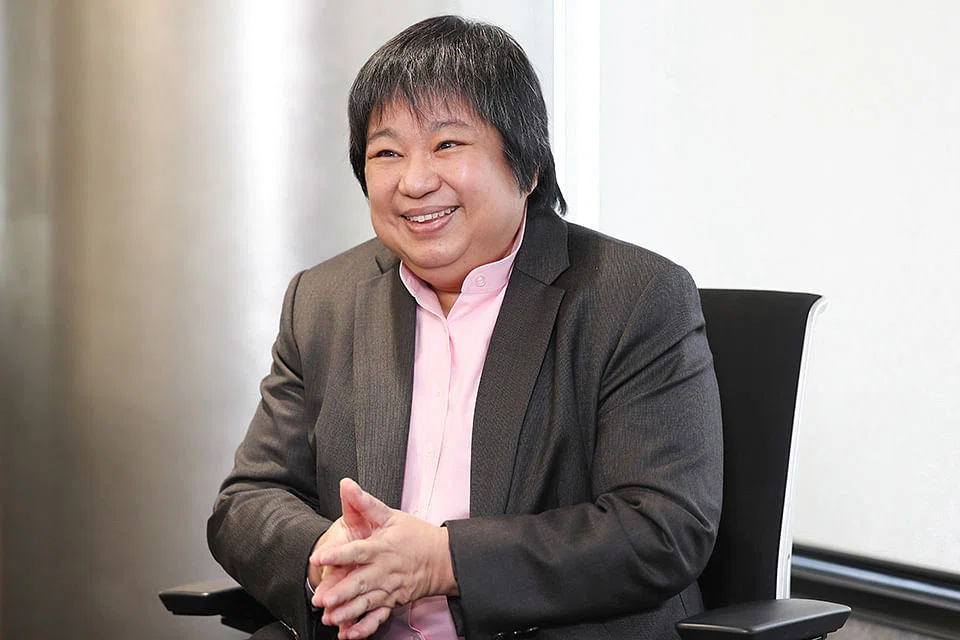
CURIOSITY and an appreciation of each individual's uniqueness are qualities that Accenture Singapore chairperson Teo Lay Lim has had since a young age, and which have seen her through more than three decades in the organisation - not least as Accenture's own approach evolved.
As a young person, she read biographies of historical figures and was fascinated by the approach of viewing events through the lens of the individual. Even when travelling overseas for tennis as a student, glimpsing scenery through the windows of a bus, she would wonder: what would it be like to live in that house, or that village? What goes on behind those walls? What is the way of life here?
Similar inquisitiveness lay behind her choice to study business administration at the National University of Singapore, she says. "The reason why I did business was, I was always curious about what goes on behind the doors of any organisation."
Having secured a job offer before graduation in the recession year of 1985, accepting it was a "no-brainer".
Though IBM may not have been the most obvious choice for gaining insights into a variety of businesses, the opportunity was valuable. "When you work for a great company, you always learn something," Ms Teo says.
After two years, however, she began to look for a place with more varied paths - such as Accenture.
"There was no limit to what the organisation could do - and therefore, by extension, no limit to what the individuals in the organisation could do," she says. "It continues to be why I've stayed all these years."
Managing client portfolios in her early years at Accenture was a natural fit with her curiosity as to how different organisations function.
"Because of the clients we work with, you get to experience the inside of so many other companies, every year that you're here. So for someone with that very natural curiosity, it's a buffet, it's a never-ending set of opportunities."
Did it ever get samey? Not for Ms Teo: "Each company is different, unique. Every company has its own culture. Sometimes within a company there are multiple cultures, depending on which part of the organisation you work in. It's always fascinating."
Of course, over time, patterns and similarities emerged, she adds. Still, she has always believed in focusing on each unique case: "You've got to understand the individual."
Commonalities may be a good starting point, but there is no reason to stop there: "Try and tease out what is different and unique."
From recipes to co-creation
Ms Teo's eagerness to go beyond generalisations mirrors Accenture's approach today.
"Our business has changed a lot," she says. Back when she joined Accenture in 1988, the firm was famous for its rigorous methodology. "I remember that the partners I worked for - the shelves of their offices were lined with these binders."
Despite being a global firm, there was consistency across borders, as everyone "was schooled in common methods", she recalls. The approach was systematic, yet therefore prescriptive: "It was like a cookbook."
Such an approach is still effective for large-scale transformation projects today, she notes. At the same time, however, there is increasing demand for the agile approach in shorter innovation sprints: "It's not one over the other, but how you make both work."
Similarly, Accenture was famous for its repository of knowledge, which "unified the whole firm". Experiences and expertise from past projects were scrubbed of confidential details and processed so as to be accessible to anyone around the world, providing a massive go-to reference for best practices.
Yet given today's speed of change, the concept of "best practice" may no longer be as relevant in every instance. Ms Teo notes: "Looking at what is best practice may no longer be good enough. What clients are looking to us to do is to innovate for 'next practice'."
"We cannot come in and say that we have all the answers. What we have had to change is that very rigid, industrialised methodology."
Today's approach is less structured and less prescriptive. Perhaps the term "consultant" is no longer entirely appropriate, Ms Teo adds.
Instead, the aim is to design solutions together, "without a recipe". In short: "We need to innovate with clients."
When it comes to transformation, Accenture's services stretch from the earliest conception of strategy, to translating this into specific actions; building the technology around it; designing the experience; and perhaps even running part of the operations on behalf of clients.
While these are five very different capabilities, they are integrated rather than remaining distinct, adds Ms Teo.
Responsible business
Ms Teo's career at Accenture provided variety not just in the range of clients which she met, but the sorts of roles that she took on.
After about a decade of managing client accounts, at the turn of the century, she moved to handling an entire business horizontal instead: Accenture's new customer relationship management (CRM) practice.
As technology advances, more tools become available, and social media provides more data, it has become easier to understand customers as individuals as well, observes Ms Teo.
But this means greater responsibilities as well, when it comes to managing the data that companies capture about consumers in order to deliver personalised experiences - and even employee data, as internal systems grow more complex.
The broader idea of "responsible business" is something that Accenture - and Ms Teo - has been focusing on in recent years, closely related to the notion of sustainability.
This is not the old notion of corporate social responsibility (CSR), which firms often tended to see as some separate obligation to be fulfilled, she says. "It's got to be embedded."
While environmental concerns are part of it, it is "not just about being green", she adds. The idea is to pursue "sustainability in every part of the business", from technology, to procurement, to labour, including the need to reskill communities for the future of work: "We should not leave people behind."
Ms Teo became Accenture's Asia-Pacific managing director for sustainability services in 2010, a few years after moving from managing the CRM practice to managing a country: Singapore. In 2011, she became managing director (MD) for the geographic unit of South-east Asia as well.
"What I have enjoyed very much with the geographic role is that there's complete breadth," she says. "It brought everything home."
Instead of focusing on specific business areas, she had to consider the entire sweep of Accenture's offerings.
The basic question was simple: "How can we help Singaporean companies and Singaporean clients?" Answering that, however, requires looking at the whole of the firm's global experience, and seeing how to make the best insights relevant and applicable to clients here.
Being in charge of a specific geography also "allows you to really focus on the people", according to Ms Teo. "You have to look after everyone." This includes mentorship and ensuring that career pathways are provided.
Accenture looks after its staff more generally as well, with what it calls its "truly human" ethos - which, similar to Ms Teo's own approach to the world, looks at the personal and particular.
"We have to recognise that our business is all about individuals, and recognise that everyone has different needs at different points in time."
This includes an openness to matters of both physical and mental well-being, she adds. "People can come forward, can say that they have a problem. Being okay with saying that is really important."
And while the management consulating industry may have a reputation for gruelling hours, Accenture tries to avoid the expectation that employees must be available at all times: "It's okay to not be always on."
The human aspect of Accenture is one of the things that Ms Teo still focuses on today. In 2020, she relinquished her roles as Singapore country managing director and South-east Asia geographic unit managing director to become chairperson of Accenture Singapore.
"I have let go of all the profit and loss stuff," she says. "The things that I spend more time on are building people, spending time with all levels within the organisation."
Mentorship is something close to her heart. She still remembers a quote she gave back when she first took on the country MD role: "My job is to find people better than I am."
"The most effective leaders are magnets for talent," she adds. "People want to work with you. You have to inspire people."
"What I enjoy doing with people is to help expand their minds. See things in different ways."
In the much-talked-about VUCA world - volatile, uncertain, complex, and ambiguous - asking good questions is better than having the right answer, she points out. "A right answer could be wrong two weeks from now."
Ms Teo also spends time speaking to clients about broader issues such as responsible business, beyond the project-based interactions.
And not having to handle day-to-day work allows her more time to contribute to society in roles outside of Accenture.
She has a wide range of external appointments, some of which began just last year. She is a member of the Asia-Pacific Economic Cooperation's (Apec) private sector arm, the Apec Business Advisory Council, for instance, as well as a member of the Global Partnership on Artificial Intelligence's working group on the future of work.
Other appointments include being a board member of the Singapore Accountancy Commission since 2019, and the Institute for Human Resources Professionals since 2017.
What she has always hoped to do, in these external roles, is to apply skills honed in Accenture elsewhere in Singapore, she says.
"The skills that you build, you take for granted." But upon venturing outside Accenture, one discovers that it is an invalid assumption to think that such skills are widespread everywhere else, she adds.
As an Accenture-trained person, Ms Teo says that "there's so much that one can bring out there" - from dealing with change, to managing transformation, to thinking about how to structure complex projects and initiatives.
Using the organisation's capabilities for the good of the community is part of Accenture's approach to responsible business; in her own personal capacity, Ms Teo is doing the same.
TEO LAY LIM
Chairperson Accenture Singapore
1963: Born in Singapore
EDUCATION
1985: BBA, National University of Singapore
2009: IMD Leadership Development Programme, IMD Business School
2016: Regional Entrepreneurship Acceleration Programme, Massachusetts Institute of Technology, Sloan School of Management
CAREER HIGHLIGHTS
1988-1999: Management Consultant, Accenture
1999-2010: Managing Partner, CRM Asia-Pacific, Accenture
2007-2020: Country Managing Director Singapore, Accenture
2010-2011: Managing Partner, Accenture Analytics, Asia-Pacific and Managing Director, Sustainability Services, Asia-Pacific, Accenture
2011-2012: Managing Director, Asean, Accenture
2011-2020: Geographic Unit Managing Director, South-east Asia, Accenture
Since 2020: Chairperson, Accenture Singapore