More ways to pay
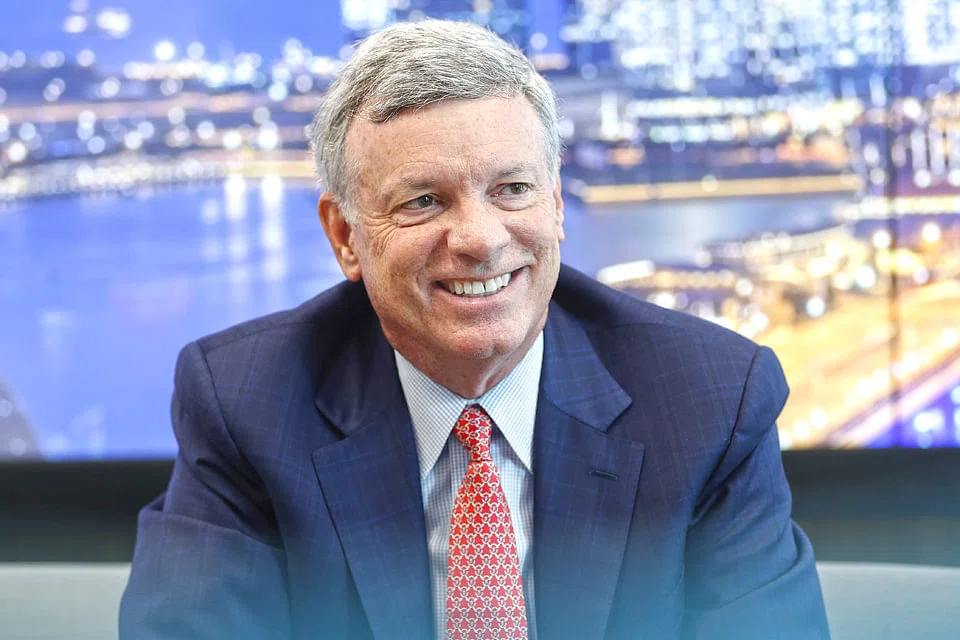
Visa CEO Alfred Kelly Jr sees a big role for credit cards to smoothen and speed up e-commerce, and in driving two-way payments.
WE SHOP, tap and go, and we don't think twice about it. Marie Kondo may have something to say about all that easy consumerism, but spending on plastic is a way of life for many shoppers in bustling cities.
Behind that spending are the pipes built by Visa, the sprawling payments networks giant that allows funds to be pumped across borders, its platform taking in as many as 65,000 transactions per second.
But the payments giant is not resting easy on its global network, and frankly, can't quite do so today.
Large waves of change in the payments scene have brushed up against the incumbents in recent years, as new players come to re-distribute the pie. And the newbies want more than just the crumbs.
Still, CEO of Visa Inc, Alfred F Kelly Jr (or Al as he is better known) is placid on the competition that he has faced since taking on the role in December 2016. "Our story is a story of change, because the payments ecosystem has been constantly changing over the last 60 years. And the clock speed of that change in the last five years has been greater than before," Mr Kelly tells The Business Times during a recent visit to Singapore.
"If you have an exciting, interesting, and growing industry, it's natural you're going to get competition. I think it's a sign of the health and the attractiveness of the payments ecosystem. Competition keeps all of us on our toes, and it's good for the end-consumer because we make sure we do everything we can to differentiate ourselves as much as possible."
To do this, Visa will have to be unflinching in discarding ideas that don't stick. An example comes up in online shopping.
Mr Kelly points to its product Visa Checkout. Billed as "the easier way to pay online", the option, solely for Visa cards, enables online shoppers to check out with a single account that can be used across their devices. Users are directed to a separate site where their Visa card details are saved, where they authenticate the purchase via a username and password on this Visa "wallet" - much like using PayPal, in fact.
But Mr Kelly concedes that Visa Checkout, launched in 2014, has clouded the e-commerce experience for consumers. So this option will, at some point, be fully replaced and phased out.
"I think that the checkout experience, and I might even say, the shopping experience more broadly on e-commerce, is still not at the level where any of us should be proud of.
"We've got to get to the point where we stop this multi-presentations of all kinds of logos and checkout options for the consumer. What we're doing online in many places around the world today is the equivalent of asking a merchant in the physical world to have a different terminal for Visa versus Mastercard, versus Amex, versus JCB. And that's crazy," says Mr Kelly, who spent 23 years at American Express before joining Visa.
"We think that there should be a single checkout icon that opens a wallet that gives you a choice of the different products. You check you've pre-loaded all your shipping and billing information, and you hit confirm. It's a simple three-button experience. And that experience is the same across all the different payment vehicles."
Grow overall pie
Visa has joined its payment network peers in getting behind a new Europay, MasterCard, Visa (EMV) standard called secure remote commerce, which in effect will bring the key payments players together to develop a seamless checkout option for online consumers, regardless of which card they are using.
"We will replace Visa Checkout everywhere it exists with secure remote commerce as soon as we practically can. We will continue to roll out Visa Checkout in markets where it's going to take a much longer period for the secure remote commerce button to be in place.
"But we think it is a far better experience for the ecosystem to have this industry-backed standard for e-commerce checkout, than for us as a network to proliferate our own singular option for consumers," says Mr Kelly.
"The e-commerce payment ecosystem has just taken a little bit of time to catch up to what is a better, less friction-filled option for the consumer when they check out."
As Visa's example shows, being overly protective today of market share - as some incumbents seek to be - fails to hold up as a strategy against the bigger goal of growing the overall pie. To Visa, partnerships still make more sense. For example, with the proliferation of mobile wallets around the world, rival wallets are not direct threats if Visa gets into as many mobile "purses" as possible, all around the world.
One big exception, though, would be China, where Visa and Mastercard still remain unwelcome. "China is a very unique situation because of the advantages that Alibaba and Tencent have there, operating without a lot of additional competition. But outside of China, we're interested and are engaged in talking to as many mobile wallets as possible. Some of these mobile wallets include a credential from a domestic player that only facilitates payments domestically, for example. Sometimes those payments don't have the capability to support disputes as they come up," he notes.
Visa - as one of the older fintechs around before the term was even coined - will more than ever before have to partner up with the new fintechs big and small as well.
"I want our company to have an open mind about the fintech community. I see the fintech community as adding value in many cases, whether they are plugging a hole, or solving for some friction point," says Mr Kelly, adding that Visa, despite its size, is "not a terribly bureaucratic company".
"The payments ecosystem is probably one of the greatest example in the world of partnerships. It's an ecosystem that is impossible for any one company to do on its own. So historically, it was acquirers, issuers, and networks. But I think now there are gateways, there are all kinds of different types of issuers, and there are all kinds of different players."
Still, Visa is also trying to diversify its revenue, going beyond taking a cut from merchants and banks when it facilities a payment. This interchange fee can cause pain for smaller merchants when the business lacks scale.
The revenue diversification has particular relevance in this region. With Asia growing relatively robustly and promising much potential with its long-term urbanisation trend, Mr Kelly acknowledges that Visa's standard interchange pricing doesn't necessarily befit smaller merchants, be they here or anywhere else in the world.
"We've got to try to accommodate as best we can. And I think in some cases, we have more work to do. As it relates to Visa's pricing, we get a very small piece of the whole economics in any kind of payment, and our attitude or philosophy is that we price to the value added on the transactions that we process on our network, and we get a small fee for that value," he explains. "But in addition to that, we're trying to diversify our revenue streams."
Mr Kelly says he told the Asia-Pacific team during his trip out to the region, that one of the big growth areas here will be in developing Visa Direct, a service that allows consumers to receive payments, rather than just sending payments off, as they typically do with Visa transactions. In certain markets, Visa customers can, for instance, receive funds from friends when they split a dinner bill, while parents can send allowances to their children that can be spent via Visa debit cards.
Visa is also working with insurance companies to enable them to, when somebody files a claim, adjudicate that claim and then through Visa Direct, send the money back directly to the claimant's bank account, says Mr Kelly. The service is meant to get the money back to the consumer quicker, and to save overall costs for the insurers who typically send a cheque out.
"Visa Direct is a very important initiative and symbolically, it sends a very strong message that our Visa (payment) rails, which people tend to think of us working in a one-way direction, can work in the other direction," he adds.
The service is currently in some 25 markets, and the aim is to have it in every market around the world. "It's something we're very excited about, and that I think represents a whole new flow of volume and associated revenue for Visa as I look at it over the next five to 10 years," says Mr Kelly.
Even as the payments firm is spreading out its revenue basket to build its Asia business, Visa still sees attractive opportunities to disrupt its worst enemy: cash.
"When you look at the population, combined with the fact that we still have, by our estimates, over six trillion dollars being spent on cash and cheque in Asia, it just represents enormous opportunity... We have to continue to work with our issuers to make sure they understand that cash is very expensive. The counting of cash, the storage of cash, the movement of cash, the securing of cash, the potential of fraud, are all very high," points out Mr Kelly.
That being said, there are expensive risks tied to card payments as well, given the rising concerns over cybersecurity. For the Visa boss, the cybersecurity risk is top of the priorities. He wishes, too, that more retailers and merchants would be more prudent in their card management systems.
"The payments ecosystem is grounded in trust. There's trust that whenever I use my card or a payment credential, that the bank or the network is going to stand behind the purchase, and that the funds are going to flow properly around the world. I'm going to be properly billed, and the merchant is going to be properly paid," he says.
Visa has in recent years pushed out its tokenisation service, which in effect replaces the card number with a unique digital number, or the token, such that merchants see only this token, not customers' credit card numbers. This limits the odds of card details being stolen from merchants.
"We're less concerned with selling tokens, as we are having them proliferate around the world. It worries me that big merchants continue to have actual card numbers on file. It's a recipe for a real problem, and we've seen this story play out too many times, where databases get compromised, and large numbers of consumers are collateral damage because their cards get compromised.
"We're moving as fast as we can, to work with banks and merchants around the world to facilitate getting as many transactions tokenised as possible. It's not a revenue stream for us - in our mind, it's a fundamental element of making the payments ecosystem secure," says Mr Kelly.
"There is complacency. If you're in a business - and I don't blame anybody about this - your natural tendency is that a) you're only going to spend a certain amount on technology and b) your bias is always going to be toward making technological changes or enhancements that are going to help you grow your core business. And hence, if things like security of credit card numbers or disaster recovery... don't naturally allow you to grow your business, then let's be honest, they tend to fall to the lower part of the list when businesses are trying to determine how to invest their technological dollars." That is, until the database gets compromised. "Then it goes way up to the top of the list," he notes wryly.
Looking around corners
For Mr Kelly, the payments evolution has meant that he and his team will have to be on their toes, even as new technologies such as blockchain come about. The crypto market may also change the way the world understands fiat currency.
"My belief is to not be in the predicting business of where technologies could go... my job is to make sure that we're as curious as we can be, and exploring as much as we can, and that we're in essence, in the game," he says.
As an aside, sports and curiosity may be in Mr Kelly's blood: his grandfather was sports editor of The New York Times for over two decades. Mr Kelly himself had also spent a few years getting involved in running the Super Bowl.
"Curiosity is one of my most favourite words in language. We have to look around corners, we have to connect dots, and we have to ask questions. Almost every day, I seek out colleagues to ask them questions about many diverse subjects related to payments. That's a tremendous source of learning for me. I'm all about asking questions, to the point of being quite a pain in terms of the amount of questions I ask."
ALFRED F KELLY JR
CEO, Visa Inc
Age 60
EDUCATION
BA, MBA, Iona College, New York
CAREER HIGHLIGHTS
1981-1985: Held various positions in information systems and financial planning at PepsiCo Inc
1985-1987: Head of information systems at the White House
1987: Joined American Express
2000-2005: Group president of US consumer and small business services, American Express
2005-2007: Group president of consumer for small business and merchant services, American Express
2007-2010: President, and head of global consumer group, American Express
2011-2014: Chairman, president and CEO, New York/New Jersey Super Bowl Host Company
2014: Independent director, Visa Inc
2015: Management adviser, TowerBrook Capital Partners
2016: CEO, Intersection Co.
Since 2016: CEO, Visa Inc
Share with us your feedback on BT's products and services