
Fewer grads are landing jobs. Should they settle for short-term gigs?

Straight to your inbox. Money, career and life hacks to help young adults stay ahead.
[SINGAPORE] Back in 2025, I remember excitedly announcing in a group chat: “I got a job offer!”
It was the first response I’d gotten from the e-mail void in months, and I could barely contain my relief.
My friends were quick to flood the chat with congratulations. That was, until I explained that it was an offer for a temporary position. I recall the group chat immediately going silent, followed by:
“Oh… so no benefits?” “That’s not very worth it though.” “Just take what you have now and keep hunting in the meantime.”
I had been overjoyed when I received the offer letter in my inbox. But the fanfare seemed to dissipate at the line “contractual period”.
When it comes to what really counts as a job, temporary roles may often be considered second best. But in a tougher job market, should fresh graduates still hold out for a permanent offer, or start looking at short-term roles?
💼 A tougher job market
Based on the latest graduate employment survey by Singapore’s six autonomous universities, it seems that I wasn’t alone.
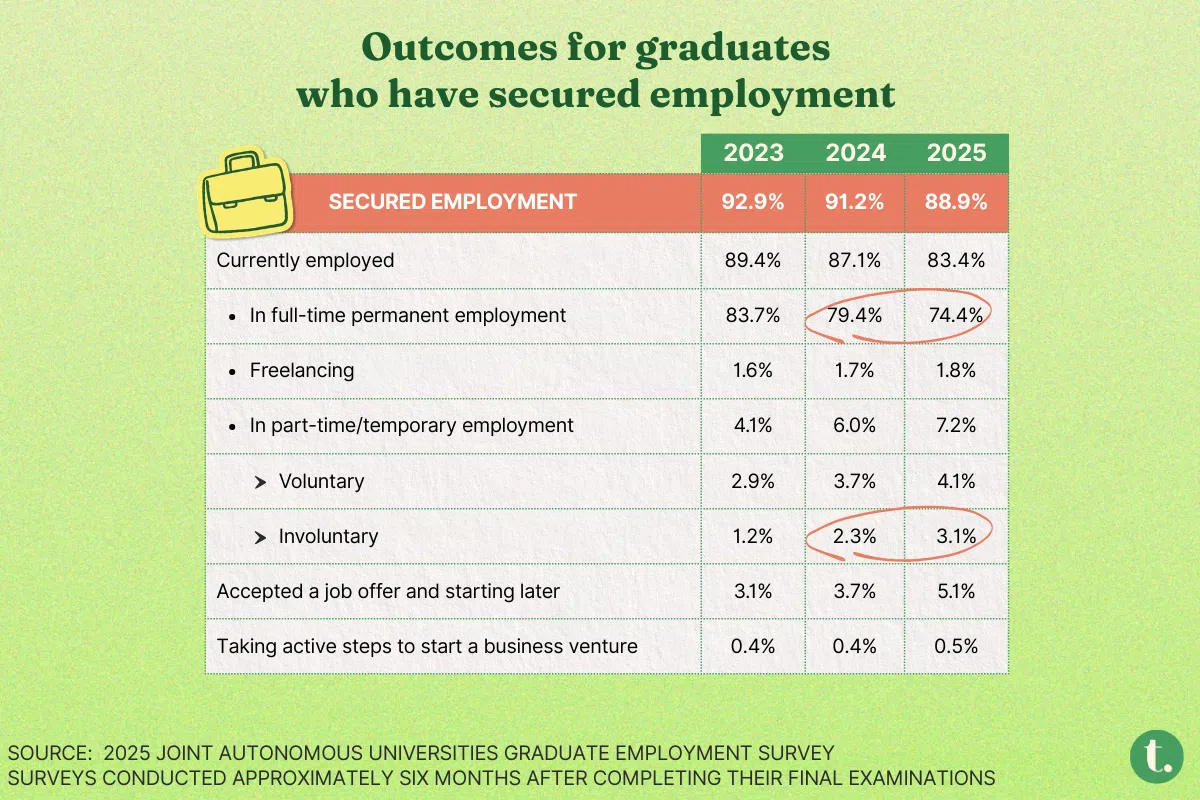
The proportion of graduates in part-time or temporary employment rose to 7.2 per cent in 2025, up from 6 per cent in 2024 and 4.1 per cent in 2023.
This comes as the percentage of graduates who secured any form of employment fell to 88.9 per cent, down from 91.2 per cent in 2024 and 92.9 per cent in 2023.



The survey classifies graduates as being in part-time employment as those working fewer than 35 hours a week, while temporary employment includes those on contracts of shorter than a year.
To be clear, not everyone in these roles was forced into them. More than half said they chose part-time or temporary employment voluntarily.
But what’s worth noting is that the proportion of graduates who took on such jobs because they couldn’t secure a full-time permanent job offer has more than doubled from 2023 to 2025.
Selena Ling, chief economist at OCBC, says that this rise is a cause for concern.
However, she notes that employment trends tend to move with economic and business cycles.
“The question is whether the causes are cyclical or structural,” she says.
Ling adds that companies may be slowing hiring due to uncertainty in the global economy, including tariffs and geopolitical risks that are causing firms to delay investments and expansion plans.
While artificial intelligence (AI) is often cited as a threat to entry-level jobs, Ling notes that AI adoption is still in its early stages, making it unlikely to be the main driver of the trend – at least for now.
☝️ Not a case of pickiness
Still, the survey suggests the trend is not simply because fresh graduates are being picky.
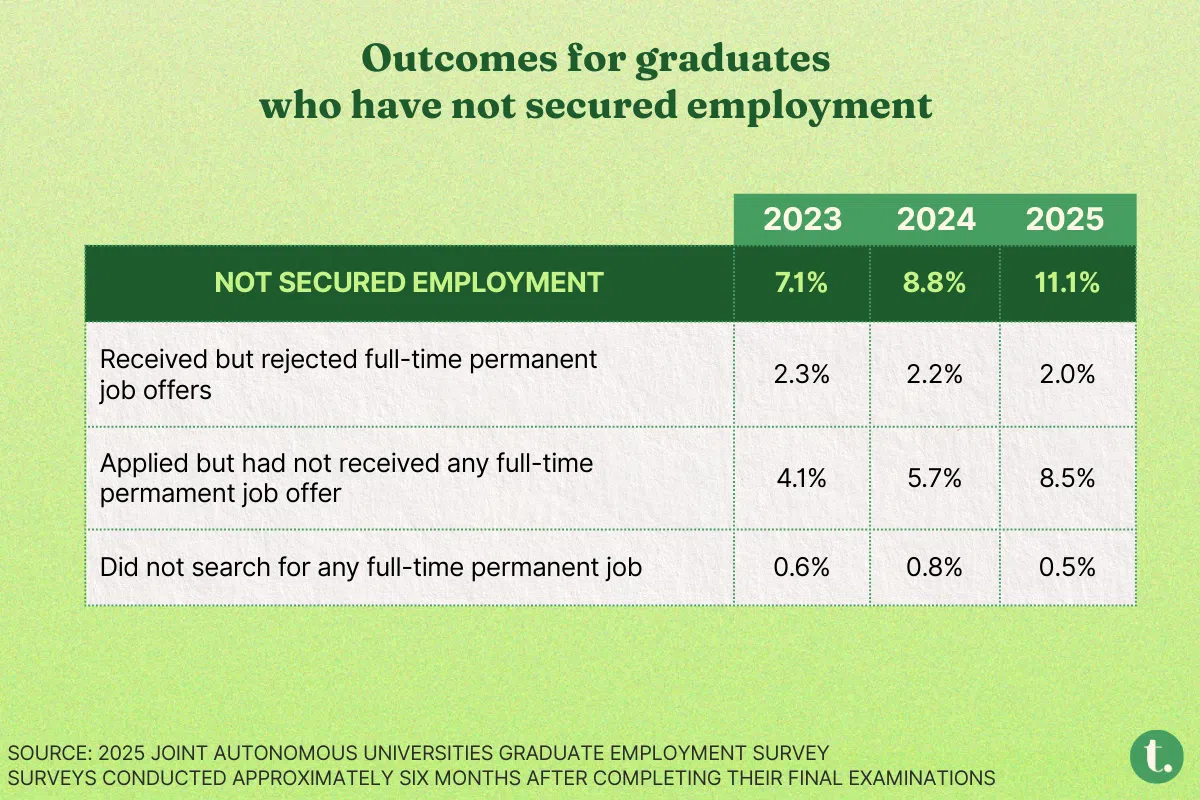
Of those unable to secure employment, the proportion of those who applied but received no offers has more than doubled since 2023 – a sign that the hiring market may be tightening for entry-level roles
Among those affected was Jean Tay, 24, who began applying for jobs in August last year but only secured a contract role this month.
“I sent out so many resumes, but nothing concrete really came out of them,” says Tay, who graduated from the National University of Singapore with a degree in information systems.
During that period, Tay says she was open to both contract and full-time roles. While searching, she also took on freelance work and part-time jobs, including web development projects and a stint at a bookstore.
Eventually, she landed the nine-month contract role at a government agency supporting AI initiatives in the public sector.
While Tay admits she felt pressured to land a full-time permanent role, she says she would rather accept a short-term role that broadens her skill set over accepting a permanent position she might not be ready for.
🎨 Choosing short-term voluntarily
For Anne Teo, 26, taking on a short-term role was always the first choice.
“I had a general interest in social media management roles, but interviews made it clear that I lacked experience,” says Teo, who graduated with a digital media degree in 2025.
So she started freelancing, creating content and shooting videos for brands while she continued her search.
Eventually, she landed a three-month part-time contract as a creative assistant.
“It was a chance to punch above my weight and get a feel of what a full-time position could look like without diving straight in,” she adds.
After the contract ended, she was converted into a permanent hire.
“Looking back, if I hadn’t been open to freelancing and part timing, I wouldn’t have been as ready for a full-time position as I am now,” she says.
❓ Should we settle?
Career coach Adrian Choo, chief executive of the human resources consultancy Career Agility, says Teo’s experience is not uncommon.
“A contract role could get you a foot in the door. You build relationships and have a good understanding of the company, so they’re more inclined to hire you,” he says.
While many graduates still associate a “proper job” with a full-time position, many companies in today’s labour market face headcount constraints and hire workers on a year-by-year renewable contract.
“There shouldn’t be an aversion to contract work,” he says. “What you want at this stage is exposure and experience.”
When I accepted my short-term job last year, a part of me felt really insecure. It felt like I was settling for something less.
But I knew that I was passionate about writing and that it was something I wanted to pursue as a career.
Two months in, I was lucky enough to be converted to a full-time position, albeit with a one-year renewable contract.
But even if I hadn’t been converted, I wouldn’t have regretted saying yes, because I would have still walked away with new skills and a clearer sense of direction.
TL;DR
- Full-time employment among fresh graduates fell again in 2025
- More graduates are turning to part-time and temporary roles
- Contract work could help graduates find clarity in career direction and gain experience
- Focus on gaining exposure instead of being too fixated on a certain type of role
Decoding Asia newsletter: your guide to navigating Asia in a new global order. Sign up here to get Decoding Asia newsletter. Delivered to your inbox. Free.
Copyright SPH Media. All rights reserved.