
🤔 Gen Zs’ perennial dilemma: Should you turn your passion into a career?

Straight to your inbox. Money, career and life hacks to help young adults stay ahead.
- Find out more and sign up for thrive at bt.sg/thrive
🙊 Reality check?
Gen Zs today are bravely charting new career paths for themselves, with many choosing to pursue their passions full-time in areas such as content creation or F&B.
While these may seem like dream jobs, young adults need to prepare mentally before embarking on their new adventure.
“Industries such as these can be very competitive and volatile, with not much job or financial security,” Ruchi Parekh, executive career and life coach at Coaching Connect tells thrive. “You could be a success today, and have little to no income tomorrow.”
Estelle Fly, 31, a Singaporean musician and dancer, relates to such financial challenges. As a freelancer, she understands there may be months when she will have to hustle harder to get jobs to pay the bills.
Although Fly maintains that she feels “privileged” to be able to do what she loves for work, she acknowledges it’s not without struggles.
She shares that it is easy to self-sabotage by playing the comparison game within the industry at large. “Sometimes, you can feel like you are never on par with the industry standard, which can be terrible for one’s self-esteem,” she shares.
“We always want to be as good as the people we admire (in the field). So it can be extremely discouraging when certain experiences make us feel that we are missing the mark.”

She was also formerly part of the now-defunct Japanese idol group Sea*A and describes her memories of that time as being “rough”.
When she trained in Japan, Fly and her group members would train every day from 10 am till the studio closed. As a result, they only ate at Lawson, a popular Japanese convenience store chain, as their sessions always ended late. Even a dream job can start to feel terrible at times when you’re pushed beyond your limits.

“When your passion becomes a job, the pressure on you to succeed can become much higher. It will feel natural for individuals to want to work intensely, and succeed in such a career choice,” says Coaching Connect’s Parekh. “This unfortunately can lead to many more cases of burnout, which can hit them even more unexpectedly.”
Living the “Hannah Montana dream”, according to Fly, is far from being picture-perfect. “If you have a dream (like of becoming a performer), I would say you shouldn’t stop yourself from pursuing it. But remember that you won’t be exempt from struggles – it’ll just be ones that ordinary nine-to-five folk are not familiar with,” she says.
💡 Purpose trumps passion
So, is the alternative to be an office robot for life?
According to a report by Manpower Group, 97 per cent of Singaporeans seek a sense of purpose and meaning in their work, with 51 per cent of those surveyed considering a career transition.
Perhaps the answer isn’t finding passion in work or vice versa, but doing work with a clear direction in mind, and establishing positive work-life boundaries.
Cliff* (not his real name), 26, who works as a trainee lawyer in an international firm in Singapore, shares that needing to be passionate about work could be a bit of a stretch. He does acknowledge, however, that it is important to not dislike what you do.
As a lawyer, he likes different parts of his work. His interests in writing and speaking to people are fulfilled when he prepares and conducts witness interviews as well as when he runs meetings with colleagues from overseas offices. “It feels very gratifying when it all comes together”, he says.
“I’d say passion can be an important guide (to what we choose to do for work). We spend most of our lives working, and it would be wise to pick something that you are willing to get out of bed for,” he explains. “But there are also many other practical things that matter, such as money and career progression.
“Ultimately, passion is simply one of many factors that inform your decision on whether something is the right gig for you.”
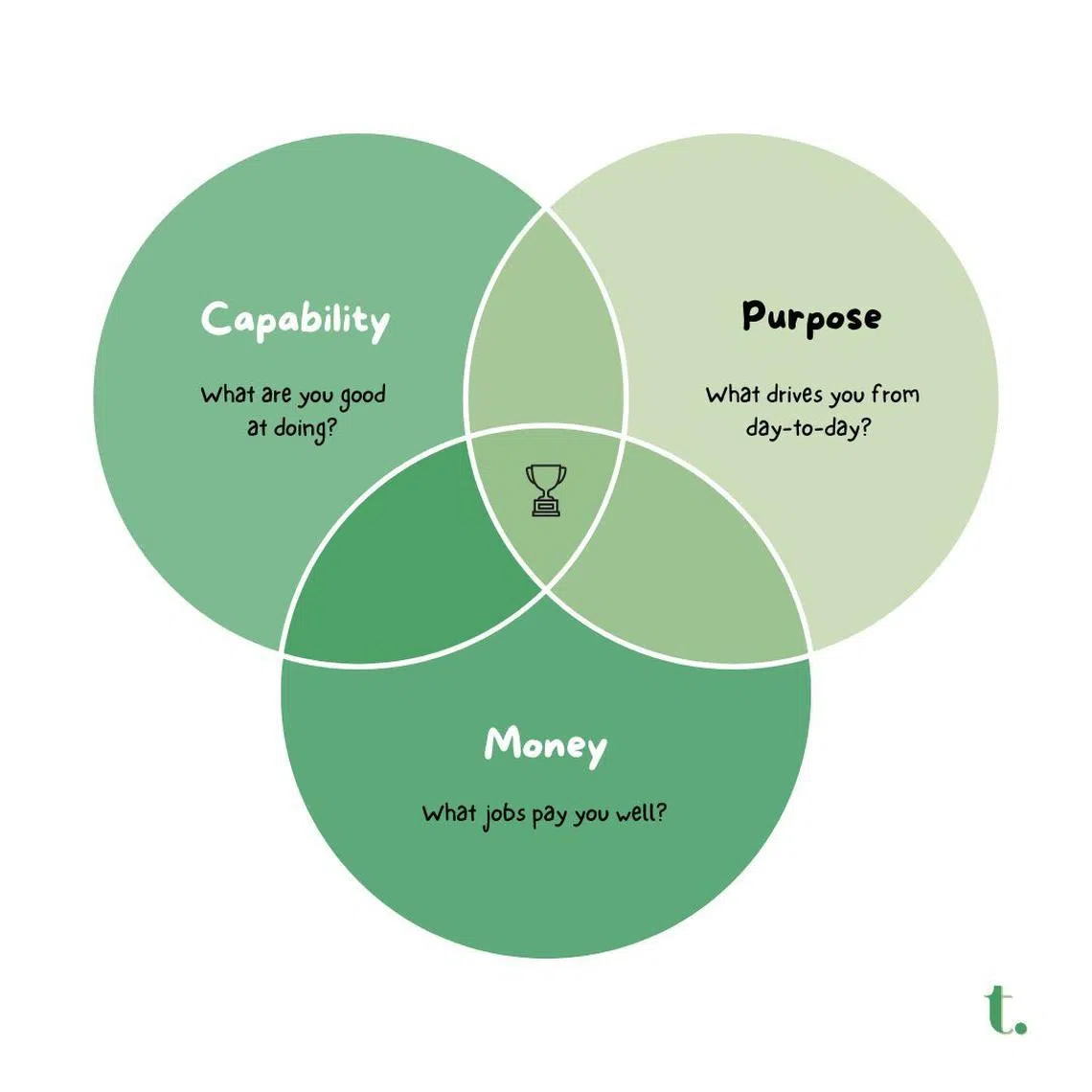
For those who are keen on exploring their passions as full-time careers – that’s okay! But before diving straight in, you may want to ask yourself a few questions:
- Do I have an initial business plan? Think about how you wish to execute this new chapter of your working life in a successful and sustainable fashion. Do you already have a pipeline of potential customers? Be clear about your business case and how you plan to hit milestones.
- Will I be able to establish good boundaries with my new work? In the event that you do pursue your passion full-time, you could easily overwork yourself and spiral into burnout if you don’t know how to stop. Consider what you can do to achieve a healthy work-life balance for yourself. If establishing such boundaries is something you may have trouble with, think carefully about how you wish to proceed.
- Have I reached out to others who have already explored the field? Networking could offer you a better perspective on what you will be getting yourself into. First-hand accounts from those currently in the field you are interested in could offer a realistic picture of your potential experience, rather than a one-sided, romanticised highlight reel of the space.
- Am I willing to face the unique challenges that come with chasing my passion full-time? You may have heard time and again about how it won’t be easy, but will you be able to brave the storms when they come knocking? Can you persevere if some of these struggles are tougher than those at your previous nine-to-five job?
- Have I worked out my finances? Following your passion usually has a cost and it might take some time for you to save enough to make sure you can weather the initial period when you might not have an income.
- What’s my Plan B? While it’s good to go all in, you also need to be able to tell when to cut your losses if things don’t work out.
There’s always a good case for ditching a toxic full-time job – but moving forward to make a livelihood of what was previously a leisurely hobby should never be done on a whim.
If you’ve done your research and are comfortable and confident about a venture you’ve always wanted to take full-time, this could be an exciting new experience for you! But for those who wish to take a leap into the dark, you may want to proceed with caution. Sometimes, certain things are best kept separate. The last thing anyone needs is for their passion to become a chore.
TL;DR
- Pursuing one’s passion full-time can sound enticing, but it can also lead to new and unique sets of challenges ⛰️
- Job and financial security may be difficult to achieve in many areas when people first start out 💲
- People can face a higher risk of burnout when their passions are taken full-time 🤯
- Do proper research to understand the reality of turning your dream into a job, instead of staying blinded to a version of it that may be rose-tinted
- Ensure that a stable financial plan has been mapped out to support your passion, or to cover any unforeseen circumstances that come your way
Decoding Asia newsletter: your guide to navigating Asia in a new global order. Sign up here to get Decoding Asia newsletter. Delivered to your inbox. Free.
Copyright SPH Media. All rights reserved.
TRENDING NOW

ABSD deadline extended to up to 7 years for developers of large en bloc sites to encourage reuse of land

15-month wait-out curb lifted for private property owners buying HDB resale flats

Mortgagee-sale listings hit six-year high in H1 2026 as financing conditions tighten

Knight Frank winds down real estate agency unit, agents to move to OrangeTee & Tie


