The infinite working day where work never ends

Straight to your inbox. Money, career and life hacks to help young adults stay ahead.
[SINGAPORE] Fresh out of university, Sheng, 26, was ready to take on the working world. The corporate sector awarded him 13-hour working days.
Soon, he found himself working with no clear start or finish to his day. Turns out, Sheng – who asked to be identified by his first name – isn’t alone.
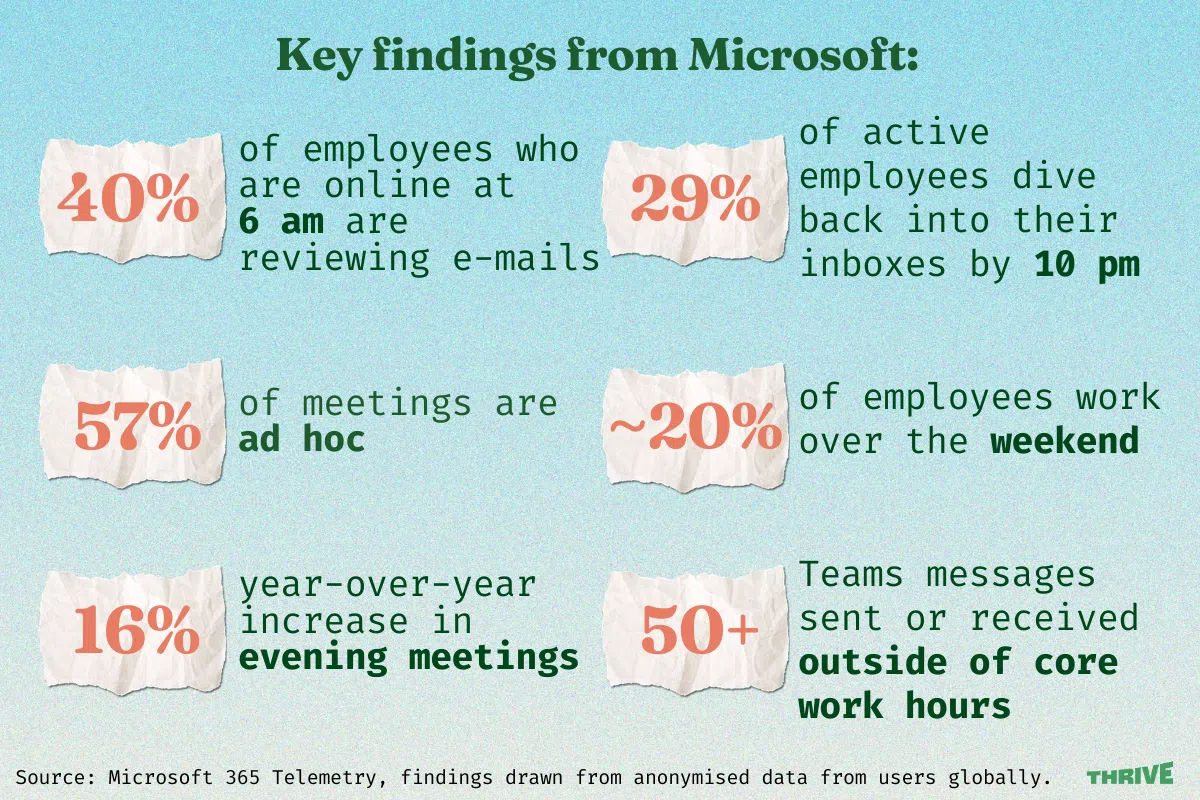
A report by Microsoft, drawn from anonymised Microsoft 365 data from users globally, found that employees are now living in an “infinite” working day – one that begins as early as 6 am and stretches well into the night, as after-hours messages and meetings that cross time zones spill beyond formal office hours.
For a lot of young professionals, this might just be the only version of work we’ve ever known.
♾️ The infinite working day
At Sheng’s first full-time stint at a consulting firm, the day begins at 8 am with a client meeting.
The rest of the morning is reserved for sorting through e-mails and to-dos for the day. That’s until he gets pulled into his first ad hoc meeting, which, like clockwork, always happens right before his lunch.
At least two more impromptu meetings occur later in the afternoon, each lasting anywhere from 30 minutes to two hours.
“Usually, when you’re on-site, people will approach and disrupt your workflow with these ad hoc discussions. Many of which, the person comes unprepared and wastes your time,” he says.
Around 6.30 pm, Sheng grabs his dinner. By 7 pm, he’s back to working on materials for the next day.



“Usually by 8 pm, I’m already zoned out, productivity drops and I work at snail’s pace,” he says.
So why not leave the office? Sheng tells me he feels obligated to work overtime, to prove he’s a valuable employee.
“This company thrives on people who are responsible. The more responsible you are, the more you get squeezed, and 80 per cent of the work is done by these responsible 20 per cent (of workers),” Sheng says.
Most nights, Sheng leaves the office at 9 pm.
Sabrina, 24, an infrastructure engineer, lives a different version of the same story.
Unlike Sheng, she isn’t ambushed by spontaneous meetings. Instead, about 30 e-mails and 20 messages land in her inbox daily, all of which require an immediate reply or action, says Sabrina, who also asked to be identified by her first name.
While she may be out of the office by 6 pm, she’s often back at her laptop past 10 pm, when clients’ troubleshooting requests start flooding in.
Sabrina isn’t spared from work during the weekends and on her days off either.
“Some bosses do not believe in work-life balance, I guess,” she tells me, half-laughing.
🪤 Trapped
Part of why this is happening is structural. Hybrid work and global teams make fixed hours feel almost quaint.
But honestly, I think a lot of it is psychological.
When you’re the newest person in the room, you want to appear nothing short of hardworking. Plus, if everyone seems to be cranking through the night, how can we simply log off on time?
Even if we are not interested in chasing the hustle culture, actually acting on our values is harder than it sounds – especially at workplaces where long hours are the norm.
🔓 Escape
For Sheng, his infinite working day ended only when he quit.
“When I resigned and actually started (working from) nine to six, seeing the evening sun go down when I was leaving felt magical,” he says.
But leaving our jobs isn’t always an option. So how do we reclaim our time without torching our careers?
For starters, if you have completed your tasks and delivered quality work, it is okay to leave the office on time, says Kelly Kan, executive coach and psychotherapist at Wellbeing Inside Out.
“The pressure to conform to these workplace cultures often comes from internal guilt rather than actual job requirements,” she adds.
Many young professionals fear setting boundaries or saying “no” because they think this will cost them a promotion or that working more hours will aid their career progression, she adds.
But most of the time, these are simply assumptions. So, it’s important to distinguish fact from feeling.
When it comes to maintaining clear work-life boundaries, the goal isn’t to never think about work, but being able to tell when work consumes you and making a conscious choice to focus on what matters in the moment, Kan says.
For example, if your mind tends to wander back to work during your downtime, here are some tips that may help:
- Transition rituals: Set aside time to do things that inform your brain that work is over. It can be as simple as doing breathing exercises, changing out of your work clothes, or going for a short walk.
- Grounding exercises: When work thoughts arise during personal time, use your senses – what you see, hear, touch, taste or smell – to anchor yourself in the present. This interrupts the mental loop of work rumination.
- Body scan: Check in with your body for a few minutes, see where you may be holding stress or tension, and release it.
TL;DR
- Working from nine to five may be a thing of the past; the modern day now looks like working with no clear start or finish
- Also known as an infinite working day, young professionals living in this endless time loop find themselves with close to no work-life balance
- Experts say the pressure to conform to unhealthy work habits often comes from internal guilt rather than actual job requirements
- Practicing transition rituals, grounding exercises and body scans can help workers stop being constantly in work mode
Decoding Asia newsletter: your guide to navigating Asia in a new global order. Sign up here to get Decoding Asia newsletter. Delivered to your inbox. Free.
Copyright SPH Media. All rights reserved.