
Can your friendships survive a salary gap?

Straight to your inbox. Money, career and life hacks to help young adults stay ahead.
[SINGAPORE] Months ago, while I was still scouring through LinkedIn for a job, I got pulled into a birthday dinner. The attendees: three fresh-out-of-university friends – two in finance, and one very unemployed (me). One friend suggested a sushi bar along Orchard, way out of my budget. I sheepishly asked for something cheaper, and they countered with a pasta place where mains started at S$20 a plate.
Looking back, that amount seems more than reasonable, especially given the birthday context. But I’d been job hunting for a while, with zero cash flow into my bank account for months. I was honestly nervous about dropping even more money on top of the gift we had already gotten for my friend.
I ended up agreeing to the dinner spot and resorted to cutting my budget for the rest of the week. Credit to my friends – they were kind enough to suggest an alternative. But I couldn’t help feeling slightly miffed. After all, they’d known about my job hunting woes. Then again, I’d agreed to their counteroffer.
With new jobs and salaries, friendships in your 20s may face a new kind of dilemma: what happens when your income brackets and what counts as “affordable” stop lining up?
🕳️ Jumping the wealth gap
A “wealth” gap between friends isn’t as straightforward as a difference in income. Sometimes it’s merely a difference in spending habits and lifestyle expectations.
This can lead to awkward situations, where some friends are more inclined to drop S$20 on sashimi, while others prefer taking their business to their local food court.
Another factor is long-term saving goals, which can leave some with less wriggle room to spend.
“It doesn’t have to be about salary difference, but the difference in amount you have to spare,” says Faith Heng, 23, who works in social services.
“I could be earning S$5,000 a month as opposed to a friend who earns S$3,000. But if I’m saving up for marriage, it could mean having more responsibility to save and less income to spare.”



😠 Where the cracks show
It’s no secret that we Singaporeans take our food seriously. With a slew of budget options, the dinner menu can quickly become a point of contention among friends.
These discussions may get even more heated with the rising cost of living and restaurant prices. Survey findings by YouGov show that one in three Singaporean diners are eating out less frequently, with higher restaurant costs cited as a top reason, followed by higher living costs.
With different wallets and expectations at the table, it can be difficult to choose a place where both parties are truly satisfied.
Travelling together can also surface similar tensions. This is hardly surprising, especially since your party would be juggling tons more decisions beyond the dinner bill.
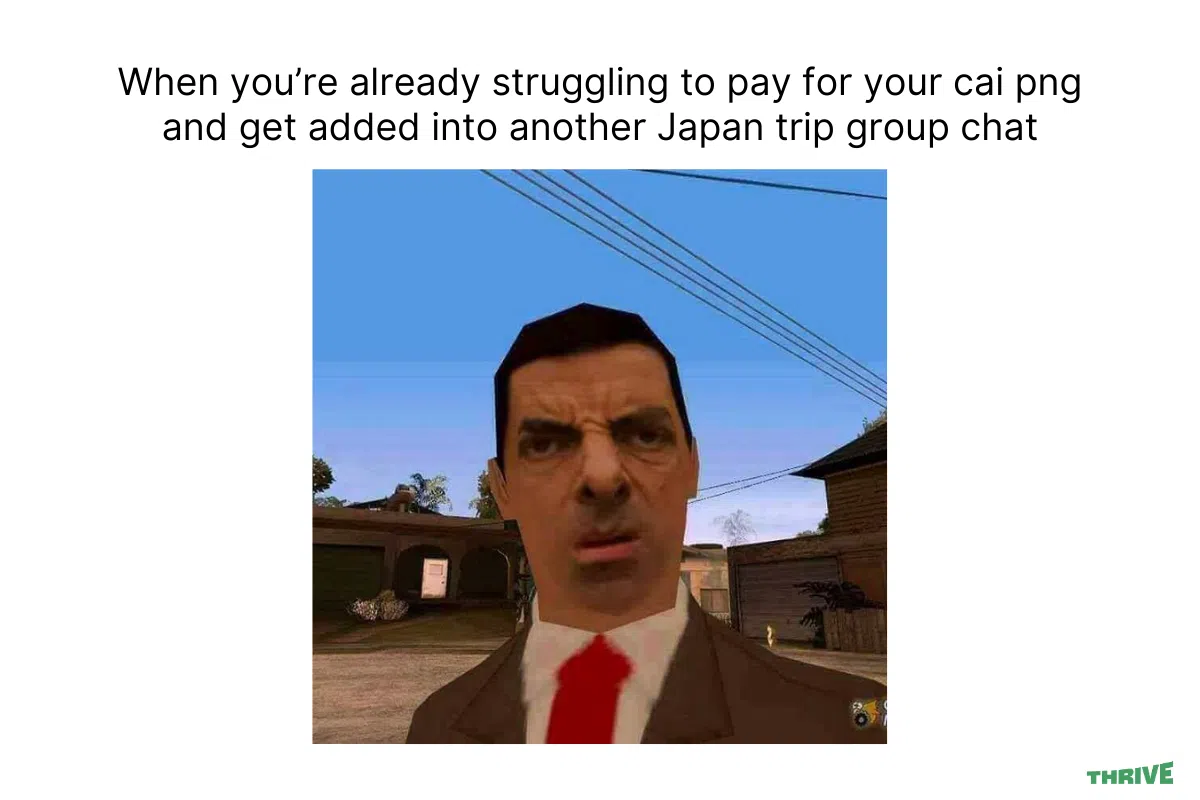
Annie Lee (not her real name), a 24-year-old associate psychologist, experienced this firsthand when she was roped into a trip to Japan with her friends. The plan was a week-long ski retreat in the mountains – an expense that could have set her back about S$4,000.
She raised her hesitations but was met with resistance. In the end, she and several others dropped out of the trip, as the majority of the group was insistent on including skiing in the itinerary.
“It’s just not something I need to spend on now. I would much rather drop that kind of money later when I’m more secure in my finances,” she says.
😓 The emotional toll
Money can be a sensitive topic to raise, especially when the ability to afford expensive things can be tied to things like self-worth and what “success” is supposed to look like in your 20s.
It can be even more pressurising to just say “yes” when you’re the minority in the group, just so you can prove that you can keep up with your friends’ wallets, or for fear of letting them down.

Much of this tension stems from an understanding gap, where it can be difficult to justify your idea of “affordability” and your willingness to spend money.
Asked about her decision to drop out of the Japan trip, Annie points to these differing attitudes.
“They just didn’t seem to understand why I wasn’t willing to spend that much, especially since they know I’m earning an income,” she adds.
💬 Talking about it
Talking about money can feel like a downer. If you’ve ever watched the hit sitcom Friends, one of my favourite episodes is where the group goes out to celebrate Monica’s job promotion.
Half of the group orders freely, while the other half orders the definition of a struggle meal – a side salad, a cup of cucumber soup, and a topping-less pizza.
When the “broke” half raises their inability to afford dining out like the other half, it escalates into a heated argument, with Rachel snapping: “We never should have talked about this!”
Someone told me it’s the topic where no one really wins – you either come off sounding stingy for speaking up, or resentful for staying silent.
But it doesn’t always have to be a painful discussion. Ideally, it should be a two-way street where both sides agree on being transparent and empathetic.
Cassie Lim (not her real name), 23, makes S$10,000 a month working in asset management. While she admits to being more liberal with her spending, she asserts that she would never expect the same of her friends.
“I think it’s my responsibility to match the person with the lower budget. And if we travel together, I can just splurge on other personal items instead of shared costs,” she says.
Looking back, I wish I had been more upfront about my hesitations during that birthday dinner discussion. Knowing my friends, they probably would have compromised without a second thought.
But admitting that I couldn’t afford dinner felt terribly awkward, especially during a time when I was beating myself up for not landing a job as quickly as they did.
At the end of the day, compromises can only go as far as your openness about your budget. While your friends have the responsibility of showing compassion, the ball is in your court to start the conversation.
TL;DR
- Outside of school, old friendships can start to feel the strain of differing financial circumstances
- Wealth gaps can show through lifestyle expectations, not just income
- Talking about money may be hard, especially when friends need to justify what they can afford
- Navigating it well requires transparency and empathy
Decoding Asia newsletter: your guide to navigating Asia in a new global order. Sign up here to get Decoding Asia newsletter. Delivered to your inbox. Free.
Copyright SPH Media. All rights reserved.