
How to lower your tax bill before the year ends

Straight to your inbox. Money, career and life hacks to help young adults stay ahead.
[SINGAPORE] If you earn an income, chances are, you’ll have to pay personal income tax.
As unavoidable as taxes are, not every dollar you earn is subject to tax. There are tax reliefs and deductions that can bring down the amount of income – or what’s known as your chargeable income – that you are taxed on.
Some, such as the Earned Income Relief, are granted automatically. The same goes for the Central Provident Fund (CPF) Relief, if your employer is part of the Auto-Inclusion Scheme for Employment Income.
Others require a little more planning on your part.
How do tax reliefs work?
A S$10,000 tax relief doesn’t mean that you pay S$10,000 less in taxes – though I sure wish I earned enough to have a tax bill that high.
Instead, tax reliefs reduce your chargeable income.

Say you earn S$40,000 this year and are eligible for S$10,000 in personal tax reliefs. Assuming no other deductions, your chargeable income would become S$30,000.
Based on the tax brackets, that brings your tax bill down from S$550 to S$200, or a saving of S$350.
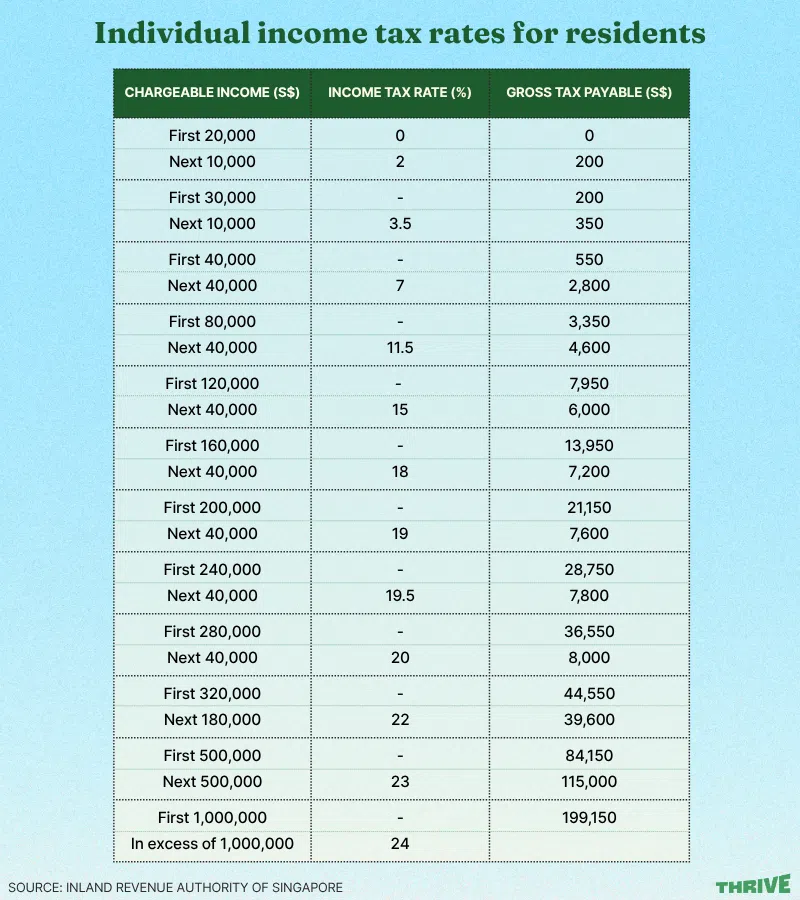
One thing to note: There’s a cap of S$80,000 on the total amount of personal income tax reliefs you can claim each year.



Here are three things you can do by Dec 31 to lower your tax bill next year.
1. Top up your CPF
If you’re a salaried employee, you’re already setting aside a portion of your salary into your CPF accounts every month, on top of contributions from your employer.
But there’s a tax incentive to put a little more towards retirement.
Under the CPF Cash Top-Up Relief, you can get up to S$8,000 in tax relief for voluntary cash top-ups to your CPF accounts, and another S$8,000 for top-ups to your family members’ accounts.
These family members include your parents, grandparents and in-laws. If your spouse or sibling had an annual income of not more than S$8,000 in the preceding year, top-ups to their account may also qualify.
Cash top-ups to your own or your family members’ Special, MediSave or Retirement accounts may qualify for tax relief.
How much you can top up and qualify for tax relief depends on the recipient’s existing CPF savings. Tax relief is only granted for top-ups up to the Full Retirement Sum for retirement savings and the Basic Healthcare Sum for MediSave savings.
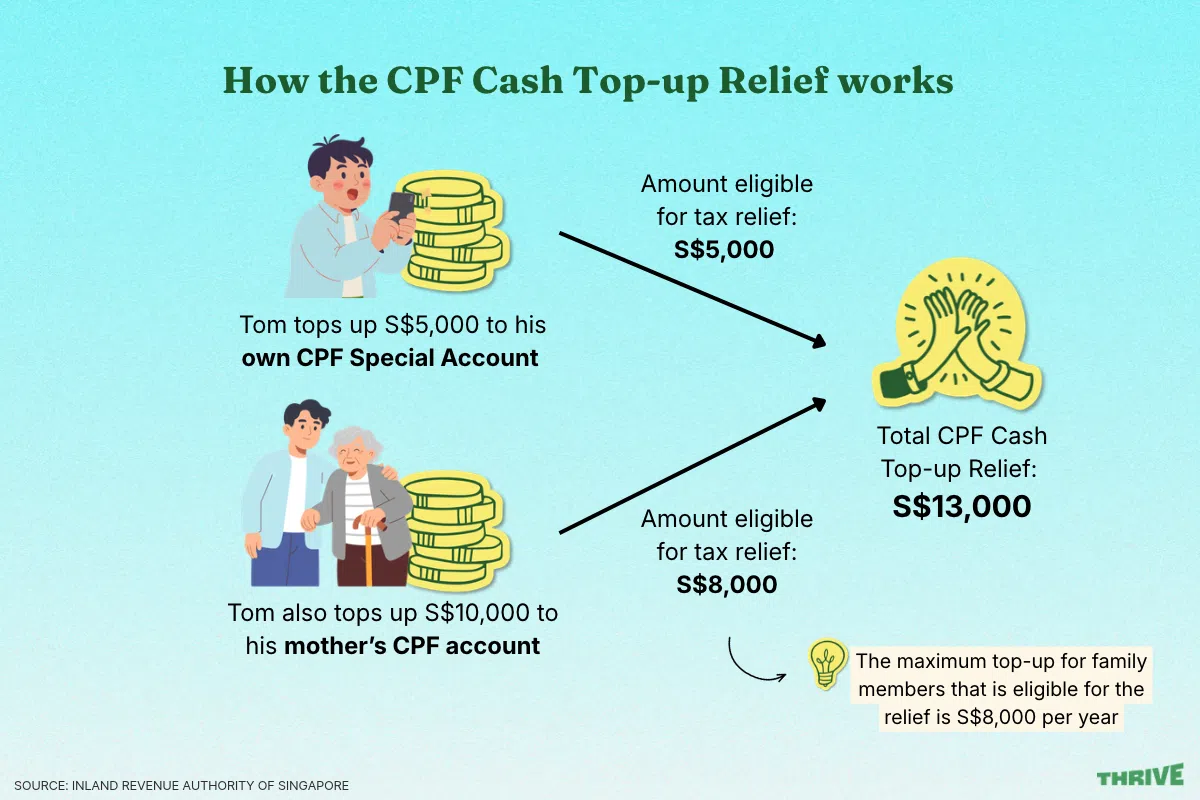
The CPF Cash Top-up Relief is automatically granted, so you do not need to make a manual claim.
A couple of things to note when making your top-ups:
- Only cash top-ups qualify for tax relief. You won’t get relief for transferring money between CPF accounts
- The portion of your top-ups that attracts government matching grants under the Matched Retirement Savings Scheme or the Matched MediSave Scheme does not qualify for tax relief
Perhaps the most important consideration, especially if you’re in your 20s or 30s, is that retirement top-ups are irreversible.
If you’re saving up for a home, for example, you won’t be able to put that money towards your down payment. So, make sure whatever you’re topping up is money you’re comfortable setting aside for retirement.
2. Put some money into an SRS account
Another way to get tax relief while saving for retirement is through the Supplementary Retirement Scheme (SRS).
You can open an SRS account with any of the three local banks and contribute up to S$15,300 a year if you’re a Singapore citizen or permanent resident.
Eligible contributions made to your SRS account by Dec 31 (or your bank’s earlier cut-off date) will be eligible for a dollar-for-dollar tax relief, subject to the overall personal income tax relief cap.
The SRS Relief is granted automatically based on the information provided by your SRS operator. So you do not need to make a manual claim.
Unlike your CPF savings, however, idle cash in your SRS account typically earns just 0.05 per cent interest a year.
The money in your SRS account can instead be invested in approved exchange-traded funds, shares, unit trusts, bonds or fixed deposits for potentially higher returns.
That money is locked up until the statutory retirement age when you make your first SRS contribution. If you do so after Jul 1, 2026, that would be 64 years old.
You do have the option of taking money out of your SRS account early, but doing so generally incurs a 5 per cent penalty, on top of the tax you’ll have to pay on the withdrawal amount.
So, as with CPF top-ups, think about whether you might need that money in the foreseeable future before making a contribution.
3. Give to charity
If you’ve been meaning to give to a cause you care about, here’s another reason to do so before the year ends.
Donating to approved charities or the Singapore government can get you tax deductions of up to 2.5 times the qualifying donation amount.
In other words, a S$1,000 donation to an eligible charity would bring your chargeable income down by S$2,500.
Unlike CPF cash top-ups and SRS contributions, tax deductions from qualifying donations do not count towards the S$80,000 personal income tax relief cap.
Not all charities qualify, so check that the organisation is an approved Institution of a Public Character (IPC).
Be sure to provide your identification number when donating so that the deduction can be automatically reflected in your tax assessment next year.
Other reliefs you may qualify for
Aside from the things you can do between now and Dec 31, there are other tax reliefs you might already be eligible for based on your personal circumstances.
Parent Relief (up to S$9,000 per dependant, or S$14,000 per dependant with a disability): If you’ve been supporting your parents, grandparents or in-laws, you may qualify for this relief. Generally, your dependant has to be aged 55 or above, live in Singapore and have an annual income of no more than S$8,000. If you don’t live with them, you’ll need to have spent at least S$2,000 supporting them over the year.
Qualifying Child Relief (S$4,000 per child): If you have an unmarried child who is below 16 or studying full-time, and whose annual income does not exceed S$8,000, you may qualify for this relief. The relief can be shared between you and your spouse.
Working Mother’s Child Relief: On top of the Qualifying Child Relief, eligible working mothers with Singaporean children born or adopted from Jan 1, 2024, can claim S$8,000 for their first child, S$10,000 for their second child and S$12,000 for each subsequent child. For children born or adopted before 2024, the relief is calculated as a percentage of the mother’s earned income.
Should you try to maximise your tax reliefs?
While it’s nice to get a smaller tax bill, it may not always make sense to set aside thousands of dollars just to save a few hundred in taxes.
If you’re already planning to put some money away for retirement or give to charity, you might as well take advantage of the tax savings that come with doing so.
But if you have more pressing financial commitments, there’s no need to scramble to make these contributions before the year ends.
Decoding Asia newsletter: your guide to navigating Asia in a new global order. Sign up here to get Decoding Asia newsletter. Delivered to your inbox. Free.
Copyright SPH Media. All rights reserved.
TRENDING NOW

Nvidia halts chip shipments to 4 countries in South-east Asia, including Singapore: FT

Should Keppel swoop in to snare Mapletree Investments?

OCBC opens 100-tonne gold vaulting facility to meet growing institutional demand

‘Very disappointed’: Singapore disagrees with US tariff rationale, to seek lower levies


