
🔑 Should you invest your CPF?

Straight to your inbox. Money, career and life hacks to help young adults stay ahead.
[SINGAPORE] For all the time I spend obsessing over my savings apps and investment portfolios, I’ll admit that I rarely think about my Central Provident Fund (CPF) accounts.
After all, it kind of feels like money I don’t often get to touch, locked away for a future home, healthcare bills and retirement decades down the road.
That is, until I inevitably come across an advertisement or a finfluencer encouraging people to invest their CPF money. Suddenly, I start wondering if I should be doing something with mine too.
But unlike putting your spare cash to work, investing your CPF money is a bit more complicated. Here’s what you need to know before making that decision.
🚿 A quick refresher on CPF
Every month, a portion of your salary is channelled into your CPF, which is split into three accounts:
- The Ordinary Account (OA), which can be used to pay for housing, basic insurance and tuition fees. It earns a guaranteed 2.5 per cent interest per year.
- The Special Account (SA), which is reserved for retirement and has a higher interest rate of 4 per cent.
- Medisave, which covers healthcare expenses. This also earns 4 per cent interest per year.
For most young adults, the OA is the account they’ll interact with the most, whether it’s to pay for their first HDB downpayment or monthly mortgage repayments.
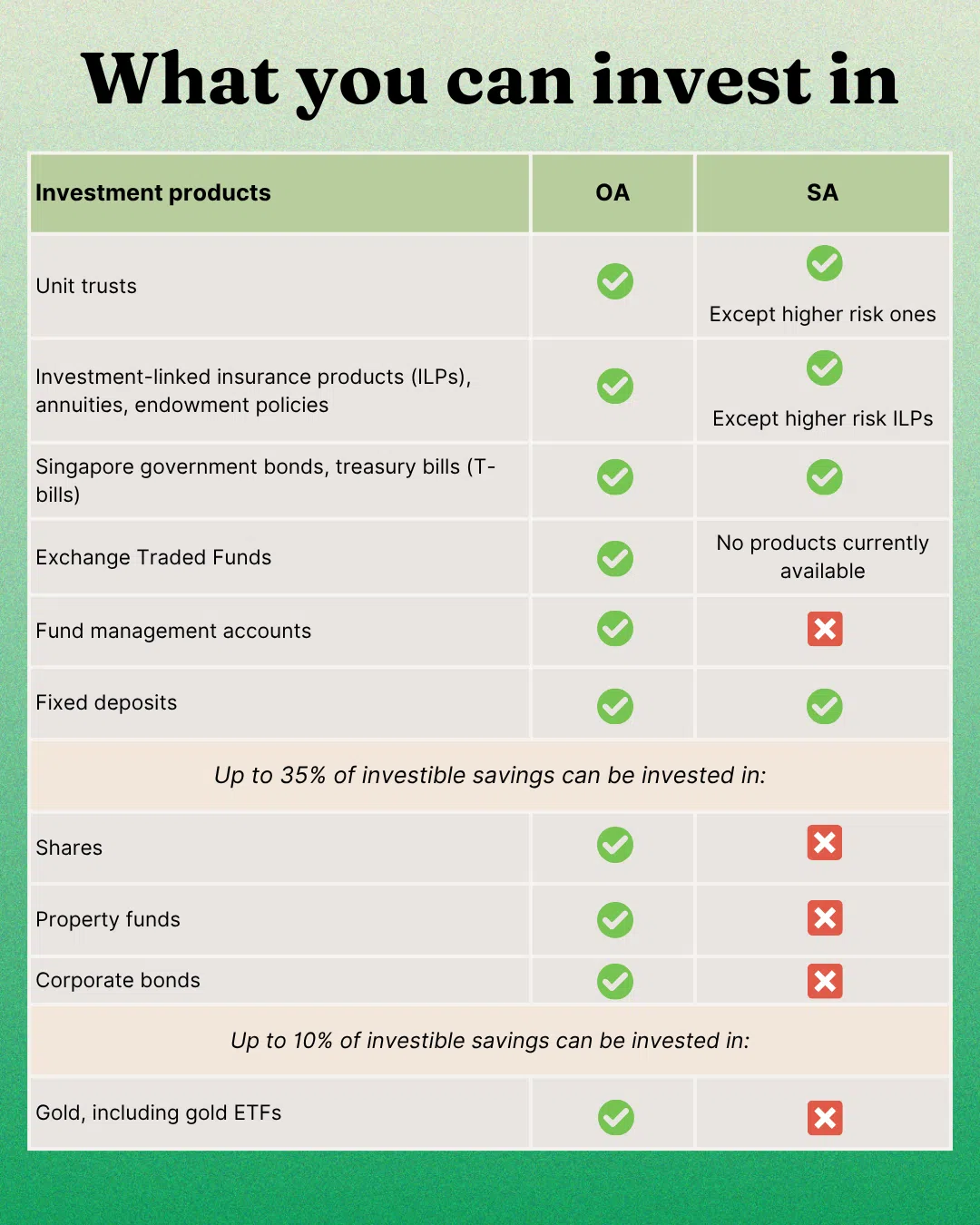
When you turn 18 years old, you’ll be able to invest money that’s in your OA and SA, but there are some criteria to meet:
- To invest money in your OA, you’ll need to first set aside S$20,000 in your account
- To invest your SA, you’ll need to set aside S$40,000
The restrictions make sense because CPF members below 55 receive an extra 1 per cent on the first S$60,000 of their combined CPF balances (capped at S$20,000 for OA).
You’ll also need to pass a quiz on the CPF investment scheme before you can start investing.



Specifically for investing your OA, you’ll also need to open a CPF investment account with one of the three local banks – DBS, OCBC or UOB.
📈 Why some choose to invest
Tan Chin Yu, advisory lead at fee-only wealth advisory Providend, said he typically does not recommend clients invest their SA funds.
“With its 4 per cent risk-free return, CPF SA offers one of the best guaranteed rates available, and it rarely makes sense to take on market risk for only marginal potential gains,” he tells thrive.
As for your OA, the argument for investing your funds is that the 2.5 per cent interest it offers may not be able to beat inflation.
From 1965 to 2024, Singapore’s average rate of inflation was 2.61 per cent. That means that the value of your OA funds would have declined on average over those years if left alone.
Investing those funds would help you not just keep up with inflation, but grow your retirement nest egg, advocates argue.
Plus, since you can’t withdraw your CPF OA until you’re 55 anyway, it’s a great way to invest in assets such as stocks, which have historically returned about 7 to 10 per cent on average over the long term, they add.
🤔 Should you do it?
Whether it makes sense to invest your CPF OA also comes down to some practical considerations.
If you plan to buy a home soon, it’s wise to keep OA funds untouched. You’ll need them for your down payment and mortgage repayments. Investing this money in long-term assets could mean having to sell at a loss during a market dip if you need to free up cash quickly.
If you have little investment experience, leaving your OA funds to grow at 2.5 per cent might actually be the smarter move. It’s risk-free and frees you from the anxiety of market swings.
CPF’s own data from previous years showed that half of CPF investors ended up earning lower returns than if they had simply left their funds in their OA.
A common pitfall, particularly for young adults, is viewing CPF investing as a shortcut to grow wealth, says Tan.
“In reality, those in their 20s would benefit more from focusing on building strong financial habits,” he says. These include spending below their means, setting aside an emergency fund, ensuring adequate insurance coverage, increasing their income, and preparing for major upcoming expenses.

Before deciding to invest your CPF, consider using cash first – especially if your cash is not earning you interest that can beat the guaranteed 2.5 per cent the OA offers.
Some investors also treat their CPF savings as the “bond” component of their portfolio, allowing them to maximise the potential returns of investments made with cash.
For all the talk about making your CPF “work harder”, it’s also worth appreciating CPF savings as what they are – a safety net that gives a guaranteed return with no volatility.
In that way, the CPF forms the foundation of your retirement plan, providing stable returns regardless of market conditions, says Tan.
Your cash savings and investments can then be layered on top to grow your wealth, with the assurance that your basic retirement needs are covered.
When structured well, these two buckets can complement each other to build a more resilient and long term financial strategy.
TL;DR
- CPF OA funds left uninvested could lose value due to inflation
- But it’s also hard to find alternatives to a risk-free, guaranteed 2.5 per cent interest
- If you’re planning to buy a home, it may be wise not to invest your OA funds for now
- There’s merit to viewing your CPF as your safety net for retirement
Decoding Asia newsletter: your guide to navigating Asia in a new global order. Sign up here to get Decoding Asia newsletter. Delivered to your inbox. Free.
Copyright SPH Media. All rights reserved.