
🙍 Has your work and personal life been affected by adverse childhood experiences?

Straight to your inbox. Money, career and life hacks to help young adults stay ahead.
- Find out more and sign up for thrive at bt.sg/thrive
💸 Trauma costs (literally)
Everyone has been through some degree of hardship in their lives – but when do these events have more longstanding and severe consequences than expected 🤔? A study that began in 2016 conducted by the Institute of Mental Health (IMH), in collaboration with KK Women’s and Children’s Hospital (KKH), found that ACEs cost Singapore’s economy an estimated S$1.18 billion per year.
The impact of ACEs can continue across a person’s lifespan and lead to higher costs of healthcare and productivity losses at work, say the researchers.
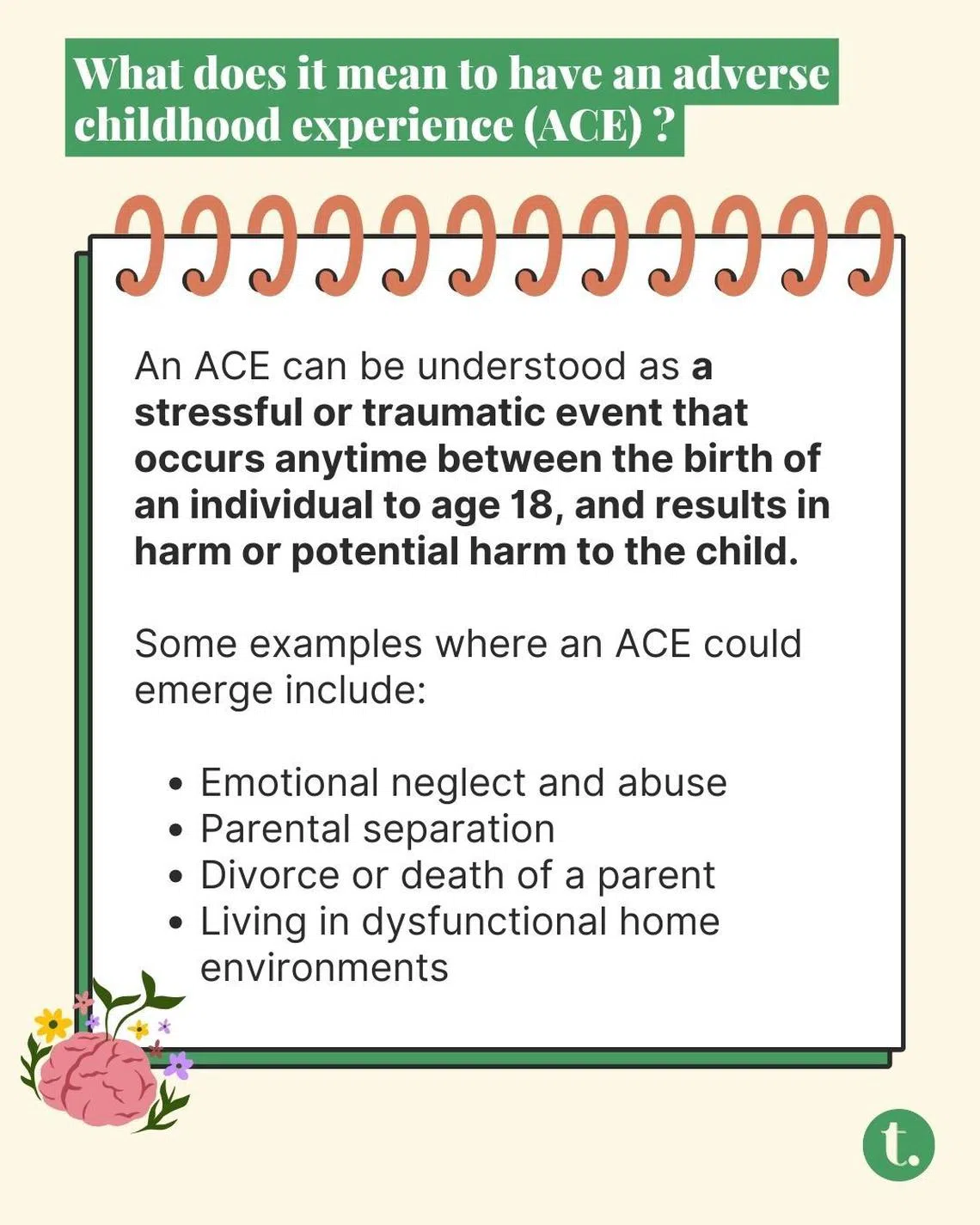
Plus, these costs are pretty steep 📈. The researchers found that the average excess costs incurred by a person with an ACE is S$767 per year, compared with a person with no ACE and S$2,168 more every year for someone who faced three or more ACEs.
In Singapore, 63.9 per cent of the adult population have experienced at least one ACE, according to the study.
However, the impact of ACEs on those who experience them extends far beyond increased healthcare costs and lower productivity levels, says Esther Oon-Bybjerg, a psychotherapist at Counseling Perspective, in an interview with thrive.
“A common outcome I have seen (with clients) is that those with severe ACEs tend to have low self-esteem, high self-doubt levels, and struggle with confidence,” she says.
“This could make it difficult for them to advocate for themselves in life or at work, such as pursuing a promotion or asking for a raise, for example.”
She adds that things such as emotional regulation and even cognitive functioning can be compromised by ACEs. “For some, this can result in challenges in meeting job demands, potentially leading to underperformance. These patterns, in the long run, can impede their career progression and personal growth in many ways.”
😨 How do I know if I’m affected by an ACE?
Deep levels of stress are often an indicator that someone may not be doing well and experts have noted that chronic stress can be caused by traumatic childhood experiences.

But how do we know if we are simply encountering day-to-day stresses or something more severe like chronic stress caused by an ACE?
Oon-Bybjerg explains that while normal stress is something we experience in response to short-term challenges, like preparing for a big presentation or dealing with a tight deadline, chronic stress isn’t so temporary.
“Chronic stress tends to be an ongoing, persistent form of stress that lasts for weeks, months, or even years,” she says.
Oon-Bybjerg adds that chronic stress isn’t to be taken lightly because it keeps the body in a constant state of alert, which can lead to severe health problems such as heart disease, a weakened immune system, high blood pressure and persistent mental health conditions.
This can be caused or compounded by traumatic stress an individual has experienced in the past, such that they experience flashbacks, nightmares or intrusive thoughts where they struggle to function in their daily life.
Diane (not her real name), 26, who works as a media professional in Singapore, can relate to how living with the effects of an ACE can disrupt basic day-to-day living. She recounts how she dealt with insomnia for over five years due to an ACE, and is still recovering from it today.
“I was constantly fatigued and unable to focus in school and at work – I felt quite incapacitated in life. It’s taken a lot of work (on my own and with my therapist) to release many anxieties I’ve held and developed over the years,” she says.
According to Oon-Bybjerg, there is a common test that individuals can take to find out their ACE score. The higher the number, the more severe the ACE:
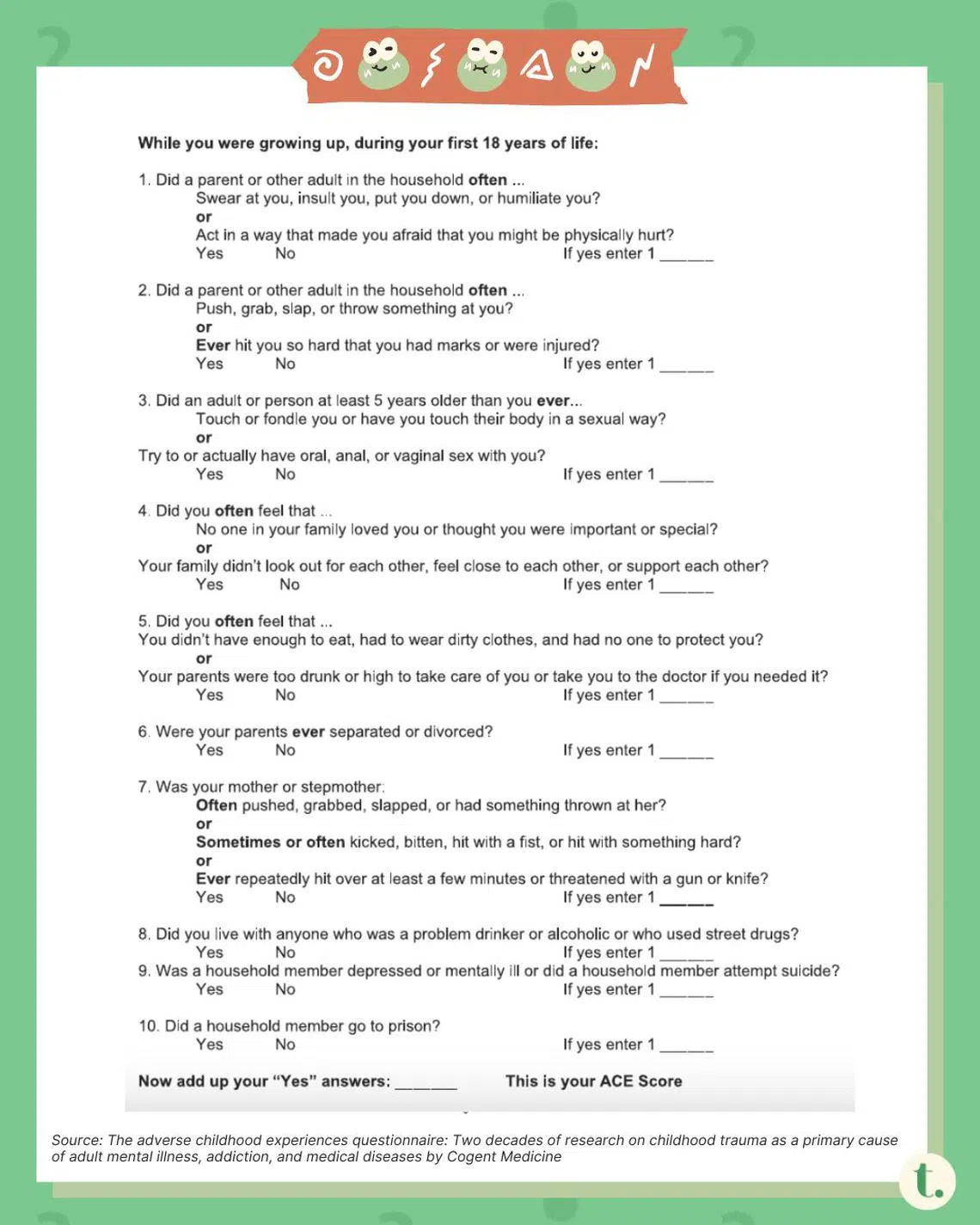
These ACE scores give mental health professionals a guide to understanding some of the client’s emotional, psychological and physiological symptoms that require attention.
However, Oon-Bybjerg also says that ACE scores don’t tally the positive experiences in early life that can help build resilience and protect a child from the effects of trauma.
“There are some people with high ACE scores who are thriving,” she explains. “Having a caring and loving grandparent, or a teacher who understands and believes in the child may mitigate the long-term effects of early trauma.”
👣 First step towards healing
Living with the aftershocks of an ACE, even into young adulthood, is a serious matter. Oftentimes, these traumatic experiences cut so deeply that we may live with the repercussions without being fully aware of how much we’ve been hurt.
Usually, in the case of resolving the impact of ACEs, speaking with a mental health professional would be most helpful to nip any problems in the bud once and for all. It’s challenging to take the first step, but a perspective from a licensed professional could be what it takes to move forward towards a life healthily 🧠.
Here are some steps you can take to work towards understanding any ACEs you may have and hopefully build the courage to seek the help you may need:
- Be patient with yourself: Confronting some unpalatable past experiences can be difficult, so don’t over-scrutinise the pace in which you face these issues. Remember that it’s your journey and yours alone. It’s not a race, and any form of comparison should be taken out of the picture 🙅.
- Write down what you went through and how you feel: This can be tough, so patience with yourself still applies here! It’s definitely not easy to bring up traumatic memories and visualise them on paper. However, if it clarifies where some trauma points lie and what you’re currently experiencing, this could help you understand what help and support you truly need. It could even be a pretty cathartic and therapeutic experience to release some hurts from your past.
- Seek professional help: Working with a mental health professional could allow you to unpack certain past traumas in more detail and provide guidance on how to heal effectively from these experiences. Licensed therapists could also prescribe techniques that could help you let go of negative habits or thoughts that could be hindering you in work and life.
We all come from different backgrounds – and while some journeys have been rockier than others, they don’t define us. Wouldn’t it be a waste to keep around any old, dysfunctional habits that fail to serve us? Perhaps, with the right help and support, you’ll reach greener pastures in the days ahead and leave painful childhood moments behind ❤️🩹.
TL;DR
- Individuals who have undergone ACEs can lead to higher healthcare costs and productivity losses at work 🥺
- ACEs can compromise one’s cognitive functions and emotional regulation abilities
- At its worst, people with struggling to deal with ACEs could potentially develop severe health issues such as high blood pressure, heart disease and chronic sleeping problems
- Do consider seeking professional help to receive tailored support and care to recover adequately if you are struggling with the effects of an ACE in your life
Decoding Asia newsletter: your guide to navigating Asia in a new global order. Sign up here to get Decoding Asia newsletter. Delivered to your inbox. Free.
Copyright SPH Media. All rights reserved.