
Is this trending app revealing how lonely we are?

Straight to your inbox. Money, career and life hacks to help young adults stay ahead.
[SINGAPORE] The question “Are you dead?” popped up on my screen the other week – not as a text from a friend I’d unintentionally ignored, but as a headline.
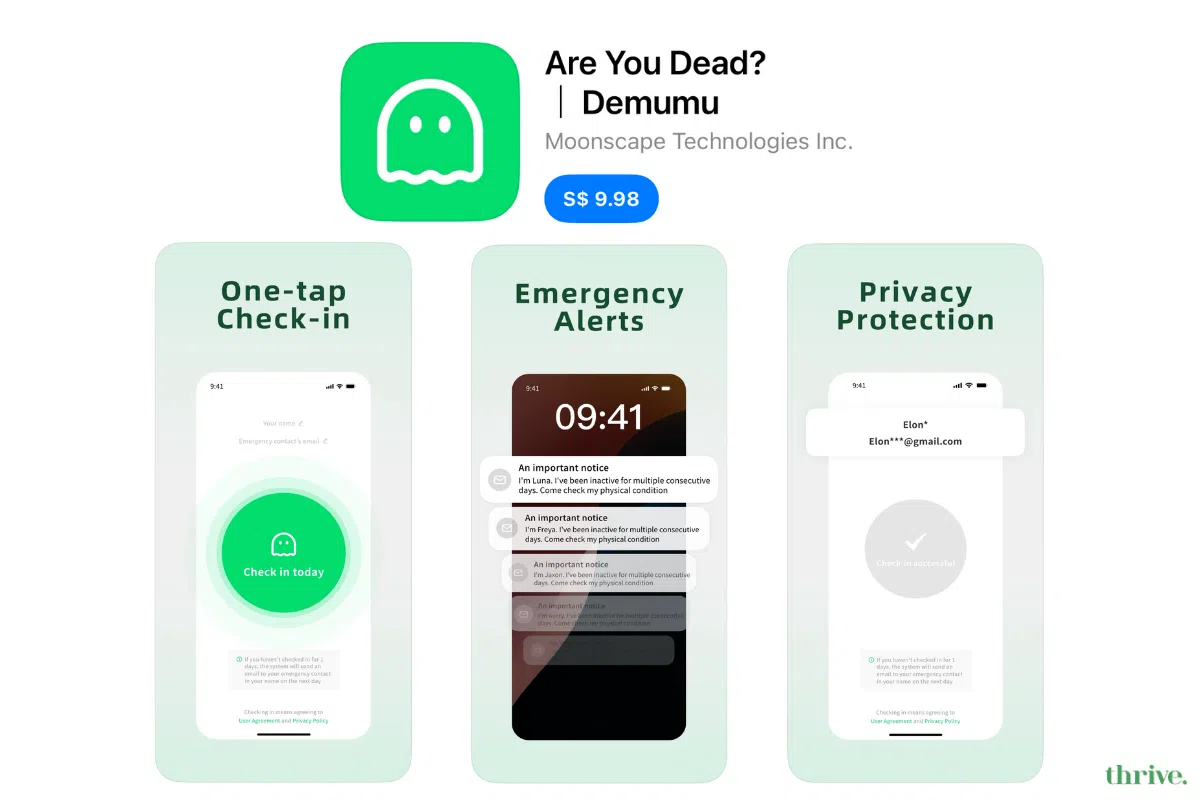
An app literally named “Are you dead” has been surging in popularity in China.
Its premise is straightforward. Users tap a big green button to check in daily. Fail to do so for two consecutive days, and an emergency contact nominated by the user gets alerted.
Targeted at young people, the app bills itself as a safety tool made for solo dwellers, who may be “alone but not lonely”.
For a while, it was the app everyone was talking about in China – where many young people live alone in cities. It has since reportedly been removed from China’s Apple App Store.
But even in Singapore, despite a steep S$9.98 price tag, the app climbed to the top in the paid utilities category of the Apple App Store. It has since fallen to 20th place at the time of writing.
The app’s blunt name and its popularity feel very in line with the times we live in. The rise of an app simply designed to track whether users are alive fits into the broader nihilistic youth-driven trends seen over the past few years.
From “quiet quitting” to China’s “lying flat” movement, and Japan’s “hikikomori”, it’s clear young people are worn out by job pressures, societal expectations and an increasingly uncertain future.
Gen Zs have also been labelled the loneliest generation.



When an app reduces being alive to a daily check-in, it raises the question: is this just another viral gimmick or a reflection of something deeper?
🌱 Proof of life
For an app that seems so simple, the market for it in China is understandable.
Economic pressures and harsh workplace competition have led many Chinese in their 20s and 30s to delay marriage and childbearing, which means more young people are living on their own.
By 2030, nearly 200 million people may be living alone, as China’s solo living rate exceeds 30 per cent, according to state newspaper Global Times.
While the app was originally built as a safety tool for people living alone, it has since gone on to tap into a deeper emotional need. For some, it quells a nagging fear of being unseen or unnoticed by serving as a daily affirmation that someone, somewhere, might still care.
Launched in 2025, the app went viral only this year, before eventually going behind a paywall.
Besides Singapore, the app – listed internationally as Demumu – has also ranked highly in app stores worldwide, including the US, Australia and Hong Kong. It’s a reminder that social isolation and loneliness aren’t confined to one country.
🤔 Will it work locally?
I was sceptical about the app’s relevance in smaller cities like Singapore – where the furthest you can be from someone is Tuas to Changi.
So, I spoke to a friend who’s living on her own. She tells me that she doesn’t need an app like Demumu for safety – at least for now. But she admits that since living on her own, she has felt lonelier.
And loneliness isn’t just about being physically alone. Many of us live with our families well into adulthood or move into Build-To-Order flats with partners, yet we may still feel empty.
In fact, young Singaporeans are more likely to report higher levels of social isolation and loneliness.
Social isolation remains one of the biggest challenges for younger workers here, fuelled by the lingering effects of the Covid-19 pandemic, economic uncertainty and changing work environments, according to the 2025 Telus Mental Health Barometer.
For clarity: social isolation refers to having objectively few social contacts or interactions, while loneliness is the subjective feeling of discomfort due to a perceived lack of social connections.
So while Singapore is small, I can see why some might reach for apps like Demumu – not for safety, but for comfort.
Because admitting we’re lonely is hard. And having something that automatically checks in on us every day can feel reassuring.
🫂 In-person interactions matter
In theory, living in a hyperconnected world should make us feel less lonely.
But in practice, surface-level digital interactions often lack real emotional intimacy, which experts say can leave people’s underlying loneliness unresolved.
A recent survey by the Institute of Policy Studies found that while 43.5 per cent of young Singaporeans – aged 21 to 35 years old – have online friends, in-person ties remain the most meaningful.
I’ve noticed that too. We chat and forward reels to our friends online, often promising to “meet soon!” But when it comes to actually making plans, suddenly no one’s free.
I can’t point fingers because I am also guilty of this. With the constant pressure to always be “productive” or doing something beneficial to my career or personal development, social time is often the first thing to go.
But that comes at a cost: social isolation and loneliness are linked to higher mortality risks and are equivalent to smoking 15 cigarettes a day.
If carving out time to connect with friends and family really does help us live longer, fulfilling lives, maybe some work can wait.
Having a few fixed hours each week to connect with people you care about can make even the loneliest weeks feel a little lighter.

TL;DR
- An app named “Are you dead” has gone viral among young people as a safety check-in tool
- Its popularity highlights deeper struggles with social isolation and loneliness globally
- Even in a hyperconnected world, meaningful in-person ties still remain essential for our well-being
Decoding Asia newsletter: your guide to navigating Asia in a new global order. Sign up here to get Decoding Asia newsletter. Delivered to your inbox. Free.
Copyright SPH Media. All rights reserved.
TRENDING NOW

LTA proposes combining car COE categories, adding rebate-surcharge system

StarHub to acquire MyRepublic’s mobile business amid ongoing telco consolidation

DBS, OCBC, UOB rout lops billions off STI as inflation, rate concerns spook investors

Grab CEO’s wife Chloe Tong on life with Anthony Tan and finding her purpose


