

Air cargo operators fly into turbulence; Asia-Pac a drag on global numbers
Trade war contributes to 7% year-to-date slide in Asia-Pac volumes; SIA, Cathay Pacific expected to be harder hit than regional peers

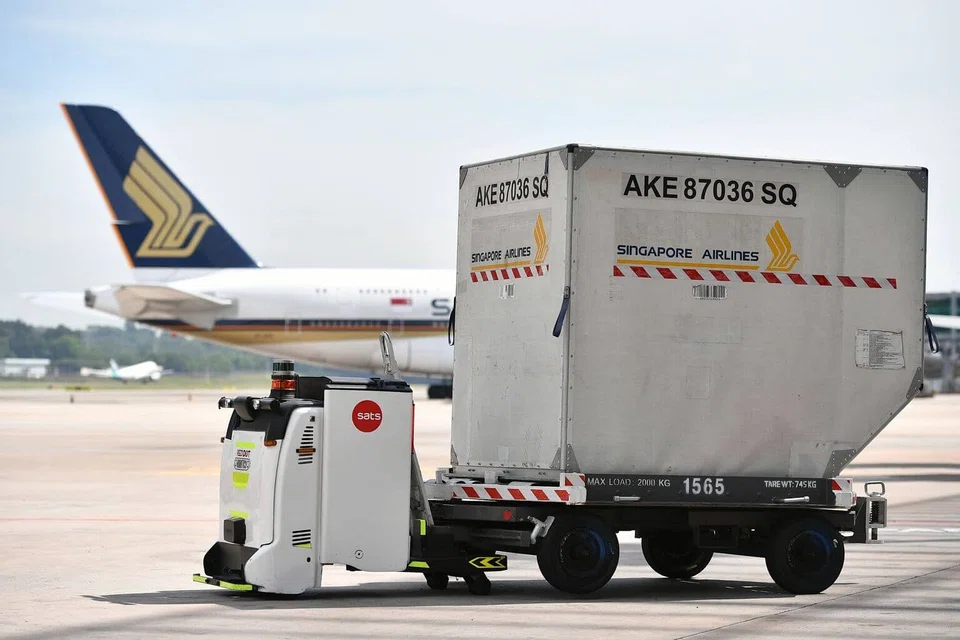
Singapore
THE slowing global economy and US-China trade war are weighing on Asia Pacific's air cargo market, with carriers such as Cathay Pacific and Singapore Airlines (SIA) expected to be harder hit owing to their exposure to their individual export hubs.
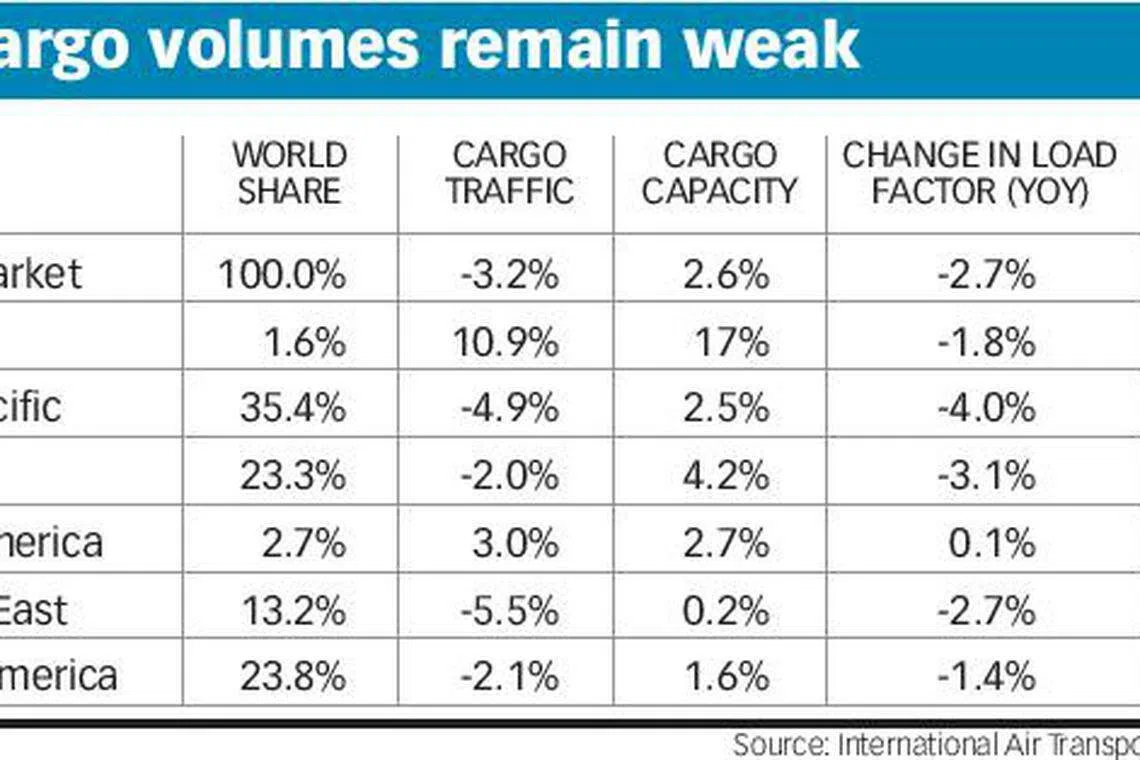
According to the latest figures from the International Air Transport Association (Iata), the Asia-Pacific suffered a 4.9 per cent decline in cargo traffic in July and a 7.1 per cent fall year-to-date. In particular, the US-China trade war and weaker manufacturing conditions for exporters in the region have significantly affected the market, Iata said.
Globally, in the first seven months of the year, air freight volumes were down 3.5 per cent from a year ago, dragged down partly by the Asia-Pacfiic region, which accounts for over 35 per cent of the global market. Another factor was last year's high base as the cargo market came off 18 months of strength, one analyst pointed out. Capacity was also injected at the time in response to brisk business, creating a supply overhang now as demand wanes.
Cathay Pacific - which receives around a quarter of revenue from its cargo business - is facing the double whammy of a softening cargo market as well as weaker passenger demand caused by the ongoing protests in Hong Kong.
In August, its group cargo volumes slumped by 14 per cent year-on-year, with load factor sliding 7.5 percentage points to 60.9 per cent. The number of passengers carried dropped 11.3 per cent, while passenger load factor shed 7.2 percentage points to 79.9 per cent.
UOB Kay Hian analysts K Ajith and David Lee said that for SIA, cargo traffic declined by 10.2 per cent year-on-year in August, the steepest decline since March 2019, with cargo load factor falling six percentage points.
They expect cargo yields to remain weak in the coming months. Year-to-date FY20, cargo traffic has declined 5.9 per cent, while load factor was 58.2 per cent, marginally lower than 1QFY20's 58.7 per cent. They said: "This bodes ill for SIA's cargo business in 2QFY20 as cargo revenue fell by S$44.6 million in 1QFY20."
The two analysts estimate that SIA Cargo, which contributed about 15.4 per cent to the parent airline's revenue in FY19, will see a 10.3 per cent slide in revenue for FY20, and clock a cargo load factor of 58.5 per cent.
However, underlying demand for passenger traffic at the parent airline remains strong - albeit potentially at the expense of yields - growing 8.1 per cent in August, while load factor went up by 1.5 percentage points. The analysts said that year-to-date for FY20, passenger traffic has increased 8.5 per cent and load factor, by 1.2 percentage point.
DBS Bank aviation analyst Paul Yong, who has a "buy" call on SIA, expects earnings to pick up for Singapore's flag carrier. He said: "SIA's passenger business has started showing signs of benefiting from their transformation programme. And despite the fact that cargo has been weak the last two quarters, performance for the parent airline is still fairly decent. Earnings are expected to improve going forward due to the continued improvement on the passenger side of the business."
Korean Air Lines too has been suffering from falling cargo volumes and revenues.
On the other hand, Mr Yong said those less affected include regional players such as the big three Chinese carriers (China Southern, China Eastern and Air China), Thai Airways and Air Asia. He added: "China's air cargo market has never been strong for the big three, mainly because there is a lot of supply in terms of cargo capacity. Meanwhile, for budget carriers such as Air Asia, cargo is not a core part of their business. They also have less bellyhold capacity owing to their narrow-body fleet."
Over at Qantas, a spokesperson said it's seeing some impact in the global freight market "due to the US-China trade tensions. Qantas Freight is able to mitigate some of the international uncertainty by pre-selling freight capacity for up to a year on key routes with key customers." The Qantas group chalked up a net freight revenue of A$971 million (S$907 million) for the year ended June 30, up about 8 per cent, bolstered by growth in its domestic freight business.
Analysts expect the outlook for the cargo market to remain subdued going forward, especially since there is little indication of the US-Sino trade fight being resolved anytime soon. Other factors weighing down the freight market include growing uncertainties around Brexit and foreign exchange volatility, reckons Shukor Yusof, founder of aviation consultancy Endau Analytics.
"The data to watch going forward is the upcoming pre-holiday stocking up of inventory," Mr Yong said. "We'll have to see if that holds up. It's the period where the freighter sector makes a large portion of their money."
Signs of the slowdown in the cargo market are also evident at Changi Airport, with the decline over January to July "the worst since the great financial crisis in 2009," pointed out Maybank Kim Eng analyst Neel Sinha in a report.
For January to August, air freight volumes were down 6.2 per cent. Still, passenger traffic at Changi Airport continues to expand, rising 3.6 per cent as 45 million travellers passed through Changi Airport over the eight-month period.
Ground handler Sats is exposed to cargo volumes at Changi Airport through its management of one of Changi's cargo terminals, which Maybank Kim Eng estimates to account for 7 per cent of revenues at most. Sats also has a minority stake in one of Hong Kong International Airport's air cargo terminals.
Nonetheless, Mr Sinha pointed out that Singapore's aviation services companies such as Sats are relatively resilient to the domestic volumes trends as they have diversified to various overseas markets.
"SIA Engineering Company (SIAEC) and ST Engineering have no direct exposure to cargo volumes," Mr Sinha added.
A prolonged slowdown in the air cargo market, however, could potentially result in lower maintenance demand for SIAEC down the line should freight operators be forced to ground planes.
For this year, Mr Yusof expects slimmer profit margins for airlines in the region, and forecasts an even more challenging outlook next year. "We're already seeing cracks on the passenger side of the business," he said, pointing to headwinds such as firm fuel prices and overcapacity in the market.
"Next year, we could see many countries going deeper into economic malaise, if not a full recession."
TRENDING NOW

He built the Vingroup empire. Now South-east Asia’s richest man is handing some key roles to his sons

Developers rush to build homes on Vietnam’s breathtaking coast, testing a new urban model

US dollar falters after Iran’s offer to reopen Hormuz sends oil lower

Tokyo reverses baby bust with AI matchmaking and generous subsidies

