Asia's high net worth acquiring taste for private jets
Purchase intentions in Asia appear to centre on pre-owned aircraft, in line with global trends
Singapore
BUSINESS jet makers are eyeing Asia as an emerging source of demand, as corporates and high net worth individuals (HNWIs) turn to chartering or purchasing jets for travel needs that commercial airlines can no longer meet.
During the pandemic, aircraft manufacturer Dassault Aviation has seen more prospects from South-east Asian countries such as Vietnam, which is not traditionally a market for business aviation. Global business aircraft brokerage Jetcraft is also seeing demand across Asia, with "good momentum from South-east Asia, and in Indonesia, Malaysia and Singapore in particular," said David Dixon, president of Jetcraft Asia.
Carlos Brana, executive vice-president of civil aircraft at Dassault Aviation, told The Business Times that a direct link between a country's industrialisation and the need for business jets could be emerging in Asia.
"China, for example, is roughly the same as the US in terms of country size. We see the Chinese people coming to the business jet model because they are visiting industry in their vast country and also in other countries," he said.
Mr Brana added that other geographical demands could factor into the equation. Travel within archipelagos such as the Philippines is challenging because commercial airlines are more likely to operate on a hub-and-spoke model that requires travelling back to a main airport repeatedly to get to other islands.
Purchase intentions in Asia appear to centre on pre-owned aircraft, in line with global trends. According to Asian Sky Quarterly, 22 per cent of global respondents polled in Q3 this year indicated purchase intentions for pre-owned private jets, up from 19 per cent in Q2. It is the only segment showing an improvement in purchase intentions from the over 420 respondents to the survey.
Mr Brana attributed this to pre-owned jets being cheaper and more readily available than brand-new ones.
Manufacturers and brokers are also sensing stronger demand for larger aircraft. In the last quarter of 2020, Airbus and Dassault Aviation both rolled out new business jet models featuring larger cabins and longer ranges, with Airbus citing "a solid business case and market demand" for its ACJ TwoTwenty.
Said Jetcraft's Mr Dixon: "The market for pre-owned private jets has always been, and continues to be, dominated by larger, long-range aircraft that can fly further intra-regionally. That said, we are also seeing an expansion of domestic travel needs recently, within countries like Indonesia or Australia, fuelled by geography and the remoteness of some communities."
He added that buyers are looking differently at how they travel from now on, and longer-range jets will enable them to take direct routes instead of making stopovers.
About half of aircraft sales that Jetcraft facilitated in 2020 were for larger models from manufacturers such as Gulfstream, Dassault and Bombardier. Mid-sized and large aircraft combined made up 95 per cent of Jetcraft's total sales.
According to Jetcraft's data for the past five years, the larger aircraft tend to be bought by ultra-high net worth individuals (UHNWIs) rather than governments and corporate buyers. Mr Dixon postulates that this could be due in part to corporations being cognisant of shareholder and public scrutiny of such purchases.
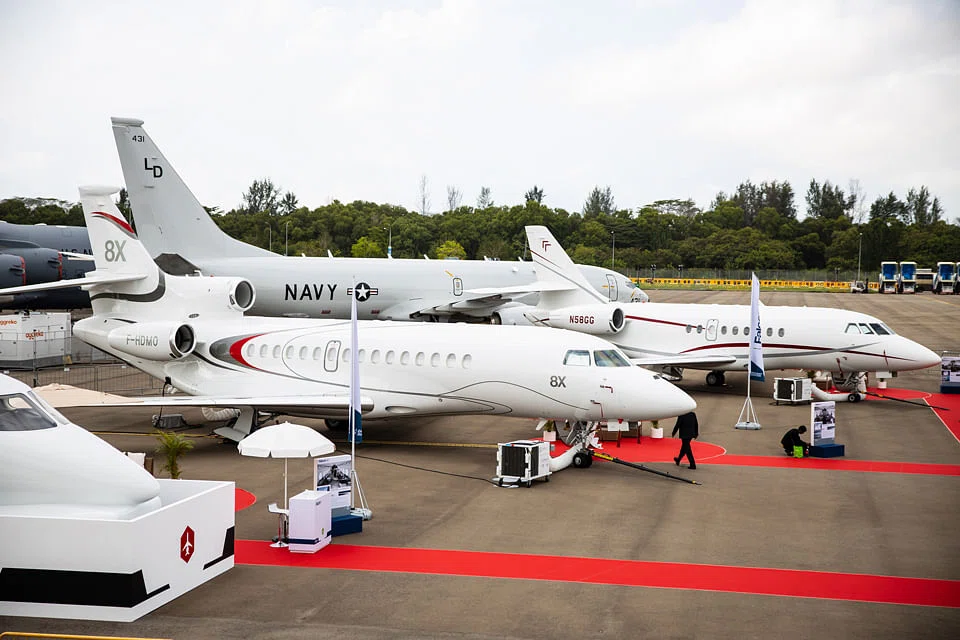
Mr Brana said Dassault is tapping on demand for safe, comfortable flights with its new Falcon 6X jet.
The jet's cabin has the largest cross-section of any purpose-built business jet and can comfortably accommodate up to 19 people. This caters to a trend Dassault has noticed among Asian clients, who tend to maximise the passenger capacity on private jets.
They also tend to carry out shorter daily mission flights rather than long-haul ones that would use a jet's full range, so the jet's maximum range of 5,500 nautical miles or 10,186km is something that Dassault expects Asian customers will come to appreciate as they use the jet more often.
"What we are proposing to our customers is that they fly their daily missions in a comfortable environment, and we expect that they will (eventually) prefer the larger aircraft not just for daily missions, but also for long-haul, because comfort is not just for one person, but can also be for 12 people," Mr Brana said.
Thomas Fissellier, director of strategy and analytics at Bombardier Aviation, noted that the heightened interest in health safety has resulted in more requests for features such as more spacious cabins for safe distancing, as well as easy-to-clean fittings and high quality air purification and circulation systems.
Globally, the business aviation sector is seeing more newcomers overall. First-time buyers normally make up 5-10 per cent of transactions yearly for Jetcraft, but it is seeing roughly double that percentage this year.
The new buyers are mostly individuals who have always been able to afford jets but found commercial airlines sufficient to meet their needs in the past, said Jetcraft's Mr Dixon.
That said, transaction volumes are still a far cry from pre-Covid days. Asian Sky Quarterly reported that new and pre-owned jet transactions in Q2 were down 36 per cent by unit volume to 490 units and 37 per cent by dollar value to US$4.3 billion compared to Q2 2019.
According to reports by market intelligence provider WingX, global business aviation activity took a massive hit in April, plunging 70 per cent to a trough of about 3,500 flights per day. However, it rebounded quickly and by July was down just 18 per cent from a year ago. Activity has remained stable at around 80 per cent of last year's levels through Nov 2020.
Meanwhile, commercial airline traffic has remained down 50 per cent or more over the same period from July to November.
Bombardier's Mr Fissellier noted that business aviation normally sees lower demand during economic downturns, but the current crisis is unusual because government regulations rather than economic factors are the predominant obstacle to air travel.
He added: "Another significant difference is the market itself - the stock market has been performing well and HNWIs have seen their wealth recover to pre-Covid levels, which is a positive market indicator for business jets."
Essential business travel, repatriation flights and transport for medical supplies and experts are contributing to the sector's recovery, said Ian Moore, chief commercial officer of charter operator VistaJet.
Other activities that private jets are making possible are leisure travel to exclusive vacation locales and family holiday reunions for students attending schools and universities in non-major cities.
Said Toby Edwards, CEO of on-demand jet charter platform Victor: "While business aviation is also operating below capacity and below pre-Covid activity levels, it is well-positioned to fill the gap where the airlines simply are not flying at all or not flying frequently enough. Chartering an aircraft has for many this year been the only viable option when they've urgently needed to travel, which explains the increase in new customers."
Even after international travel restrictions ease and commercial airlines recover, the industry players expect demand to remain strong for private jets and business aviation.
In November, Jetcraft published a report forecasting that sales of pre-owned jets will increase over the next four years, with 2,271 transactions expected in 2024, compared to the 1,617 forecast for 2020.
Mr Dixon said this is because Covid-19 has made the flexibility and control afforded by private jets more attractive, while decimating the commercial airline industry to the point that some may not recover and others will fly to fewer destinations and operate flights less frequently than before.
Dassault's Mr Brana expects that clients who have started using business jets will continue to do so for the time savings and safety they afford.
"Owners are not only concerned with what they are doing today, but also with the future," he said. "They may consider investing in the future by getting an airplane, knowing that in any case it will always be safer to get a business jet than to stay with the airlines."