

Gojek joins new carbon-credit project rewarding EV fleets and charge-point operators

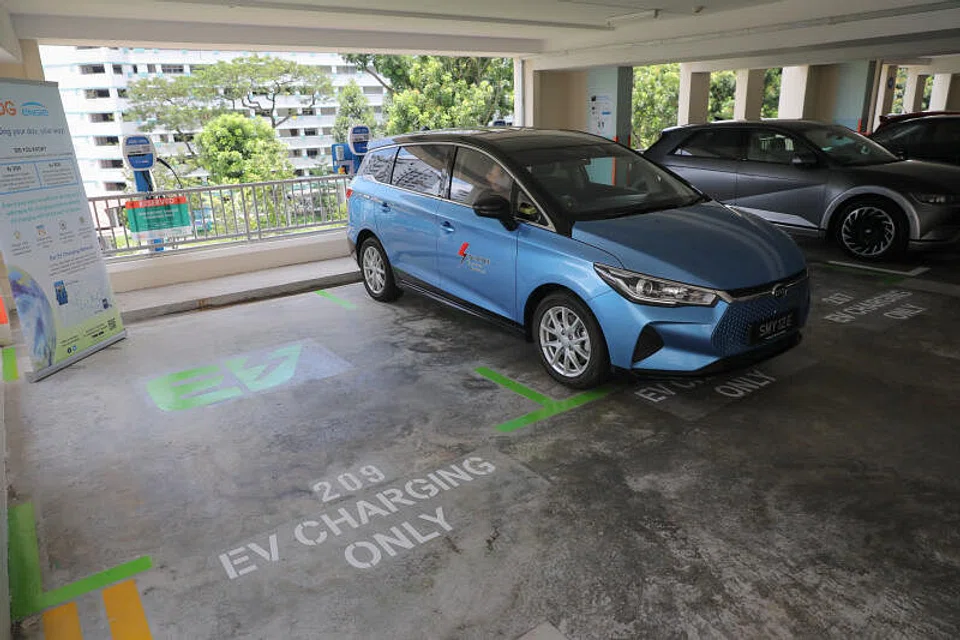
OPERATORS of electric vehicle (EV) fleets and charging points in Singapore can soon be awarded carbon credits from emission reductions under a new programme dubbed the Electric Vehicle Accelerator (EVA).
This is believed to be the first such programme in the Asia-Pacific. Gojek, which has a fleet of about 300 EVs in Singapore, is the first to get on board the EVA programme.
The ride-hailing start-up signed a partnership with CRX CarbonBank, a subsidiary of Singapore-based carbon consultancy CRX spearheading EVA, at the programme's launch on Tuesday (Apr 12).
Here is how EVA works: Carbon credits will be generated from every successful charge event on its platform. These credits are monetised and distributed downstream to registered users.
To prevent double counting, EVA uses a custom protocol to ensure that all charge events are matched to a unique payment entity. In a case where both a fleet operator and a charging point operator are EVA participants, the carbon credits will be split between the 2 parties. Up to 30 per cent of the monetised carbon credits will be returned as cash to EVA participants.
However, as it will take some time for the project to build momentum, it will start paying out carbon credits only from 2025. From now till end January 2024, CRX CarbonBank will offer registered partners a US$4.80 per megawatt hour rebate for any charge event under EVA, payable on an annual basis.
The hope is that these registered operators will pass on the monetised credits to downstream consumers, such as those leasing their EVs, CRX CarbonBank's chief executive Vinod Kesava said at the launch event on Tuesday.
"Our efforts will incentivise EVA (participants) to contribute to the advancement of Singapore's net-zero targets by 2050 and help drive the international push to reduce global emissions from transportation," he said.
Singapore is aiming to deploy 60,000 EV charging points across the country by 2030. The authorities will require all new car and taxi registrations to be of cleaner-energy models from 2030; all vehicles will have to be run on cleaner energy by 2040.
Gojek's general manager Lien Choong Luen believes the EVA can help speed up EV adoption in Singapore. His company aims to operate a fully electrified fleet by 2030. "Commitments such as these don't happen overnight and require partnership and collaboration across the industry," Lien said.
Kesava told The Business Times that several other major fleet operators in Singapore have expressed interest in being part of the programme, but declined to share names.
He added that CRX CarbonBank has set a target of onboarding a quarter of the operators in Singapore within 6 months from when emissions tracking begins, and aims to have 80 per cent of operators here as EVA participants eventually.
EVA is expected to start tracking emission improvements from June this year. The project will run till 2050.
To ensure the veracity of carbon credits generated, CRX CarbonBank is working with Singapore start-up Beep, which provides an e-roaming network that enables operators to cull data from the chargers and upload them onto the blockchain in real time. To ensure the transparency of tracking, EVA taps the open-source OpenAttesation standard developed by the Singapore government.
In 2019, a similar programme was developed in the US by the Climate Neutral Business Network, an Oregon-based advisory firm, to sell certified credits from charging stations into the voluntary carbon market.
READ MORE:
Decoding Asia newsletter: your guide to navigating Asia in a new global order. Sign up here to get Decoding Asia newsletter. Delivered to your inbox. Free.
Copyright SPH Media. All rights reserved.
TRENDING NOW
Genting Singapore trails MBS, but helps anchor Malaysian parent group’s finances

He built the Vingroup empire. Now South-east Asia’s richest man is handing some key roles to his sons

CDL to invest S$5 billion, target S$6 billion divestments under refreshed strategy

Stocks to watch: CDL, Centurion, Oiltek, Geo Energy Resources

