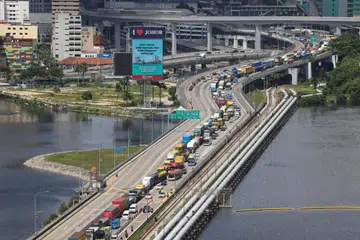
Idle containers leave global supply chains fractured
Major US ports are overwhelmed with shipping containers from Asia; box availability in China is at a new low


Singapore
THE global trade imbalance due to Covid-19 has resulted in a mismatch between where sea containers are and where they need to be, causing supply-chain bottlenecks that have spread to Asia and may, at best, start to improve only by the second half of this year.
Container availability across China, the world's factory and a major exporter, is at a record low. In contrast, major ports in the US are overwhelmed by a surge of shipping containers from Asia, but unable to fill the empty containers and have them shipped back to Asia on time.
Twenty containerships at anchorage have been bound for the port of Los Angeles since mid February, compared to zero in normal conditions. Anchorage waiting times have stretched to around eight days, with more ships on their way. Some 85 per cent of ships heading to Los Angeles are unable to go straight to berth. Delays have also been reported in Singapore, the world's second largest container port.
Teo Siong Seng, executive chairman and managing director of Pacific International Lines (PIL) - the world's 12th largest liner - said as container liners struggle to meet demand for containers on the US and European routes, there is a knock-on effect on other trade lanes when containers are diverted. Most in the industry are expecting the container shortages in Japan, South Korea, India and South-East Asia to last until mid-2021.
Mr Teo, better known in the shipping circles as S. S. Teo, said: "Unfortunately, shippers and freight forwarders have to deal with higher freight costs in the near term.
"Meanwhile, global container service schedule reliability has dropped due to port congestion, with high cargo rollover rates. These delays significantly disrupt supply chains, manufacturing, operations and eventually affect profit margins."
He is cautiously optimistic about the container shipping market, and expects it to remain strong through most of 2021.
So far, the consequences of the supply imbalance have been grave: ports are congested, ships are delayed and freight rates have increase 10-fold, said Hapag-Lloyd, Germany's largest shipping company.
Speaking to The Business Times from Germany, Tim Seifert, director of corporate communications at Hapag-Lloyd, said on Wednesday that global supply chains have been stretched since the second-half of last year.
"There is basically an adequate number of containers in the market, but in many cases, empties are not where they are needed and should be, for example, at production sites in Asia," he said.
Global demand for container transports fell at the height of the pandemic in April to June last year, but surged by the second half. Instead of US$2,100, factories are now charging more than US$3,000 for a single standard container.
"People are spending more time at home during the coronavirus pandemic since they can't go out or travel. As a result, they are spending more on consumer goods such as furniture, computers and exercise equipment; most of which are produced in Asia. That's why we are seeing a surge of cargo from Asia, particularly to the US and Europe," Mr Seifert said.
He added that entire supply chains are struggling to manage the enormous increase in demand, not just ports and terminals, but also hinterland infrastructure, including trains and trucks.
Last year, Hapag-Lloyd bought 300,000 TEU (twenty-foot equivalent), boosting its own stock by more than 10 per cent, to address the imbalance. Recently, it placed an order for six ultra-large container carriers (ULCCs). Global order books for ULCCs have come off their multi-year lows.
Demand aside, health precautions have also slowed the flow of containers through ports.
An employee of a pest-control company in Singapore said he has been busy fumigating carriers before they depart from Singapore as these cargo containers are considered high-risk carriers of exotic pests and hitchhikers.
German firms FraunhoferCML and Container xChange note that empty containers are spending 45 days on average in depot. In China, the average time each box is sitting idle is more than two months.
The latest figures from Container Trade Statistics (CTS) indicate that global container import and exports dropped to 14.3 million TEU in January, compared to 15.2 million TEU in December. However, the global price index jumped 16 points to 109 points, from 93 points in December. Year on year, the price index is up 51.4 per cent, from 72 points in January 2020.
The Far East-Europe price index jumped 100 per cent to 150 points in January, up from 75 points a year ago. For the trans-Pacific route from the Far East to North America, the rise was less pronounced at 34 per cent to 122 points, from 91 points the year before.
"I am still waiting for my supplies from the US since the order was made last October," said a chief executive officer of a local manufacturing plant. He added that the shipment from the US to Singapore used to take eight to 12 weeks; now, he has been told that the container is waiting to be filled.
Mahesh Sivaswamy, chairman and chief executive officer of Transworld Group Singapore, which owns BLPL Singapore Pte Ltd and Straits Orient Lines (S) Pte Ltd, said the Covid-19 has caused delays in operations, "be it the stuffing of containers or the delivery of cargo covering the last mile".
"Asian business is getting affected for sure, as they do not have the luxury of planning just-in-time deliveries, which entails a need to plan in advance and also stock the cargo.
"This further affects their cash flows as cash gets converted to stocks. As to the cost of logistics, the new higher costs are something people get adjusted to," he said.
Straits Orient Lines recently joined the ranks of liners expanding their fleet by buying two containerships for US$15 million.
On whether buying more containers will alleviate the situation, Mr Sivaswamy said: "One may wish to buy containers, but factories producing them have their challenges from manpower to raw materials, and containers require ships to carry them.
"Building of ships or containers has its lead time, so the year 2021 and major part of the 2022 will remain till the supply catches up with the demand."
The logistics chaos is turning the tide for some global container shipping companies hit by the slowdown in global trade due to the pandemic last year. Hapag-Lloyd is expecting strong financial results for the first-quarter 2021, amid high freight rates and firm consumer demand.
Its chief executive Rolf Habben Jansen said the group expects that the result for 2021 as a whole would be significantly higher than the year before. This is due in large part to freight rates being at or near record highs on major trade lanes.
READ MORE: Container ships flood Singapore as global scheduling left in tatters