Ikea buying own containers amid logistics woes
Swedish furniture giant is also chartering vessels to ensure its shelves are kept stocked

Singapore
A SIX-DAY Suez Canal blockage in March this year is still making its impact felt across the global supply chain, causing delays to the delivery of some furniture pieces from Ikea.
That's not all.
Ikea, like many other big businesses, has had to contend with the global shortage of shipping containers, congested seaports, capacity constraints on vessels, and lockdowns in many markets.
So acute are the delays that the Swedish furniture and furnishings giant has been forced to adopt a novel idea for these times: it has bought containers and chartered vessels to make sure shelves are adequately stocked.
The company is also transporting more goods on trains from the Asia-Pacific to Europe, as well as re-routing to avoid congested ports.
It is investing in temporary warehouses across its value chain to avoid having production stops too.
Ikea's situation reflects the global interconnectivity of supply chains today.
The company was reported to have about 110 containers on the Ever Given and other ships in the pile-up when the boxship got wedged in the Suez Canal for nearly a week.
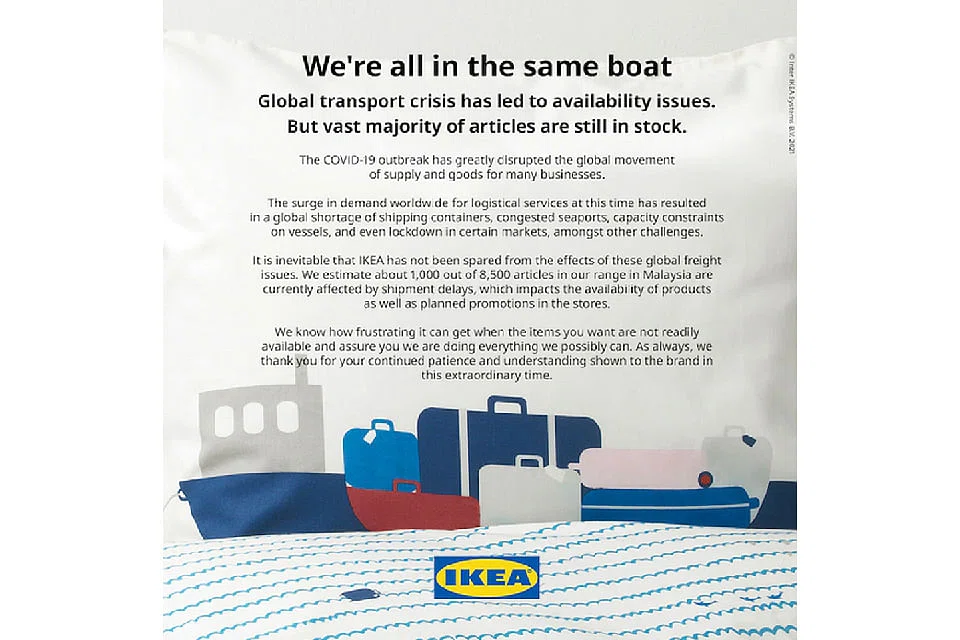
Over in Singapore, the company's website for its store here said in an undated notice that it estimated about half of its articles are currently affected by shipment delays.
"This impacts the availability of products and planned promotions in our stores."
Jaap Doornbos, Ikea's retail director for Singapore and the Philippines, told The Business Times that Ikea Singapore has had a very challenging period during May and June but the availability of products has improved significantly in the last three months.
Doornbos stated: "The main challenges have been delays in shipments from Europe (for example, the Suez Canal blockage) port congestion and delays in the port operations in Kuala Lumpur, which is connected to the distribution centre serving Singapore. We are prioritising the best-selling articles in our range and moving stock from other countries in South-east Asia to Singapore. "
He noted that Ikea has stocked the range of goods for the Singapore market in local warehouses, making it possible for Singapore customers to still get the products that they have in stock "relatively fast".
He, however, also conceded that stocking is still not yet back on the level its customers expect, and "we are working every day to improve the situation".
Ikea's Malaysia and Thailand websites have published similar messages, but Malaysia seems to be less severely impacted as about 1,000 out of 8,500 items are impacted by shipment delays while Thailand's stock availability is "improving" by the day.
The company assured its customers via these websites that it is "doing everything we possibly can" to improve the situation.
Irate customers had taken to social media late last year to complain about late and missing furniture deliveries, The Guardian reported.
Margareta Lantz, Ikea's press officer, said that the company has taken "many extraordinary actions" such as buying containers and chartering space on a vessel.
But the company does not intend to develop such a business model on a permanent basis.
Lantz stated that Ikea will continue to work closely with its freight partners to secure the needed transport capacities as it sees clear benefits of close partnerships.
"Together with our service providers, we (will) find new, innovative solutions to ensure availability of our products."
While it makes sense for Ikea to take matters into its own hands, taking over one's shipping from freight-forwarding partners might not be feasible for retailers and supermarkets that stock a myriad of items from various sources and countries.
DFI Retail Group, a unit of the Singapore-listed Dairy Farm International, told BT that it does not own containers or charter vessels for its over 10,000 outlets across Asia.
Its rival in the supermarket sector FairPrice, is not doing it as well.