Ion Mobility launches Singapore's first electric motorcycle
The battery-powered bike will be sold in Indonesia in H1 2022; company's CEO eyes SE Asian markets and beyond
Singapore
COULD a Singaporean startup do for motorcycles in South-east Asia what Tesla has done for cars by making electric power not just practical, but desirable?
James Chan, the founder and chief executive officer of Ion Mobility, believes he has just the machine to do it.
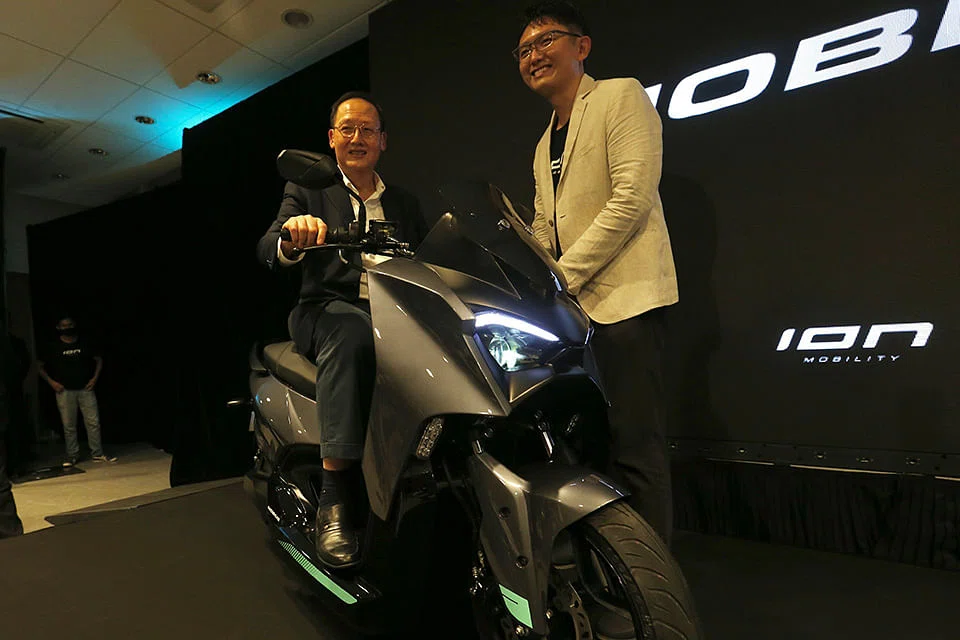
On Thursday (Dec 2), the homegrown electric motorbike company unveiled the Mobius, a battery-powered bike that it will build and sell in Indonesia in the first half of 2022.
"We can't wait to introduce the Ion Mobius onto the roads of Indonesia next year," he said. Ion Mobility will take pre-orders there "soon" and assemble it in the Greater Jakarta area.
If all goes to plan, the company will crank out 1,500 of them a month between factories in China, Indonesia and Singapore by the end of 2022.
"In terms of execution, it's doable. But in terms of all parts of the company reaching that level of maturity and servicing our customers well, that requires a lot more capital," Chan said.
In October, the company said it raised US$6.8 million in its latest funding round. For a vehicle manufacturer, that amounts to running on fumes, but the company has hit an impressive milestone by readying a bike for production in under 2 years - far less time than it is taking Chan to get his motorcycle licence.
"I've been trying," he quipped.
He added: "We have raised far less than a lot of software companies that have less to show than we do."
Decentralising has given the company speed. A Shenzhen office adds engineering input and puts the company at the doorstep of suppliers, while a Jakarta team gives it a presence in a country that buys 6.5 million motorcycles a year.
Both outposts were established during the pandemic.
At the launch of Mobius on Thursday, Second Minister for Trade and Industry Tan See Leng said: "As Singapore moves towards electrifying its vehicle population by 2040, the launch of the Ion Mobius cannot be timelier and more significant."
He noted that the company had received support from JTC and worked with Enterprise Singapore (ESG) to develop the bike and expand its overseas footprint.
An investment from SEEDS Capital, ESG's investment arm, will go towards boosting its manufacturing and go-to-market operations in Singapore and Indonesia.
Chan eventually wants to see his smart scooters in Thailand, Vietnam, the Philippines and beyond. Southeast Asia has 200 million combustion motorcycles ripe for displacement by a zero-emissions model, he said.
"There are no compelling options for South-east Asian riders to switch away from their traditional combustion motorbikes. These are either too underwhelming for riders - in other words, short-ranged and low-powered - or too expensive and in form factors that are not suited for their daily use," he said.
Performance-wise, the Mobius is comparable to the small-engined motorcycles that once ruled the region.
Chan believes it is too early to reveal specific prices, but said the Mobius is benchmarked to combustion models 155 cc in capacity. Such bikes retail for around 25 million rupiah (S$2,375).
The bike's 17 horsepower motor powers it to 110 kmh; its battery pack offers anywhere from 120 km to over 200 km on a single charge, depending on its specification.
It takes about 3 hours to fully charge from empty, and has 3D-printed body panels. Many of its components are made in Indonesia, helping it meet a threshold of local content so it can avoid paying punitive duties.
Yet, Chan believes it is not the hardware that will set the Mobius apart from its rivals: It has both Bluetooth and LTE connectivity, so riders can pair the bike with their smartphones through an app.
This, in turn, enables the riders to customise various settings, review their trip data to improve their riding style, and use GPS data to find the bike and more.
Ion Mobility says it wants third parties to offer hyperlocal services through the app to help make the Mobius a better experience.
"We have a triple CPU computer with more computing power than the moon lander, and sensors that we intend to put into the bike that will allow us to collect data that goes beyond just the paradigm of what cars are collecting today," he said.
"For example, I can arrive at a more accurate insurance underwriting model for motorbikes based on the riding patterns of my customers, because I control the full stack of data."