

JB-Singapore RTS will bring economic benefit, but may not ease weekend congestion
RTS link agreement signing ceremony on July 30 at the Causeway; witnessed by Singapore, Malaysia PMs
 Add BT as a preferred source
Sharon See
DeeperDive is a beta AI feature. Refer to full articles for the facts.
Singapore
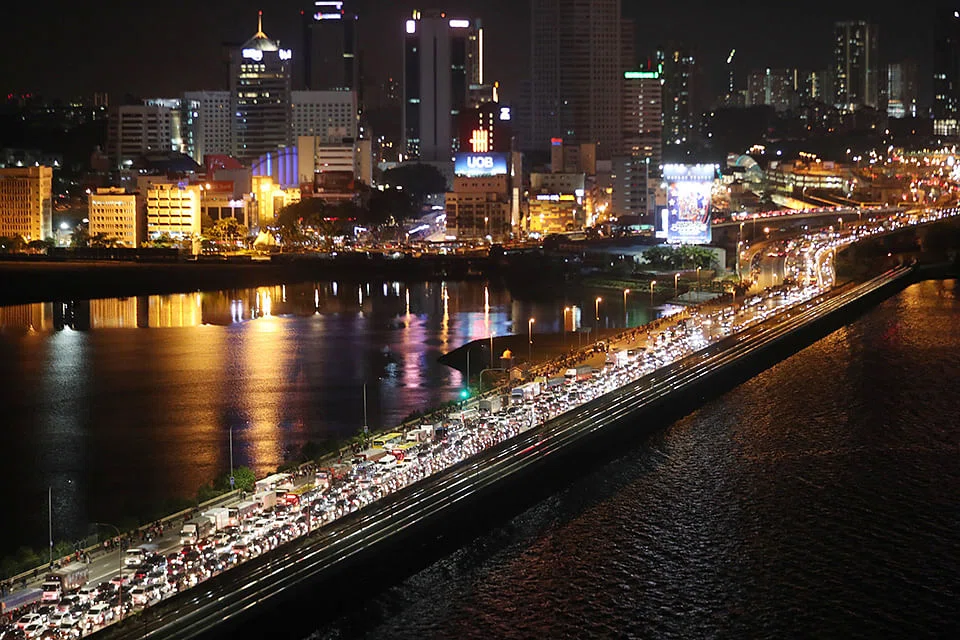
THE widely-anticipated train service linking Singapore and Johor Baru that is expected to be finalised next week will not only ease congestion on the Causeway, the connectivity will also bring economic benefit to both cities, economists told The Business Times.
This is especially because a large part of the Singapore economy is dependent on "Malaysian day workers", who cross the border daily to work in Singapore. Many spend several hours on the commute and have to do so very early in the morning.
The Johor Baru-Singapore Rapid Transit System (RTS) will help to cut both time and costs for these workers as well as their employers, said Walter Theseira, a transport economist from the Singapore University of Social Sciences.
"It will actually widen the availability or the catchment pool of Malaysian workers for Singapore firms and make it easier for them to recruit. There will be less cost pressure in manpower costs for Malaysian workers," he said.
"Frankly, a lot of these services and manufacturers in Singapore wouldn't find their business model viable without access to Malaysia, workers; that's a reality," he added.
Navigate Asia in
a new global order
Get the insights delivered to your inbox.
This issue was brought to the fore recently as both countries imposed quasi lockdowns - the circuit breaker in Singapore and the movement control order in Malaysia - during the Covid-19 pandemic.
Assoc Prof Theseira noted that many affected firms had to find accommodation for their Malaysian workers and could not simply replace them with workers from other countries on short notice.
In fact, the Covid-19 pandemic could have highlighted the importance and urgency of the RTS Link project, which has gone through multiple delays over the past decade.
"From the Malaysian side, I'm sure that they have seen how much damage to the economy in Johor Baru is being caused by cessation of travel - not just the spending of Singaporeans in Johor but more importantly, I think it's the remittances, it's the business activity," he said.
Michael Li, a transport economist at the Nanyang Technological University, said the connectivity will benefit both Singapore and Johor. He noted that Johor has been developing very rapidly in recent years, particular in healthcare, education and leisure.
"In the long run, we hope to see a vibrant extended metropolitan area. In the future, we may need several RTS lines to improve the integration," he said.
Earlier this week, Malaysian Transport Minister Wee Ka Siong said in Kuala Lumpur that Singapore and Malaysia will sign the agreement to finalise the RTS Link project on July 30. The ceremony at the Causeway will be witnessed by the prime ministers of Singapore and Malaysia.
Singapore had previously said the RTS Link is expected to serve about 10,000 commuters at peak periods, every hour and in one direction. Construction is expected to begin next year with a view to begin operations by end-2026, reported The Straits Times. This would help to ease morning and peak hour traffic on the Causeway, observers said.
Shekhar Jaiswal, head of research and senior analyst on transportation at RHB Banking Group, said: "If you can ease that congestion at the peak, you would have more capacity available to move goods. People can move on the RTS, and the Causeway can be made available for goods transport."
However, any easing of traffic may only be palpable on during morning and peak hour congestion on weekdays. Assoc Prof Theseira believes the RTS may not make a dent on traffic during the holiday period.
He said families and travellers going to Malaysia for holidays or long weekends would most likely prefer to drive, as they would otherwise have to look for local transport once they cross the border.
However, Mr Jaiswal believes more commercial properties may come on stream at Bukit Chagar, the planned terminal station in Johor, which would make it attractive for day shoppers to travel by train.
Decoding Asia newsletter: your guide to navigating Asia in a new global order. Sign up here to get Decoding Asia newsletter. Delivered to your inbox. Free.
Copyright SPH Media. All rights reserved.
TRENDING NOW
‘Boring’ is the new black: The stars are aligning for a Singapore stock market revival
Near sell-out launches in March boost developer sales to 1,300 units after four slow months

China pips the US if Asean is forced to choose, but analysts warn against reading it like a sports result

Genting Singapore’s Lim Kok Thay receives S$7.5 million pay package for FY2025

