Singapore gears up for cleaner cars with bigger rebates, EV battery leasing

Singapore
TWO initiatives announced on Thursday are set to further fuel Singapore's drive towards greener transport.
The Vehicular Emissions Scheme (VES) will soon give bigger rebates to reward buyers of cleaner cars, while upping surcharges to discourage people from buying pollutive models.
A new business model for electric vehicle (EV) users to rent batteries is also in the works, by Singapore utilities firm SP Group and South Korean car maker Hyundai Motor Group.
Starting next year, the VES's rebates and surcharges will be increased for new cars and taxis as well as imported used cars, depending on the vehicle's pollutant levels.
The enhanced emission rebates will take effect on Jan 1, 2021 till Dec 31, 2022, said the National Environment Agency (NEA) and the Land Transport Authority (LTA) in a joint statement on Thursday.
The increased surcharges will kick in only on July 1, 2021, and last till Dec 31, 2022, to allow time for the market to adjust to them.
Rebates for vehicles in Bands A1 and A2 will be increased by S$5,000 for cars and S$7,500 for taxis starting next January. That means a person who buys an A1 car will receive a S$25,000 rebate instead of S$20,000, while an A2 car will attract a S$15,000 rebate instead of S$10,000.
The enhanced VES coupled with the Electric Vehicle Early Adoption Incentive (EEAI) will offer buyers combined cost savings of up to S$45,000 when they purchase a new fully electric car and up to S$57,500 for a new fully electric taxi.
These higher savings will encourage EV adoption, by narrowing the upfront cost gap between electric cars and their internal combustion engine equivalents, said NEA and LTA.
The EEAI, effective from Jan 1, 2021 to Dec 31, 2023, offers a rebate of 45 per cent, capped at S$20,000, off the additional registration fee for the purchase of a new fully electric car or taxi.
Meanwhile, the surcharges for Bands C1 and C2 will rise by S$5,000 for cars and by S$7,500 for taxis, starting next July. That means a C1 car will incur a surcharge of S$15,000 instead of S$10,000, while a C2 car will be slapped with a S$25,000 surcharge instead of S$20,000.
There will be no change in the pollutant criteria for each VES band for the duration of the enhanced scheme, till the end of 2022.
Vehicles in Band B do not come with any rebates or surcharges under the scheme.
The VES was implemented in January 2018 to encourage buyers to choose car models with lower emissions across five pollutants: carbon dioxide, hydrocarbons, carbon monoxide, nitrogen oxides and particulate matter.
NEA said on Thursday that it will contact the vehicle industry in due course for consultations on the possibility of tightening the VES band thresholds.
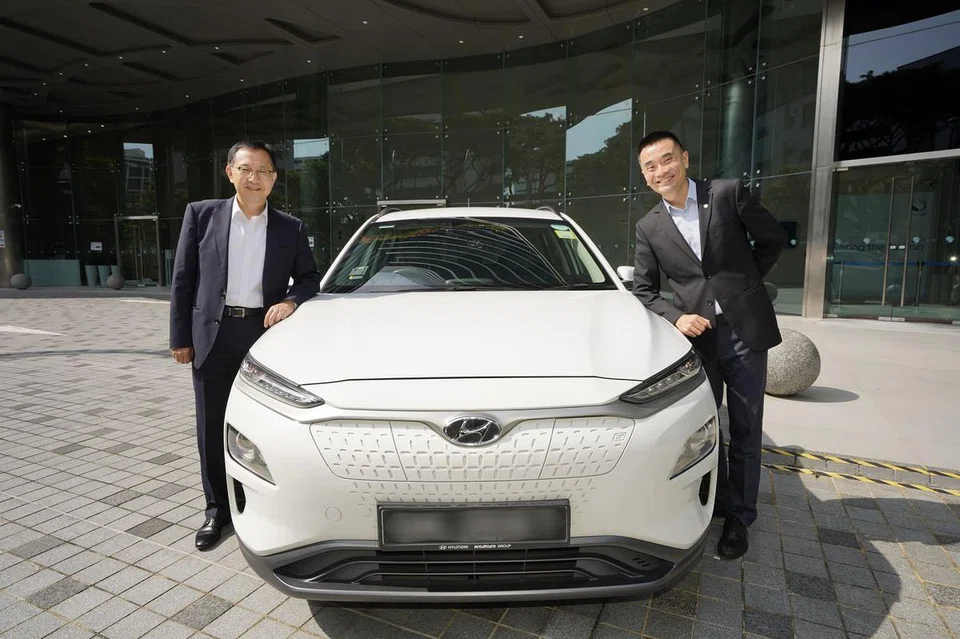
Separately, SP and Hyundai will jointly develop a business model named battery-as-a-service for the leasing of EV batteries.
The two companies said this will be the first such model in South-east Asia, enabling EV users to rent the car battery instead of owning it.
SP and Hyundai aim to accelerate the adoption of EVs in Singapore with the tie-up. Both companies will also conduct a study on EV battery utilisation and improving the ownership experience for consumers. In addition, they are looking to expand the EV charging infrastructure and develop new solutions for battery reuse and recycling to achieve carbon neutrality.
SP and Hyundai said they hope to lower the initial cost of purchasing EVs as well as make charging points and low-carbon mobility solutions more accessible to vehicle owners in Singapore.
Hyundai last month announced a S$400 million innovation centre in Jurong, which may produce up to 30,000 vehicles per year by 2025.
The South Korean firm on Thursday said it will step up its efforts to expand the supply of EVs in Singapore in cooperation with SP, which is growing its network of EV charging infrastructure.