

Singapore's private aviation business soars amid virus fears

Singapore
SINGAPORE'S share of regional business jet transactions has been growing since the pandemic and that trend could remain strong, with service providers building their physical presence here in recent months.
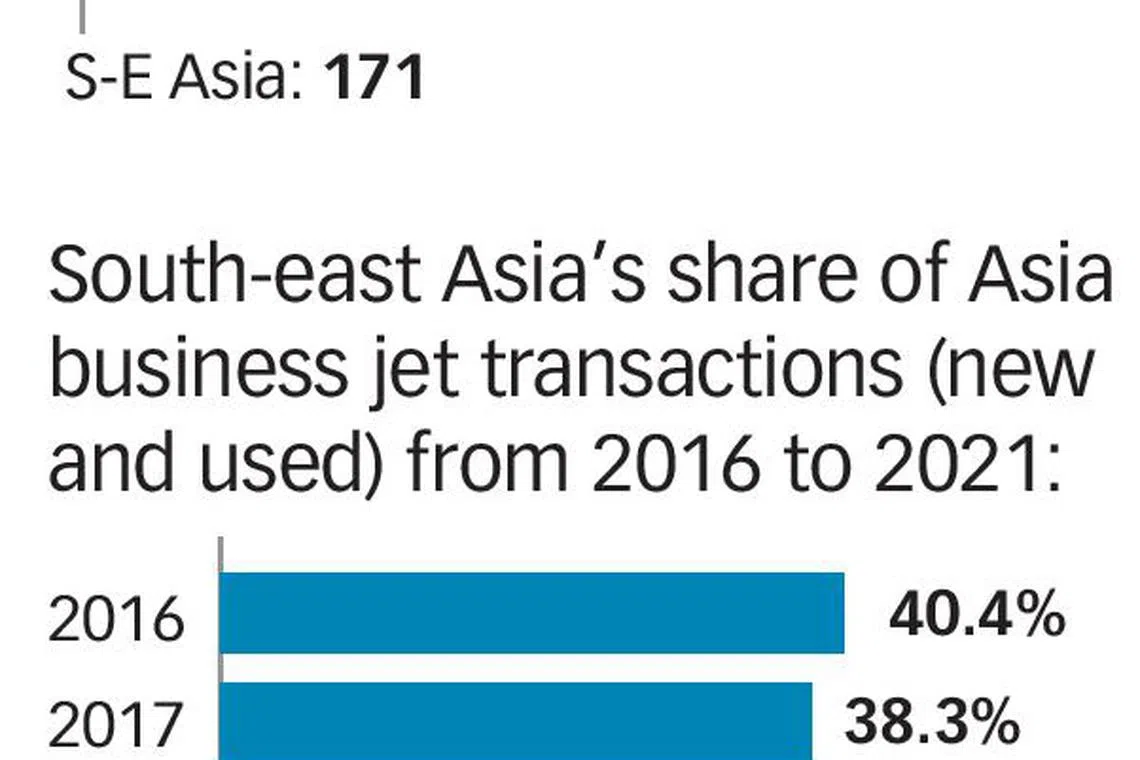
According to Jetcraft, drawing from business aviation research firm Amstat, Singapore accounted for the lion's share of South-east Asia business jet transactions, which rose to nearly 70 per cent of the sales in the region in 2020 from 33 per cent the year before.
The increase in business jet sales in Singapore were to Singapore buyers, and did not include the many clients from Indonesia and Malaysia who transacted through Singapore as a major financial and aviation hub.
Jetcraft Asia president David Dixon told The Business Times that South-east Asia accounted for about 42 per cent of the business jet transactions in all of Asia in 2020 and nearly 30 per cent this year to mid-September.
He said the majority of business jet transactions traditionally take place in the fourth quarter each year, it would therefore not be accurate to share data on Singapore's share of South-east Asia transactions at the end of Q3 as this would not provide a like-for-like comparison with transactions still ongoing in 2021.
"Jetcraft chose to open an office in Singapore as it is a central hub in South-east Asia and holds a strategic position in the market. South-east Asia as a whole is a strong region for business aviation, and we have many important clients located throughout the region, not just in Singapore."
Jetcraft, which deals in used business jets, is opening an office in Singapore to support the strong demand in South-east Asia. The firm will be recruiting a local team in Singapore, as well as relocating existing employees as soon as possible, subject to border restrictions.
The total number of business jets worldwide currently stands at about 21,903, with 908 of them in Asia including 171 in South-east Asia.
Mr Dixon noted that used business jets provide immediate delivery, while new ones have longer lead times ranging from a few months to years. "UHNWIs (ultra high net worth individuals) want to secure an aircraft now in the event borders reopen, or in the case of urgent essential travel, so they can fly safely and securely on their own aircraft."
He also cited a study by Globe Air, a European charter operator, that identified the risk of contracting the coronavirus being 30 times lower when flying privately, due to the reduced number of touch points. The study noted there were up to 700 touch points in a commercial airport and aircraft, versus approximately 20 for a business jet journey.
Having fewer passengers on board business aircraft allows personal "bubbles" to be maintained through an entire journey, from transfer to aircraft steps, often bypassing the terminal to ensure interactions are kept to a minimum.
"Even on the first class on SQ (Singapore Airlines), not to be demeaning about first class on SQ, but there's all the touch points in the airport, I believe the airport is one of the ... main reasons why our business has grown," said Mr Dixon.
He also noted that the pandemic has raised significant awareness of the flexibility, control and feeling of security that flying privately affords, particularly with airline schedules disrupted.
"The first-time buyers we're working with have always had the means and need for ownership, but many didn't have the inclination until now because they were able to fly using commercial airlines."
Since the pandemic hit, these individuals have been re-evaluating their priorities and the health and safety of themselves, their employees and their families. They are seeing the functional and tangible benefits of business aviation which outweigh any previous barriers, and their confidence in the industry is growing, he added.
Air 7, a charter service operator, meanwhile established a marketing arm in Singapore in September to target the South-east Asia market. It offers charter services on behalf of owners of United States-registered private aircraft, enabling these owners to legally profit from their idle planes.
Echoing Mr Dixon's comments on travellers wary of potential virus infection and there are far fewer commercial aviation options than pre-pandemic, Air 7 Asia's managing director Jamie Lenox sees booming demand for private aviation charter, especially when countries in the region reopen their borders.
Most of the charter aircraft available in Singapore were on a floating fleet pre-pandemic, said Mr Lenox, owned by big international operators who would have aircraft all over the world. However, demand in the US and Europe has picked up as their borders are re-opening, resulting in all of the aircraft that were preparing for South-east Asia having now been taken there.
There are fewer than 10 private jets in Singapore that are legally available for chartering, besides the large jet floating fleets. The handful of jets that are available for chartering in Singapore can expect to be very busy, he added.
He also said there is currently a large amount of illegal chartering going on in South-east Asia. Owners who illegally charter out their jets might not realise they are breaking the law for engaging in the activity without an air operator certificate, and thus risk having their planes impounded by the authorities.
The aviation authorities in the region, the United States and Australia, for example, are clamping down on illegal chartering, said Mr Lenox.
However, his company can help aircraft that are registered in the US - most private jets in South-east Asia are registered in the US because US registration is easy and widely recognised - to be put on its certificate so that the jet owners can legally charter out their planes.
TRENDING NOW

He built the Vingroup empire. Now South-east Asia’s richest man is handing some key roles to his sons

Why the best annuity in Singapore may not be enough

In a super-aged Singapore society, we must learn to differentiate independence from dignity

Despite the de-dollarisation debate, demand for dollar liquidity in Asia is growing

